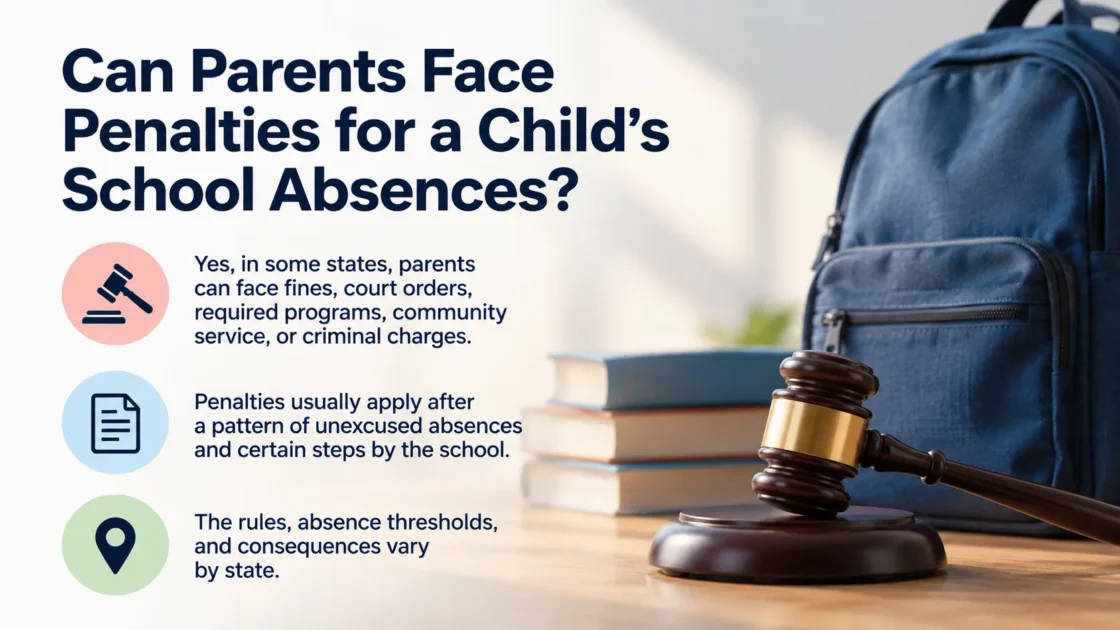
Yes. In some U.S. states, a parent or guardian can face fines, court orders, required programs, community service, or criminal charges when a child repeatedly misses school without a legally accepted reason. The exact rule depends on state law, the number and type of absences, the steps already taken by the school, and in some states whether the parent failed to make a reasonable effort to get the child to school.
The U.S. Department of Education says chronic absenteeism is typically defined as missing at least 10% of school days for any reason, including excused and unexcused absences.1 Parent penalties, by contrast, are generally tied to a state’s compulsory-attendance, truancy, or unexcused-absence rules. A student can therefore be chronically absent without the circumstances necessarily creating a parent offense.
When Can a Parent Be Held Responsible?
Compulsory-attendance laws generally require a parent, guardian, or another person responsible for a school-age child to make sure the child receives the education required by state law. A penalty does not normally arise simply because a child misses a day of school.
Legal action is more likely when a pattern of unexcused absences develops and the conditions written into state law are met. Depending on the state, those conditions can include:
- a specified number of unexcused absences or missed parts of school days;
- prior written notice to the parent;
- attendance conferences or other school interventions;
- failure of earlier attendance measures to resolve the problem;
- evidence that the parent failed to require attendance;
- willful conduct, criminal negligence, or another level of fault required by the applicable statute.
These requirements are not interchangeable. An attendance threshold used in one state should not be treated as a national truancy threshold.
Examples of Parent Penalties Under State Law
The differences between state systems can be seen in current attendance laws from California, Texas, Florida, and Washington. These examples illustrate possible approaches rather than a complete list of U.S. rules.
| State | When Parent Liability May Arise | Possible Parent Consequences |
|---|---|---|
| California | A parent, guardian, or other person having control of a pupil can be subject to enforcement for failing to comply with compulsory education requirements when the pupil is not excused or exempt. | California Education Code Section 48293 provides fines of up to $100 for a first conviction, $250 for a second conviction, and $500 for a third or later qualifying conviction. A court may use parent education and counseling instead of the listed fines and may order enrollment or reenrollment of the pupil.2 |
| Texas | When a student has 10 or more unexcused absences or parts of days within a six-month period in the same school year, a district may file a parent complaint if it provides evidence of the parent’s criminal negligence. | Education Code Section 25.093 makes parent contributing to nonattendance a fine-only misdemeanor. Maximum fines rise from $100 for a first offense to $500 for a fifth or later offense. Texas law also allows certain parent charges to be dismissed after completion of an agreement involving counseling, training, or another designated program.3 |
| Florida | Parent prosecution may follow nonenrollment or nonattendance when no valid reason is found, but the school and district must first comply with statutory attendance-enforcement procedures. Schools also report a minor student who accumulates 15 unexcused absences within 90 calendar days. | A parent who refuses or fails to have a minor student under the parent’s control attend regularly can commit a second-degree misdemeanor. A court may also order parent training, attendance at school with the student in appropriate cases, community service, counseling, or other services.4 |
| Washington | Parent liability can arise from violations of Washington’s mandatory-attendance provisions after the attendance and intervention process required by state law. | A court may fine a parent up to $25 for each unexcused day covered by the statute. Community restitution may be ordered instead, and a fine may be suspended while the parent participates in a supervised attendance plan or attendance conference.5 |
What Types of Penalties Can Parents Face?
The available consequences depend on the state and the facts of the case. A monetary fine is only one possibility.
- Fines: Some states set a maximum amount per offense, conviction, or unexcused day.
- Parent education or training: A court or attendance process may require participation in a program intended to address the attendance problem.
- Counseling or family services: State law may allow or require services aimed at addressing barriers that are contributing to absences.
- Community service or restitution: Some jurisdictions make this available instead of, or in addition to, a monetary penalty.
- Court orders related to attendance: A parent may be ordered to ensure that the child attends school or to participate in an attendance plan.
- Misdemeanor proceedings: Certain states classify particular failures to comply with compulsory-attendance requirements as criminal offenses.
The existence of a penalty in state law does not mean every attendance case reaches court. Many statutes require notices, conferences, attendance plans, prevention measures, or other intervention before a parent case can proceed.
Are Parents Penalized for Excused Absences?
Usually, the legal question is not simply how many days a student missed. The reason for the absence and the way the school classifies it can change the result.
An absence accepted under state law or district policy may include illness, medical care, religious observance, family emergencies, or another authorized reason. The exact categories and documentation rules vary. A school may require a parent statement, medical documentation, advance approval, or another form of verification for particular absences.
A high number of excused absences can still cause a student to meet a chronic-absence definition because that measure commonly counts absences regardless of reason. That does not convert every excused absence into truancy or automatically create parent liability.
An attendance report may show that a student has missed a large share of the school year, while the legal process separately examines whether those absences were excused, whether compulsory-attendance rules apply, whether required notices and interventions occurred, and whether the parent met the duties imposed by state law.
Does a Parent’s Effort to Improve Attendance Matter?
It can. Some statutes expressly recognize a parent’s efforts when deciding whether liability exists.
Florida, for example, provides an affirmative defense when a parent can show a bona fide and diligent effort to control the student and keep the student in school.4 Washington allows a parent charged under its mandatory-attendance provision to show reasonable diligence in attempting to cause the child to attend, and also recognizes a defense when the school failed to perform specified statutory duties.5
Texas uses a different standard for its parent offense: the statute requires criminal negligence, and a district seeking to file a parent complaint under the applicable attendance threshold must provide evidence of that criminal negligence.3
These examples show why an absence count alone cannot determine whether a parent is legally responsible.
What Usually Happens Before a Parent Penalty?
The sequence differs by jurisdiction, but attendance enforcement commonly begins inside the school system rather than in court. The process may involve several stages:
Some laws make particular intervention steps mandatory. For example, Florida bars criminal prosecution of a parent until the school and district have complied with the attendance-enforcement process required by Section 1003.26.4
Which Rules Apply to a Particular Child?
The controlling rules depend on the student’s state, age, enrollment status, school or district attendance policy, classification of the absences, and any exemptions that apply. A parent notice from the school may also identify the specific attendance statute, local threshold, intervention requirement, or next step involved in that student’s case.
A percentage shown in an attendance portal should not by itself be treated as proof that a parent faces a fine or prosecution. The official school attendance record, state compulsory-attendance law, district rules, documented reasons for absence, notices already issued, and required intervention steps determine whether an attendance matter has reached a legal enforcement threshold.