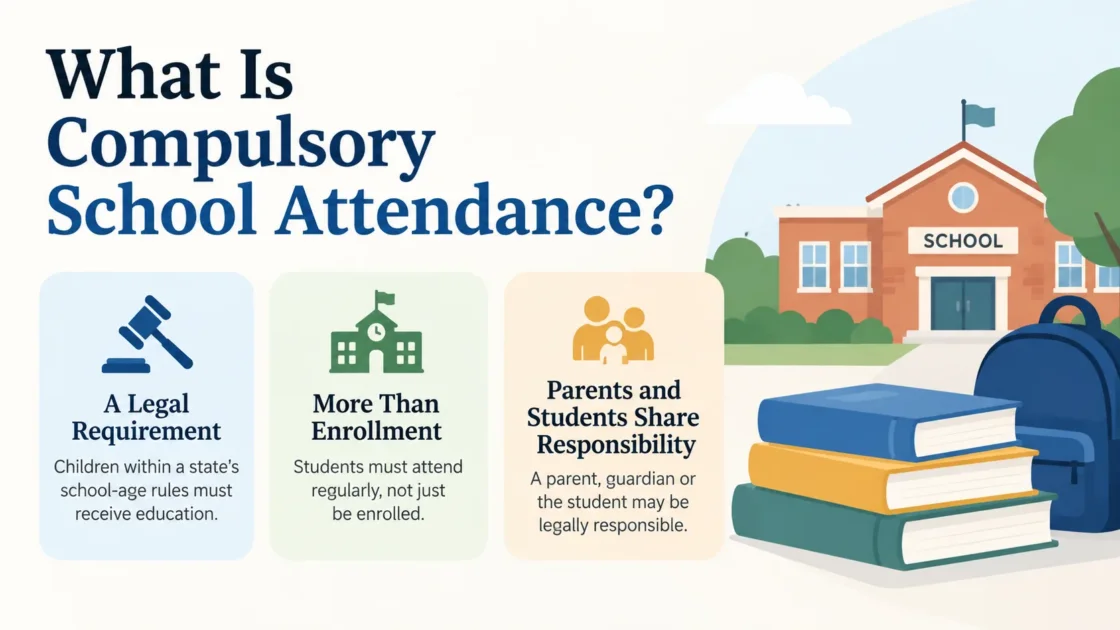
Compulsory school attendance is the legal requirement that a child within a state’s compulsory school-age rules receive education through a legally recognized option and meet the attendance obligations that apply to that option. The required ages, exceptions and recognized forms of education are set mainly by state law, so there is no single compulsory-attendance age range for every student in the United States.
What Compulsory School Attendance Requires
A compulsory-attendance law answers a basic legal question: when is a child required to receive and regularly participate in qualifying education?
The requirement is broader than school enrollment. A student may be enrolled but still fail to meet an attendance requirement if the student does not attend as required. Conversely, compulsory education does not necessarily require enrollment in the local public school. Depending on state law, a private school, home education program or another recognized educational arrangement may satisfy the requirement.
Compulsory-attendance laws commonly address several related points:
- the age at which the attendance requirement begins;
- the age or condition at which it ends;
- who is responsible for ensuring the child attends;
- which educational settings satisfy the requirement;
- whether enrollment before the normal compulsory age changes the child’s attendance status; and
- which exemptions or alternative arrangements are allowed.
For children covered by the law, a parent, guardian or other person legally responsible for the child is commonly required to ensure that the child receives the education required by the state. Some statutes also place an attendance responsibility directly on the student.
There Is No Single Compulsory School Age in the United States
Compulsory-attendance ages vary by state. A statement such as “children in the United States must attend school from age 6 to 18” is therefore too broad. It may describe the general rule in some states, but it is not a nationwide age requirement.
The differences are not limited to the numbers at each end of the age range. Birthday cutoffs, early enrollment, kindergarten rules, graduation, withdrawal procedures and statutory exemptions can change how the law applies to an individual student.
| State | General Age Rule | Detail That Affects the Rule |
|---|---|---|
| California | 6 to 18 | Children between ages 6 and 18 are generally subject to compulsory full-time education unless an exemption applies. |
| Florida | Generally 6 to under 16 | The starting rule includes children who turn 6 by February 1 of the school year. Reaching age 16 does not by itself complete every withdrawal requirement. |
| Ohio | 6 to 18 | A child under 6 who has been enrolled in kindergarten can also become subject to compulsory-school-age rules, with a withdrawal provision for that situation. |
| Texas | At least 6 to under 19 | Enrollment can matter before age 6. A child enrolled in prekindergarten or kindergarten becomes subject to attendance requirements. |
| Virginia | Generally 5 to under 18 | The rule uses a September 30 birthday cutoff and recognizes several lawful education options outside ordinary public-school attendance. |
| Washington | 8 to under 18 | The law also recognizes circumstances such as approved private-school attendance and qualifying home-based instruction. |
A child’s birthday, enrollment history, educational setting, graduation status and any applicable exception can affect the result. A general state age range should not be treated as an individual attendance determination.
Kindergarten Eligibility and Compulsory Attendance Are Different Rules
The age at which a child may enter kindergarten is not necessarily the age at which attendance becomes legally required.
A state can allow children to enter public kindergarten at age 5 while setting its general compulsory-attendance age later. Another state may require attendance at age 5. In some states, voluntarily enrolling a younger child can also activate attendance requirements that would not otherwise apply until a later age.
Ohio illustrates the enrollment issue. Its general compulsory-school-age range begins at age 6, but a child under 6 who has been enrolled in kindergarten is also treated as being of compulsory school age unless the child is formally withdrawn under the applicable rule. Texas similarly requires attendance after a child is enrolled in prekindergarten or kindergarten even when the child is younger than the general minimum age.
For that reason, three questions should be kept separate:
- When is a child eligible to enter kindergarten?
- When does the state’s general compulsory-attendance age begin?
- Does voluntary enrollment create an attendance obligation before that age?
Reaching a Certain Age Does Not Always Mean a Student Can Simply Stop Attending
The upper age limit also needs context. Some states end the general requirement at 16, while others extend it to 17, 18 or beyond. Even where an age appears to mark the end of compulsory attendance, state law may attach additional conditions.
Florida is an example. A student who reaches age 16 during the school year can become eligible to leave compulsory attendance, but the statute provides a formal declaration process for terminating enrollment. The student’s age alone does not replace that process.
Other states may recognize high school graduation, completion of an equivalent program or another statutory condition before the ordinary upper age is reached. The applicable state rule therefore matters more than a general statement that a student can “drop out at 16” or “must stay until 18.”
Free Public Education Eligibility Is a Separate Age Rule
The right to attend public school without tuition and the duty to attend school are different legal questions.
A state may provide free public education to students across a wider age range than its compulsory-attendance law covers. A student can therefore be old enough to have a right to enroll in public school while no longer being within the state’s general compulsory-attendance age range.
When education is required
Determines when a student must attend school or otherwise satisfy the state’s compulsory-education requirement.
When public education is available
Determines the age range in which a qualifying student is entitled to public education without tuition.
Compulsory Attendance Does Not Always Mean Public School Attendance
Compulsory education is sometimes misunderstood as a rule requiring every covered child to attend the neighborhood public school. State laws commonly recognize more than one way to satisfy the education requirement.
Depending on the jurisdiction, lawful options can include:
- public school;
- private, religious or parochial school;
- home education that meets the state’s requirements;
- instruction by an approved tutor or teacher in states that recognize that option; or
- another educational program specifically permitted by state law.
The terminology is not identical from state to state. One state may describe home education or private-school attendance as an exemption from a public-school attendance provision, while another may treat it as an alternative method of satisfying compulsory education. The practical question is whether the student’s educational arrangement is recognized under the law that applies in that state.
Virginia, for example, expressly permits compulsory attendance to be satisfied through public school, qualifying private or religious schools, certain tutoring arrangements or home instruction that meets state requirements. Washington’s attendance law likewise recognizes approved private schools and qualifying home-based instruction among its alternatives and exceptions.
An Excused Absence Is Not an Exemption from Compulsory Attendance
An excused absence normally concerns a particular period when a student who remains subject to attendance requirements is permitted to miss school. An exemption from compulsory attendance concerns whether the ordinary attendance requirement applies in the first place or whether another legally recognized arrangement satisfies it.
| Question | Excused Absence | Compulsory-Attendance Exemption or Alternative |
|---|---|---|
| What does it affect? | A particular absence or period away from school | The student’s legal attendance obligation or the way that obligation is satisfied |
| Is the student still generally enrolled? | Usually yes | Depends on the type of exemption or educational arrangement |
| Does the absence disappear from the attendance record? | Not necessarily; it may still be recorded as an absence | Not primarily an absence-coding issue |
| Typical examples | Illness, approved appointment or another accepted reason | Qualifying home education, recognized private education, completion status or another statutory exception |
A child who misses school because of an accepted illness, for example, does not stop being subject to compulsory-attendance law merely because that day’s absence is excused. The reason for the absence and the underlying duty to receive education are separate questions.
States also differ in the exemptions they recognize. Depending on the statute, provisions may address a student’s health or ability to attend, completion of graduation or equivalent requirements, particular educational programs, employment-related circumstances for older students, or other specifically defined situations.
Compulsory Attendance, Truancy and Chronic Absenteeism Measure Different Things
These terms can involve the same student’s attendance record, but they do not describe the same condition.
| Concept | Main Question | What Usually Determines It? |
|---|---|---|
| Compulsory attendance | Is this student legally required to receive qualifying education? | State law, age, enrollment status, educational setting and applicable exemptions |
| Truancy | Has the student accumulated unexcused attendance violations that meet an applicable rule? | State law and, where permitted, local attendance rules and absence classifications |
| Chronic absenteeism | Has the student missed a large share of enrolled school time? | An attendance measure commonly based on missing 10% or more of school days, including both excused and unexcused absences |
| Attendance or course-credit requirement | Has the student attended enough instructional time to satisfy a separate academic rule? | State law, district policy or course-specific attendance requirements |
Being within compulsory school age does not make a student truant. It establishes that an attendance obligation applies. Truancy requires the additional facts specified by the applicable attendance law or policy, usually involving unexcused absences.
Chronic absenteeism is different again. A student can become chronically absent through a combination of excused and unexcused missed days without meeting a state’s truancy definition. A student can also encounter a truancy rule before reaching a commonly used chronic-absence percentage if the jurisdiction’s unexcused-absence trigger is lower.
Separate academic attendance requirements can operate alongside all of these rules. A state or school system may use attendance for course credit, promotion or another academic purpose without changing the student’s compulsory-attendance age.
What Determines Whether Compulsory Attendance Applies to a Particular Student?
An age range by itself is not enough to determine every student’s status. The applicable rule is usually resolved through a sequence of facts.
Check the state’s lower and upper compulsory-age rules and any birthday cutoff tied to the school year.
Determine whether early enrollment in kindergarten, prekindergarten or another grade creates an attendance obligation before the general minimum age.
Identify whether the student attends public school or another form of education recognized by state law.
Check whether graduation, an equivalent completion status or another statutory exception changes the ordinary attendance requirement.
Withdrawal procedures can also matter for older students. Reaching a state’s listed upper age threshold should not be assumed to cancel enrollment automatically when the statute requires a declaration, parent involvement, school documentation or another step.
The controlling state law, the student’s official enrollment and attendance record, and any applicable school or district procedures determine how compulsory attendance applies to an individual student. A national age chart can show the general rule, but it cannot account for every enrollment trigger, exemption or student-specific condition.