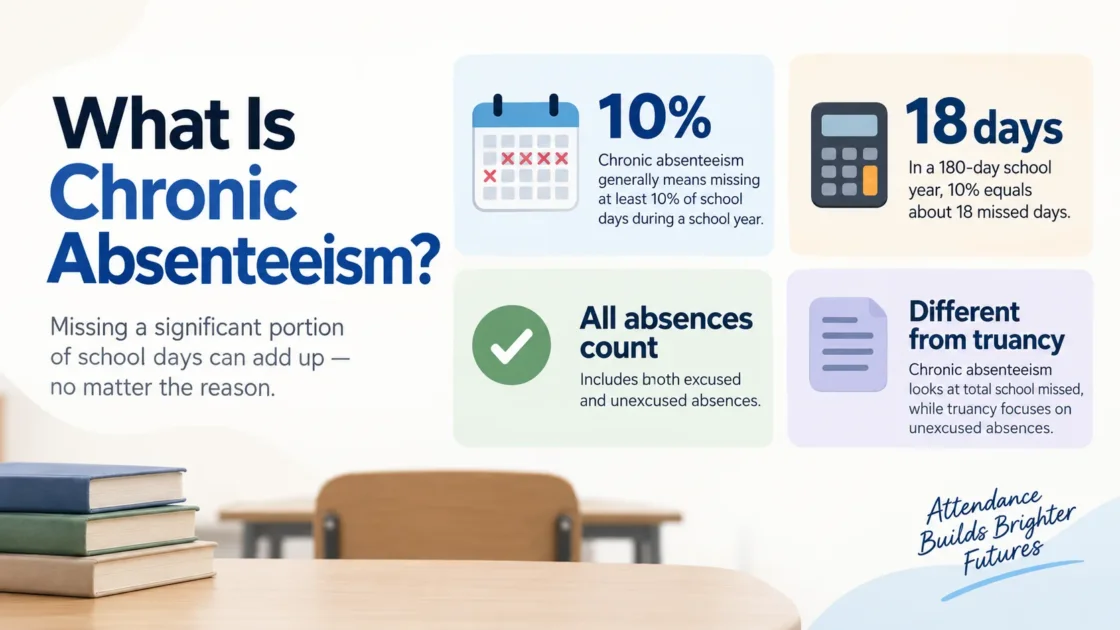
Chronic absenteeism means a student misses 10% or more of school days during the school year for any reason. Excused and unexcused absences both count toward the commonly used measure.1 In a 180-day school year, 10% equals about 18 missed days.
A student is commonly considered chronically absent after missing at least 10% of the school days used for the attendance calculation, regardless of whether the absences are excused or unexcused.
How the 10% Threshold Works
The threshold is based on a percentage rather than one fixed number of days. This allows the measure to adjust to different school calendars and, in some systems, to the number of days a student was enrolled.
| School or Enrollment Days | 10% of Days |
|---|---|
| 100 days | 10 days |
| 150 days | 15 days |
| 170 days | 17 days |
| 180 days | 18 days |
The 18-day figure applies to a 180-day school year; the actual 10% cutoff changes with the number of school or enrollment days used in the calculation. Attendance calendars and enrollment rules can therefore produce a different day count while using the same percentage threshold.
Excused and Unexcused Absences Can Both Count
Chronic absenteeism focuses on how much instructional time a student misses, not only on why the student was absent. Excused absences can still push a student above the chronic-absence threshold because the measure tracks missed school days, not whether the school accepted the reason for each absence.1
Absences may accumulate because of illness, appointments, family circumstances, transportation problems or many other reasons. They do not need to occur on consecutive school days. Scattered absences throughout the year can eventually reach the same percentage threshold as one long period away from school.
States and school systems may handle partial-day absences, enrollment periods, disciplinary absences and other attendance situations differently. Those rules can affect the number of days included in a student’s reported absence percentage.
Chronic Absenteeism Is Different From Truancy
Total missed school
Usually measures whether a student has missed 10% or more of school, including both excused and unexcused absences.
Unexcused attendance problems
Generally relates to unexcused absences and is governed by state law, district policy or other local attendance rules.
A student can be chronically absent without meeting a truancy threshold. A local truancy rule may also be triggered before a student has missed 10% of school, depending on the jurisdiction. The terms describe different attendance concepts and should not be used interchangeably.
Chronic absenteeism is mainly an attendance and reporting measure. Being classified as chronically absent does not, by itself, establish that a student has violated a truancy law or another attendance requirement.
Chronic Absenteeism Is Not the Same as an Attendance Rate
An attendance rate measures how much school a student or group attended. Chronic absenteeism identifies students whose individual absence totals cross a defined threshold.
For example, a school can have a high average attendance rate while still having many chronically absent students. Different students may be missing school on different days, so a school-level daily attendance percentage does not show whether the same students repeatedly lose instructional time.
How Occasional Absences Can Add Up
A student does not need to miss several weeks in one stretch to become chronically absent. In a 180-day school year, averaging about two missed days per month across nine months produces 18 absences, which equals 10% of the school year.
- 5 missed days out of 100 school days equals a 5% absence rate.
- 10 missed days out of 100 school days equals a 10% absence rate.
- 18 missed days out of 180 school days equals a 10% absence rate.
The basic calculation is:
Days absent ÷ school or enrollment days × 100. If the applicable measure reaches 10%, the student meets the commonly used chronic absenteeism threshold.
What Chronic Absenteeism Measures
The metric helps schools identify students who have lost a large share of available instructional time. Counting both excused and unexcused absences gives a broader picture than looking only at attendance violations.
It can also identify patterns that a daily attendance rate may not reveal. A student missing one day here and another day there may never have one long absence, yet the cumulative total can reach the chronic-absence threshold over the school year.
For federal chronic absenteeism data, Ed Data Express defines the measure as the unduplicated number of students absent for 10% or more of school days during the school year.2
When the Simple Calculation and School Record Differ
A 10% calculation is useful for estimating a student’s absence percentage, but it may not exactly match a school’s reported chronic-absence status. Enrollment dates, partial days and attendance coding can affect which days enter the calculation.
For a student-specific result, use the attendance record and chronic-absence definition applied by the school, district or state rather than relying only on a separate day-count estimate.