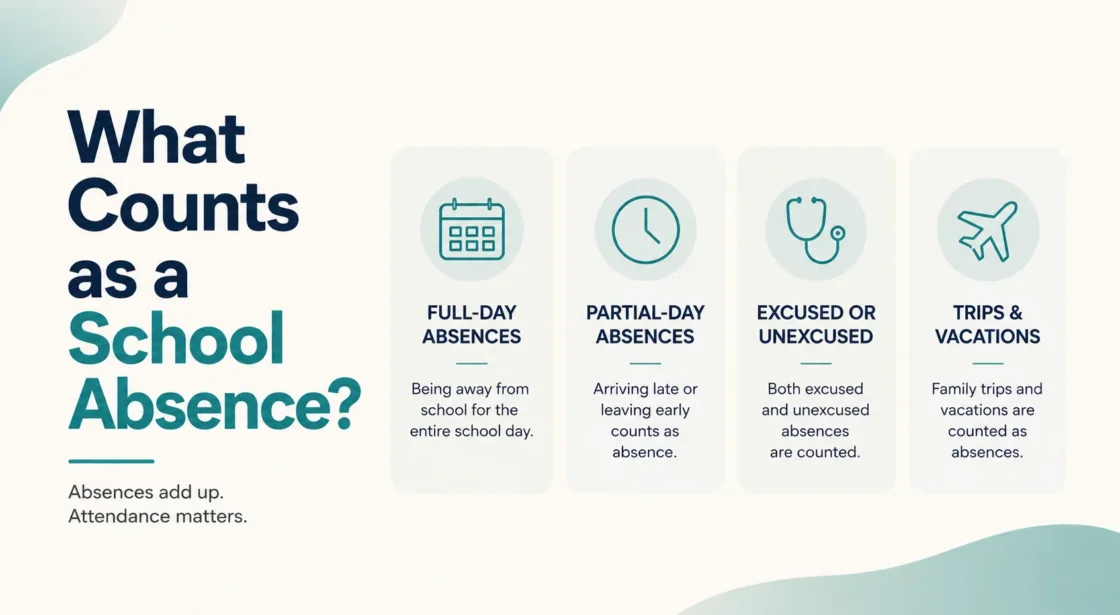
A student is generally absent when the student is not physically at school and is not taking part in instruction or an instruction-related activity at an approved off-campus location. The National Center for Education Statistics uses this distinction between attending and not attending, while states and districts decide how specific absences are classified.
That means being away from the school building does not always equal an absence. A school-approved field trip, work-study placement, homebound lesson, or other authorized instructional activity may be recorded as attendance. By contrast, staying home sick can still be an absence even when the school accepts the reason and marks it excused.
What Usually Counts as a School Absence?
The exact attendance code depends on the school system, but the situations below show how common cases are generally handled. The distinction to watch is whether the student is receiving approved instruction, not simply where the student is located.
| Situation | Usually Recorded As | What Determines the Record |
|---|---|---|
| Student stays home because of illness | Absence | The school may classify it as excused if its attendance rules are met. |
| Student misses school for a medical or dental appointment | Absence or partial-day absence | The amount of instructional time missed and local documentation rules matter. |
| Student takes a family trip during school days | Absence | Whether it is excused depends on state, district, or school policy. |
| Student skips school or cuts a class | Unexcused absence | The student is missing scheduled instruction without an accepted reason. |
| Student attends a school-approved field trip | Present | The activity is part of, or related to, an approved educational program. |
| Student receives approved homebound or off-campus instruction | Can be present | The program must meet the attendance requirements used by the school system. |
| Student is in an in-school suspension and receives instruction | Can be present | Instruction continues even though the student is removed from the regular classroom. |
| Student is suspended out of school and receives no instruction | Absence | The student is not participating in instruction during the missed school time. |
| School is closed for a holiday, weather closure, or scheduled non-school day | Not an absence | Students are not counted absent on a day when school is not in session. |
When Being Off Campus Can Still Count as Present
Attendance is not limited to sitting in the usual classroom. NCES guidance treats students as present when they are participating in an instructional program approved by the school, district, or state. Examples can include field trips, work-study, instruction at another approved site, homebound instruction, and some school-approved extracurricular or cocurricular activities. NCES attendance guidance describes these as forms of attending when the activity is part of an approved educational program.
Remote or alternative instruction can also count as attendance when the state or school system authorizes the program and the student meets its participation rules. The details are not uniform nationwide. A student who simply completes missed homework at home should not assume that the original absence disappears unless the school’s rules specifically provide an attendance-recovery method.
Excused and Unexcused Are Both Absence Categories
An excused absence does not normally become a day of attendance just because the reason was approved. It remains missed instructional time. NCES notes that states and districts make the excused-versus-unexcused determination, so illness, bereavement, religious observance, family emergencies, transportation problems, and other reasons can be handled differently across school systems.
This distinction also matters when looking at chronic absenteeism. The U.S. Department of Education says chronic absenteeism is typically defined as missing at least 10% of school days for any reason, including excused and unexcused absences.
Tardies, Early Pickups, and Partial-Day Absences
Arriving late or leaving early does not have one nationwide conversion rule. Schools may record a tardy, an early dismissal, a class-period absence, a half-day absence, or a full-day absence depending on how much scheduled instructional time the student misses.
For example, Connecticut reports a student as in attendance for state purposes when the student is present at school or a qualifying school-sponsored activity for at least half of the regular school day. A shorter presence can be reported as an absence. The state’s student attendance reporting guidance also makes clear that local districts may use more detailed attendance practices for their own records.
The attendance portal or student handbook should show whether late arrivals and early departures remain tardies, become partial-day absences, or accumulate under another local rule.
How Suspensions Are Recorded
Disciplinary removal can be recorded differently depending on whether instruction continues. Under the NCES attendance taxonomy, a student removed from the regular setting but still receiving instruction can be treated as present. A student removed for disciplinary reasons and not receiving instruction is absent.
Current California reporting guidance follows the same practical distinction for absenteeism reporting: out-of-school suspensions are treated as days absent, while in-school suspensions are treated as attendance because the student remains in school receiving instruction. The California Department of Education CALPADS FAQ also notes that partial-day suspension reporting can differ from full-day absence reporting.
How Individual Absences Add Up to Chronic Absenteeism
For the commonly used federal measure, chronic absenteeism begins when a student misses at least 10% of school days. In a 180-day school year, 10% is 18 days. The percentage is more useful than a fixed number when a student enrolls late, transfers, or is measured before the end of the year.
Days absent ÷ days enrolled × 100. A student who has missed 9 of 90 enrolled school days has a 10% absence rate.
The 10% measure should not be treated as a nationwide truancy limit. Local rules can use different triggers for unexcused absences, notices, attendance interventions, course credit, or other school procedures.
Which Record Decides Whether an Absence Counts?
The student’s official school attendance record controls how a particular day or class period is coded. State rules, district policy, the school calendar, the student’s schedule, approved instructional programs, and documentation can all affect the final code.
If an attendance entry looks wrong, compare the date with the school’s attendance policy and the student’s schedule. A field trip, approved instructional placement, corrected tardy, documented absence, or attendance-recovery program may need a different code, while an accepted excuse may change the type of absence without changing the fact that instructional time was missed.