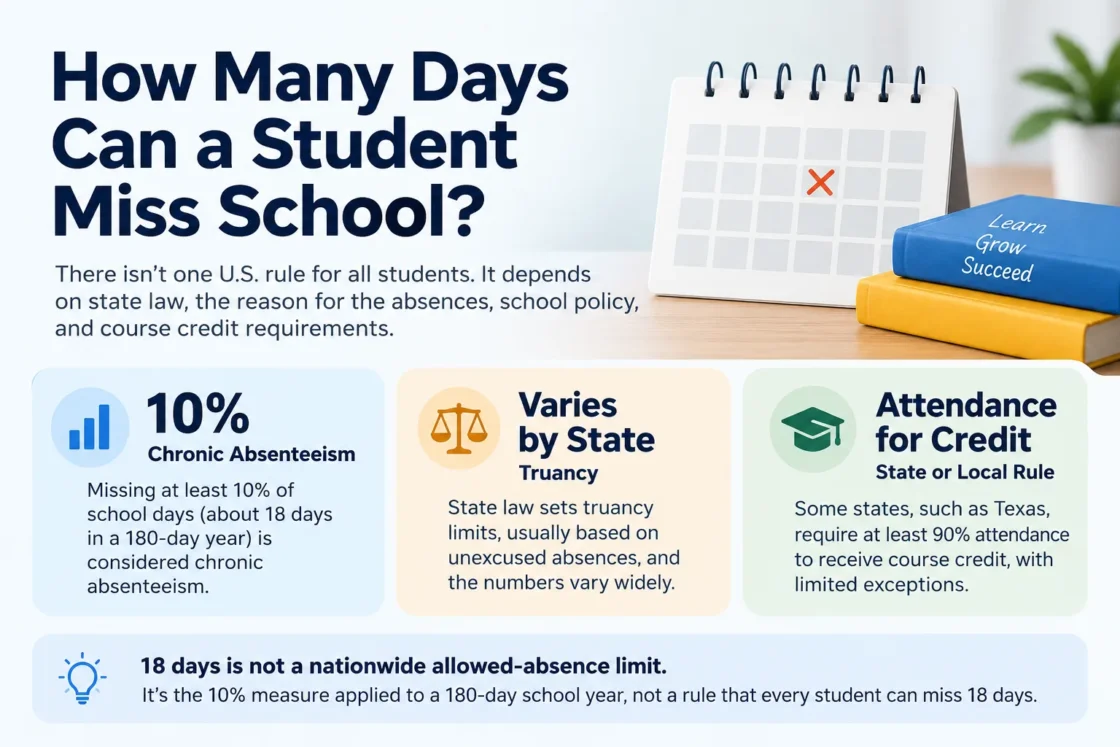
There is no single U.S. rule that gives every student the same number of days they are allowed to miss school. A commonly cited number is 18 days in a 180-day school year, but that is the approximate point at which a student reaches the federal chronic absenteeism measure. It is not a nationwide legal allowance. Truancy rules, course-credit requirements, and local attendance policies can apply sooner or use different thresholds.
Why 18 Days Is Often Mentioned
The U.S. Department of Education typically defines chronic absenteeism as missing 10% or more of school days for any reason, including both excused and unexcused absences. The department describes this as approximately 18 days during a school year.1
18 daysApproximate amount in a 180-day year
All absencesExcused and unexcused
A student can face an attendance notice, truancy classification, intervention, or course-credit issue before reaching 18 total missed days. The applicable rule depends on the state, school district, type of absence, and sometimes the individual course.
The Number Changes Depending on the Attendance Rule
Questions about how many days a student can miss often combine several different attendance rules. They should be considered separately.
| Attendance Rule | What It Measures | Example |
|---|---|---|
| Chronic absenteeism | Total instructional time missed, regardless of the reason | Missing 10% or more of school days is typically considered chronic absenteeism.1 |
| Truancy | Usually focuses on absences or missed instructional time without a valid excuse | California classifies a student as truant after three full unexcused days, three unexcused absences or tardies exceeding 30 minutes, or a qualifying combination.2 |
| Course credit | Attendance required to receive credit or a final grade | Texas generally requires attendance for at least 90% of the days a class is offered. Students attending at least 75% but less than 90% may qualify through an approved instructional plan.3 |
| Local attendance policy | District rules for absence classifications, interventions, credit, or promotion | New York allows local education agencies to decide which absences are excused and whether to establish a minimum attendance standard for course credit.4 |
These examples show why a statement such as “students can miss 18 days” is too broad. Eighteen days describes a widely used chronic-absence benchmark, while legal and academic attendance rules can operate differently.
Do Excused Absences Count?
For chronic absenteeism, yes. The federal measure includes days missed for any reason, so illness and other excused absences can still contribute to the 10% threshold.1
Truancy is different. Truancy rules generally focus on attendance problems without a valid excuse, and the exact trigger comes from state law or local procedures. California, for example, uses unexcused absences when determining the initial truancy classification.2
Course-credit rules can be different again. An absence may be properly excused while still affecting an attendance calculation under some policies, while another rule may exclude particular types of approved absences. New York, for example, gives local education agencies discretion over several parts of their attendance and course-credit policies.4
How to Calculate the 10% Absence Mark
The chronic-absence threshold is percentage-based. That makes the student’s number of enrolled school days more useful than assuming every calendar contains exactly 180 days.
Missed days ÷ enrolled school days × 100 = percentage of school missed
| School Days | 10% of Days |
|---|---|
| 180 days | 18 days |
| 170 days | 17 days |
| 160 days | 16 days |
| 90 days | 9 days |
For example, a student who misses 20 days out of a 180-day calendar has missed about 11.1% of school. That places the student above the typical chronic absenteeism threshold.1 It does not automatically mean that the student must repeat a grade, lose every course credit, or meet a nationwide truancy threshold.
Enter the school days and absences to see how much instructional time has been missed.
A School May Act Before 18 Missed Days
Schools do not necessarily wait until a student reaches the chronic-absence threshold. Unexcused absence rules can trigger notices or attendance procedures much earlier. California’s initial truancy rule, for example, can apply after three qualifying unexcused attendance violations during one school year.2
Academic rules may also use percentages rather than a fixed annual number. Under the Texas 90% rule, the calculation is tied to the days a particular class is offered, so the relevant absence limit can differ between a full-year course and a shorter course.3
Which Absence Limit Applies to a Particular Student?
The applicable number should be checked against the student’s actual school and jurisdiction rather than using 18 days as a universal limit. The records and rules that usually matter are:
- the state’s compulsory-attendance and truancy requirements;
- the district or school’s excused and unexcused absence policy;
- course-credit or promotion attendance requirements;
- the number of instructional days for which the student is enrolled; and
- any approved absence, make-up, attendance-recovery, or exception provisions that apply to the student.
For a general attendance measure, missing 10% of school is the clearest national benchmark. For truancy, course credit, promotion, or another individual outcome, the student’s official school, district, and state rules determine the applicable threshold.