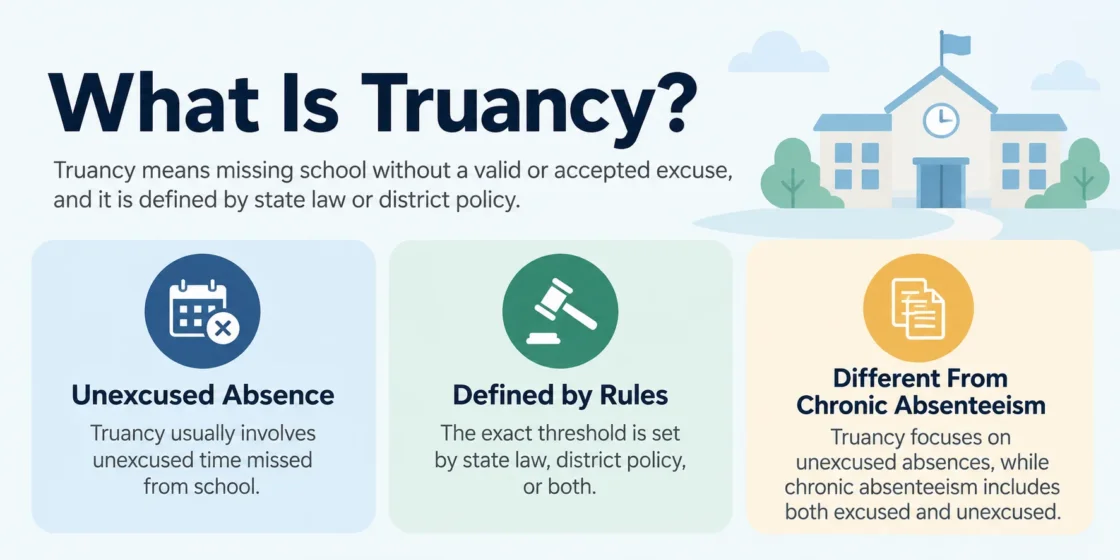
Truancy generally refers to school absence without a valid or accepted excuse by a student who is subject to compulsory attendance requirements. The exact point at which unexcused absence becomes a formal truancy classification is set by state law, district policy, or both. There is no single nationwide number of missed days that makes every U.S. student truant.
A student can miss school and not be truant. Illness, an approved medical appointment, a recognized religious observance, or another accepted reason may still be recorded as an absence, but it is generally treated differently from an unexcused absence for truancy purposes.
Truancy also should not be used as another name for chronic absenteeism. Truancy usually centers on unexcused attendance problems and compulsory-attendance rules. Chronic absenteeism measures how much school a student misses overall, including both excused and unexcused absences.
What Makes an Absence Truancy?
A truancy determination usually depends on more than the fact that a student was not in class. The applicable attendance rules determine whether the missed time was unauthorized and whether enough unexcused time has accumulated to trigger a truancy classification or response.
- The student is subject to an attendance requirement. Truancy laws generally operate through state compulsory-attendance requirements.
- Required school or instructional time was missed. Depending on the jurisdiction, this may involve a full day, part of a day, individual class periods, or a specified number of instructional hours.
- The missed time was not accepted as excused. Schools classify absences under applicable state and local rules rather than simply according to whether a parent knew about the absence.
- An applicable threshold may need to be reached. Some states distinguish an individual unexcused absence from formal statuses such as truant, habitual truant, or chronic truant.
An unexcused absence can count toward a truancy threshold without immediately placing a student in a formal truancy category. The terminology and trigger depend on the jurisdiction.
There Is No National Truancy Threshold
The National Center for Education Statistics has noted that there is no national standard defining truancy or determining what counts as excused versus unexcused absence. State and local definitions therefore cannot be reduced to a rule such as “10 absences always equals truancy.”
Jurisdictions also measure missed time differently. A rule may be based on school days, parts of days, instructional hours, consecutive absences, accumulated absences during a month, or a school-year total.
| Example | Attendance Measure | What the Rule Shows |
|---|---|---|
| California | Three full days without a valid excuse, three unexcused tardies or absences of more than 30 minutes, or a qualifying combination in one school year | A truancy rule can include both full-day absences and portions of a school day. |
| Ohio habitual truancy | 30 consecutive hours, 42 hours in one school month, or 72 hours in one school year without legitimate excuse | A state can measure truancy in hours rather than simply counting absent days. |
California’s Department of Education currently describes the state’s initial truant classification using Education Code Section 48260. Ohio’s current Revised Code defines an habitual truant using the 30-, 42-, and 72-hour thresholds. These are examples of different state systems, not formulas that apply nationwide.
Truancy, Unexcused Absence, and Chronic Absenteeism Are Different
Three attendance terms are often used as though they describe the same condition. They measure different things.
| Term | What It Describes | Do Excused Absences Count? | Is There One U.S. Threshold? |
|---|---|---|---|
| Unexcused absence | Missed school time that is not accepted as excused under the applicable attendance rules | No; the term specifically refers to absence classified as unexcused | No |
| Truancy | Unexcused attendance problems evaluated under state or local compulsory-attendance rules | Generally no | No |
| Chronic absenteeism | A measure of how much school a student has missed overall | Yes, under the commonly used federal measure | The U.S. Department of Education typically uses 10% of school days as the chronic-absence measure |
The U.S. Department of Education describes chronic absenteeism as typically missing at least 10% of school days for any reason, whether the absences are excused or unexcused. In a 180-day school year, 10% equals 18 days.
That 18-day example is not a national truancy limit. A student could reach a state’s truancy threshold with fewer than 18 missed days if enough of the missed time is unexcused. Another student could miss 18 or more days for accepted reasons, meet a chronic-absence measure, and never satisfy the applicable truancy definition.
Does an Excused Absence Count as Truancy?
An absence properly classified as excused generally does not count toward a truancy threshold that is based on unexcused or non-legitimate absences. It can still remain an absence in the student’s attendance record and can contribute to chronic absenteeism.
The reason given by a family and the school’s official attendance code are not necessarily the same thing. A parent may approve an absence, but state or district rules determine whether the school can classify that reason as excused.
| Situation | Typical Truancy Treatment | What Still Needs to Be Checked |
|---|---|---|
| Documented illness accepted by the school | Generally not counted as truancy | Local excuse and documentation rules |
| Approved medical appointment | Generally not counted as truancy | Whether the school records a full-day or partial-day absence |
| Skipping school without an accepted reason | Can count toward truancy | The state or local threshold |
| Cutting a scheduled class | Can be an unexcused class-period absence | How the school measures period attendance and missed instructional time |
| Family trip during school days | Depends on the attendance rules | Whether the trip qualifies as an excused absence |
| School-approved instructional activity away from campus | Normally not truancy when recorded as attendance | Whether the activity qualifies as approved instruction |
Can Tardies and Partial Days Count Toward Truancy?
They can. There is no nationwide rule stating that a tardy always counts, never counts, or converts into a full absence after a specific number of minutes.
California provides a clear example. A student subject to the state’s compulsory education requirements can be classified as truant after being tardy or absent for more than a 30-minute period without a valid excuse on three occasions during one school year. Three full unexcused days, or a qualifying combination of full days and these longer partial-day events, can also satisfy the initial definition.
Other jurisdictions can use instructional hours, class periods, half days, or different local attendance codes. A portal entry marked simply as “tardy” therefore does not reveal by itself whether the event counts toward a truancy threshold.
Who Is Subject to Truancy Rules?
Truancy is tied to compulsory attendance. States set the ages and circumstances under which a child must attend school or receive another legally recognized form of education, and those requirements vary across the country.
Enrollment status can also matter. State law may contain exemptions or separate rules for private education, home instruction, alternative programs, students who have completed certain education requirements, or other situations recognized by law.
For that reason, a student’s age alone is not enough to determine truancy status. The applicable compulsory-attendance provision, enrollment status, educational setting, and attendance record need to be considered together.
What Happens When Unexcused Absences Accumulate?
Reaching a threshold does not create the same response in every state. Depending on the applicable rules and the student’s attendance history, the process can include notice to the family, a review of the attendance record, a school meeting, attendance supports, an intervention plan, referral to another attendance process, or further action if unexcused absences continue.
Current state laws illustrate why the sequence should not be reduced to “miss a set number of days and go to court.” Ohio, for example, uses its habitual-truancy thresholds but also provides that an attendance officer does not file a juvenile-court complaint when the school or district determines that the student and family are making satisfactory progress in improving attendance.
California likewise separates an initial truancy classification from later stages such as repeated truancy and habitual truancy. Its current attendance guidance describes notices, school-family contact, and further attendance procedures as distinct steps.
What to Check in a Student’s Attendance Record
A percentage or total number of absences is not enough to determine whether a student is truant. The classification of the missed time matters.
- The exact dates marked absent
- Whether each entry is excused or unexcused
- Full-day versus partial-day absence
- Class periods or instructional hours missed
- Tardies and early departures
- Whether required documentation was submitted and accepted
- The number of unexcused days, hours, or events accumulated during the period used by the applicable rule
- Any attendance notice or status already recorded by the school
Two students with the same number of missed days can have different truancy status if one student’s absences are excused and the other’s are unexcused. The applicable state or local threshold can also use a different unit of measurement.
Can a Student Be Both Truant and Chronically Absent?
Yes. The two categories can overlap, but neither one automatically proves the other.
| Attendance Pattern | Possible Truancy Status | Possible Chronic Absence Status |
|---|---|---|
| A small number of excused absences | Generally no | Usually below the common 10% measure |
| Enough excused absences to reach 10% of school days | Not on the basis of those excused absences alone | Yes under the commonly used 10% measure |
| Repeated unexcused absences below 10% of school days | Possible, depending on the applicable truancy rule | May still be below the 10% measure |
| Large number of unexcused absences | Possible | Possible if total absences also reach the applicable chronic-absence measure |
Truancy status for an individual student ultimately depends on the student’s official attendance record and the law or attendance policy that applies to that student. A statewide example, a general percentage, or another district’s attendance rule cannot establish the student’s official status.