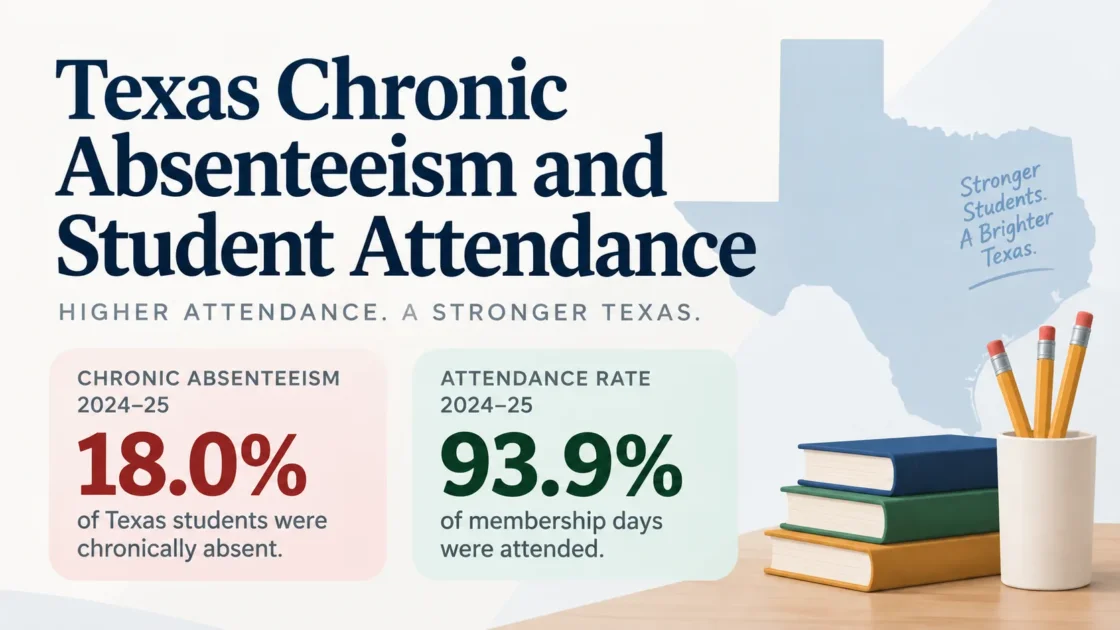
Texas reported a statewide chronic absenteeism rate of 18.0% for 2024–25, while the statewide attendance rate was 93.9%. Chronic absenteeism has fallen for three consecutive reporting years since reaching 25.7% in 2021–22, but the latest rate remains above the 11.4% reported in 2018–19. The latest statewide figures are published through the Texas Education Agency Texas Performance Reporting System.
Texas Chronic Absenteeism Trend
The sharpest recent increase occurred between 2020–21 and 2021–22. The statewide chronic absenteeism rate rose from 15.0% to 25.7%. Since then, Texas has recorded lower rates each year: 20.3% in 2022–23, 19.0% in 2023–24 and 18.0% in 2024–25.
Percentage of students reported as chronically absent in statewide TPRS data.
The 2024–25 rate was 7.7 percentage points below the 2021–22 rate.
| School Year | Attendance Rate | Chronic Absenteeism |
|---|---|---|
| 2020–21 | 95.0% | 15.0% |
| 2021–22 | 92.2% | 25.7% |
| 2022–23 | 93.3% | 20.3% |
| 2023–24 | 93.6% | 19.0% |
| 2024–25 | 93.9% | 18.0% |
Attendance has also moved upward since 2021–22. The statewide attendance rate increased from 92.2% that year to 93.9% in 2024–25. The improvement in both measures points in the same direction, although attendance rate and chronic absenteeism measure different things.
Attendance Rate and Chronic Absenteeism Measure Different Things
93.9%
The statewide share of student membership days recorded as attended in 2024–25.
18.0%
The statewide share of students meeting the chronic absenteeism measure in 2024–25.
An attendance rate is based on days attended across the student population. Chronic absenteeism is a student-level measure that identifies students whose absences cross a defined threshold. For that reason, a 93.9% attendance rate does not mean that only 6.1% of students were chronically absent.
Chronic Absenteeism Across Texas Student Groups
The statewide 18.0% rate masks wide differences among student groups. In 2024–25, Texas reported chronic absenteeism rates above 20% for African American students, Hispanic students, Pacific Islander students, students receiving special education services and economically disadvantaged students. Asian students had the lowest rate among the groups shown in the statewide report.
| Student Group | Chronic Absenteeism |
|---|---|
| Statewide | 18.0% |
| African American | 22.2% |
| Hispanic | 20.6% |
| White | 12.9% |
| American Indian | 19.6% |
| Asian | 6.5% |
| Pacific Islander | 21.1% |
| Two or More Races | 16.7% |
| Special Education | 21.6% |
| Economically Disadvantaged | 22.2% |
| Emergent Bilingual/English Learner | 19.1% |
These figures describe differences in reported attendance outcomes; they do not by themselves identify why one group has a higher or lower rate. District, campus, grade level, enrollment patterns and student circumstances can all vary within the statewide categories.
Texas Now Has a Statutory Chronic Absence Definition
Texas law added a specific definition of a “chronically absent student” through legislation effective September 1, 2025. Texas Education Code Section 48.009 defines the term as a student absent for more than 10% of the school’s required operation and instructional time within a school year, or within an enrollment period that exceeds 30 instructional days. The Texas Education Agency’s SB 991 guidance also explains how the definition is applied by school systems.
Most years in the statewide trend were reported before the 2025 statutory change. Historical TPRS figures should therefore be read using the reporting method attached to each school year rather than by retroactively applying the newer legal definition.
The 2025 change also added chronically absent students to the state’s definition of students at risk of dropping out for purposes of accelerated instruction. This makes chronic absence more than a statewide reporting measure in current Texas law, while still keeping it separate from truancy and class-credit rules.
Chronic Absence Is Not the Texas 90% Credit Rule
Texas Education Code Section 25.092 generally requires a student to attend at least 90% of the days a class is offered to receive credit or a final grade, subject to statutory exceptions and attendance-recovery procedures. This individual class-credit requirement is separate from the statewide chronic absenteeism rate reported by TEA. See the Texas Education Code attendance provisions for the controlling rule.
A student can therefore encounter more than one attendance measure during the same school year. Chronic absenteeism is used to identify patterns of missed instructional time, while the 90% rule concerns eligibility for credit or a final grade in a class. Truancy is another separate concept tied to unexcused absences and compulsory-attendance requirements.
Statewide Numbers Can Differ Sharply from Local Results
The statewide 18.0% chronic absenteeism rate should not be treated as the expected rate for every Texas school or district. TEA’s reporting system publishes attendance and chronic absenteeism data at state, district and campus levels, with student-group breakdowns where reporting rules permit.
For comparisons, the school year and metric should stay the same. A district’s chronic absenteeism percentage should be compared with the statewide chronic absenteeism percentage for the same year, rather than with the statewide attendance rate or a figure from another reporting period. This keeps changes in student attendance separate from changes caused by mixing different measures.