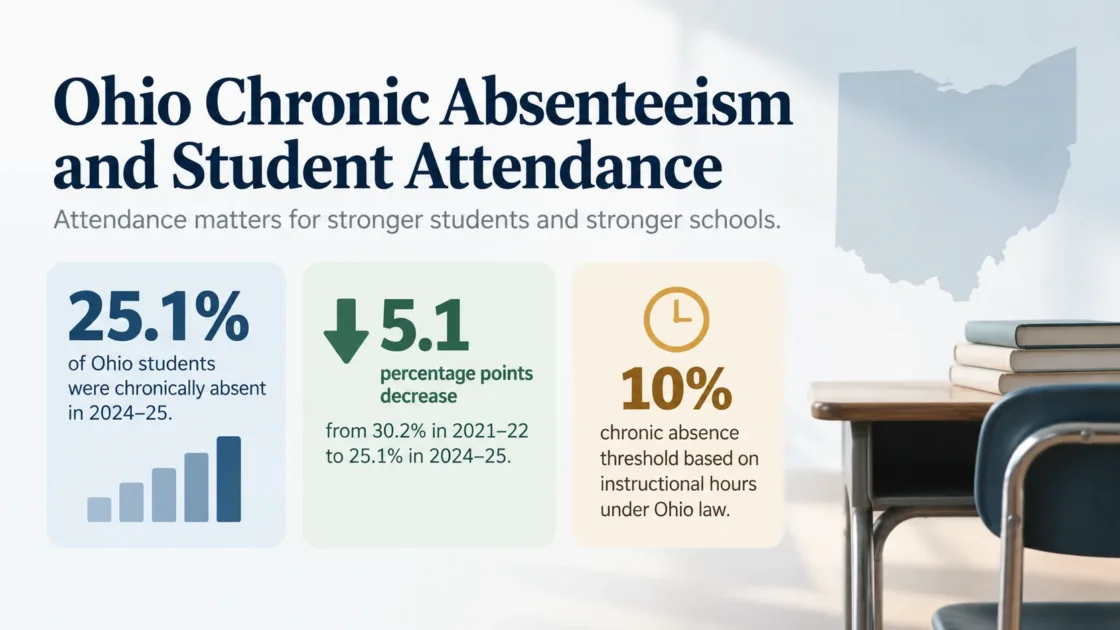
Ohio’s statewide chronic absenteeism rate was 25.1% in 2024–25, representing 384,873 students in the state’s published chronic absence data. The rate has fallen for three consecutive school years since reaching 30.2% in 2021–22, but it remains well above the 16.7% recorded in 2018–19. Under current Ohio law, chronic absence is measured in hours and includes time missed for both excused and unexcused reasons.
Ohio Chronic Absenteeism Fell to 25.1% in 2024–25
Ohio’s statewide data show a sharp rise in chronic absence after 2019–20, followed by a gradual decline from the 2021–22 peak. From 30.2% in 2021–22 to 25.1% in 2024–25, the rate fell by 5.1 percentage points. The published number of chronically absent students fell from 473,223 to 384,873 over the same period, a decrease of 88,350 students.
Percentage of students identified as chronically absent in statewide Ohio data.
The 2019–20 value is retained because it appears in the published state series, but that disrupted school year should not be treated as a normal attendance baseline.
| School Year | Chronically Absent Students | Chronic Absenteeism Rate |
|---|---|---|
| 2018–19 | 268,634 | 16.7% |
| 2019–20 | 179,652 | 11.2% |
| 2020–21 | 377,439 | 24.0% |
| 2021–22 | 473,223 | 30.2% |
| 2022–23 | 418,382 | 26.8% |
| 2023–24 | 396,218 | 25.6% |
| 2024–25 | 384,873 | 25.1% |
The largest value in this series is 30.2% in 2021–22. The next three reported rates were 26.8%, 25.6%, and 25.1%. The most recent decline was therefore 0.5 percentage points, smaller than the 1.2-point decline one year earlier. Despite the recovery, the 2024–25 rate remained 8.4 percentage points above 2018–19.
Ohio Measures Chronic Absence in Hours
Since September 30, 2025, Ohio Revised Code defines a chronically absent student as one who misses at least 10% of the minimum number of instructional hours required for the school the student attends. Ohio therefore does not set one statewide chronic-absence threshold expressed as a fixed number of school days.
The minimum annual instructional hours vary by grade configuration. Applying the statutory 10% rule produces different chronic-absence thresholds for half-day kindergarten, full-day kindergarten and elementary grades, and grades 7–12.
| Student Level | Minimum Annual Hours | 5% of Minimum Hours | 10% Chronic-Absence Threshold |
|---|---|---|---|
| Half-day kindergarten | 455 | 22.75 hours | 45.5 hours |
| All-day kindergarten | 910 | 45.5 hours | 91 hours |
| Grades 1–6 | 910 | 45.5 hours | 91 hours |
| Grades 7–12 | 1,001 | 50.05 hours | 100.1 hours |
Local attendance policies set the point at which families are notified about accumulating absences, but that notification point cannot be later than 5% of the applicable statutory minimum hours. A district may choose to contact families earlier. Chronic absence begins at the separate 10% threshold.
Converting 10% into a number of days can be useful for a rough illustration, but Ohio’s current statutory definition is written in hours. Daily schedules also vary, so a fixed day count can give the wrong threshold for an individual school or student.
These statutory thresholds should also be kept separate from Ohio School Report Card calculations. Report Card chronic absenteeism uses each eligible student’s reported possible attendance hours rather than simply applying 45.5, 91, or 100.1 hours to every student in the corresponding grade range.
Which Missed Hours Count Toward Chronic Absenteeism
Chronic absenteeism is broader than unexcused absence. Time away from instruction can contribute to chronic absence even when the school accepts the reason for the absence. The classification becomes especially important when chronic absenteeism is compared with truancy, which is based on absence without a legitimate excuse.
| Attendance Situation | Chronic Absence Treatment | Attendance Record Treatment |
|---|---|---|
| Excused absence | Missed hours count | Recorded as excused absence hours |
| Medically excused absence | Missed hours count | Recorded as an excused absence when properly documented under local procedures |
| Unexcused absence | Missed hours count | Recorded as unexcused absence hours |
| Late arrival | Missed instructional hours count | Only the time actually missed is relevant to the hour calculation |
| Early dismissal | Missed instructional hours count | Only the time actually missed is relevant to the hour calculation |
| Leaving for an appointment and returning | Missed instructional hours count | The absent portion of the day is recorded rather than automatically treating the entire day as absent |
| In-school suspension | Does not create absent hours in the Report Card calculation | Included as attendance hours |
| Out-of-school suspension with instructional services | Instructional-service hours are treated as attendance | Included as attendance hours when qualifying instructional services are provided |
| Out-of-school suspension without instructional services | Hours contribute to the Report Card absence calculation | Included as unexcused absence hours for that calculation |
| School-sponsored field trip | Does not create absent hours | Included as attendance hours |
| Graded co-curricular activity | Generally treated as instructional participation | Student is treated as present for the qualifying activity |
A series of short absences can therefore accumulate even when a student rarely misses an entire school day. Ten late arrivals that each result in one missed instructional hour produce 10 missed hours. The same principle applies to repeated early departures.
Chronic Absenteeism Is Not Habitual Truancy
Ohio uses chronic absenteeism and habitual truancy for different purposes. Chronic absence looks at missed instructional time for any reason. Habitual truancy is tied to absence without legitimate excuse and uses separate hour thresholds.
10% of applicable instructional time
Excused and unexcused missed time can count. The measure is used for attendance monitoring, support, and state reporting.
Unexcused-hour thresholds
Only absence without legitimate excuse is used to determine whether the statutory habitual-truancy thresholds have been reached.
A student meets Ohio’s habitual-truancy hour definition when absence without legitimate excuse reaches any one of these levels:
- 30 or more consecutive hours;
- 42 or more hours in one school month; or
- 72 or more hours in one school year.
These thresholds should not be substituted for the chronic-absence threshold. For example, a grades 1–6 student can reach the statutory 91-hour chronic-absence level through properly excused medical absences without those same hours becoming habitual-truancy hours.
Current Ohio law also considers attendance improvement. If the district or school determines that the student and family are making satisfactory progress toward improved attendance, the attendance officer does not file a habitual-truancy complaint on that basis.
The 2025 Law Shifted Attendance Intervention Earlier
Ohio changed its attendance law effective September 30, 2025. The former statutory category called “excessively absent” was removed, while chronic absence became part of the state’s attendance-law structure. District attendance policies required under the revised law focus on identifying attendance problems before a student reaches the chronic-absence threshold.
Older Ohio materials may refer to notification after 38 hours in a school month or 65 hours in a school year for nonmedical or unexcused absence. Those thresholds belonged to the former “excessively absent” provision and were removed from the current version of the law.
Under the revised policy requirements, Ohio school districts must address several points directly:
- use strategies intended to prevent students from becoming chronically absent;
- set a family-notification point that does not exceed 5% of the applicable minimum annual instructional hours;
- provide more intensive interventions and supports as absences increase;
- include resources that can address the reasons behind a student’s absences;
- provide one or more absence intervention teams for students at risk of becoming chronically absent; and
- not suspend, expel, or otherwise prevent a student from attending school based on the student’s absences.
The August 1, 2026 deadline for adopting these policies has passed, so the revised structure is relevant to attendance practices for the 2026–27 school year rather than being a future change.
Ohio’s Dashboard and Report Card Do Not Calculate the Rate the Same Way
Ohio now has two prominent ways to view chronic absence: the statewide Attendance Dashboard for current-year monitoring and the annual School Report Cards for finalized accountability reporting. A rate shown in one system should not automatically be expected to match the other.
Current-year headcount measure
Counts students who have missed at least 10% of school held so far and divides that number by the total number of students. It does not apply FTE in the same way as the Report Card.
Annual FTE-weighted measure
Uses eligible students’ possible attendance hours and weights students by enrollment duration when producing the district or school chronic absenteeism rate.
Weekly Dashboard Categories
Ohio launched its public Statewide Attendance Dashboard in April 2026. For the 2026–27 school year, the data feed was shifted to district EMIS submissions. The tool can display statewide, district, building, and grade-level information while following attendance during the school year rather than waiting for the annual Report Card.
| Category | Share of School Hours Missed |
|---|---|
| Satisfactory | Less than 5% |
| At risk | 5% to under 10% |
| Moderate chronic absence | 10% to 20% |
| Severe chronic absence | More than 20% |
The dashboard recalculates a student’s status from the school time that has occurred so far. A student can therefore move between categories during the year. Missing one day during the first five instructional days, for example, represents 20% of the time held at that point; continued attendance later can bring the percentage back below 10%.
Annual Report Card Method
The annual Report Card calculation starts with each student rather than simply dividing all absent hours statewide by all possible hours. A student must have at least 100 possible attendance hours in a district or school to be included in that entity’s chronic absenteeism calculation.
For an eligible student, chronic status is based on the percentage of that student’s own possible attendance hours that were missed. A student who misses 10% or more is classified as chronically absent. Enrollment duration is then converted to full-time equivalent, or FTE, when the district or school rate is calculated.
Attendance rate: attendance hours ÷ possible attendance hours. Student absence rate: excused and unexcused absent hours ÷ possible attendance hours. District or school chronic absenteeism rate: FTE of eligible chronically absent students ÷ FTE of all eligible students.
A student enrolled for the full school year generally contributes 1.0 FTE. A student enrolled for roughly half of the applicable time can contribute about 0.5 FTE. This weighting is one reason the final Report Card percentage can differ from the dashboard’s current-year headcount percentage.
Attendance rate and chronic absenteeism rate are also not mathematical opposites. A school with a 92% attendance rate does not necessarily have an 8% chronic absenteeism rate. The first measure summarizes hours attended; the second measures how much of the eligible student population crosses an individual absence threshold.
Some attendance situations have special treatment in the annual calculation. In-school suspension is recorded as attendance. Out-of-school suspension is recorded as attendance when the student receives instructional services from the local education agency, but as unexcused absence when those services are not provided. School-sponsored field trips count as attendance. For students with an IEP or 504 plan that includes a modified schedule, possible attendance hours reflect the hours the student is actually scheduled to receive instruction.
Ohio’s 2025–26 Chronic Absenteeism Target Is 14.5%
Ohio School Report Cards use annual chronic-absenteeism goals as part of the Chronic Absenteeism Improvement Indicator. These percentages are accountability targets, not statewide observed rates. For example, Ohio’s actual statewide chronic absenteeism rate was 25.1% in 2024–25, while the accountability target for that school year was 16.4%.
| School Year | Target |
|---|---|
| 2020–21 | 24.0% |
| 2021–22 | 22.1% |
| 2022–23 | 20.2% |
| 2023–24 | 18.3% |
| 2024–25 | 16.4% |
| 2025–26 | 14.5% |
| 2026–27 | 12.6% |
| 2027–28 | 10.7% |
| 2028–29 | 8.8% |
| 2029–30 | 6.9% |
| 2030–31 | 5.0% |
Year-over-Year Improvement Provides a Second Path
A district or school does not have to reach the annual target to satisfy the chronic absenteeism indicator. Ohio also provides an improvement pathway based on the prior-year rate.
| Prior-Year Chronic Absenteeism Rate | Required Improvement | Example |
|---|---|---|
| Below 36.7% | Reduce the prior-year rate by at least 3% on a relative basis | 25.0% × 0.97 = 24.25% |
| 36.7% or higher | Reduce the rate by at least 1.1 percentage points | 40.1% → 39.0% |
A 3% relative reduction is not the same as a three-percentage-point drop. A school moving from 25.0% to 24.25% has reduced its rate by 0.75 percentage points, which equals a 3% reduction relative to the 25.0% starting rate. At higher starting rates, Ohio uses the separate 1.1-percentage-point standard shown in the table.