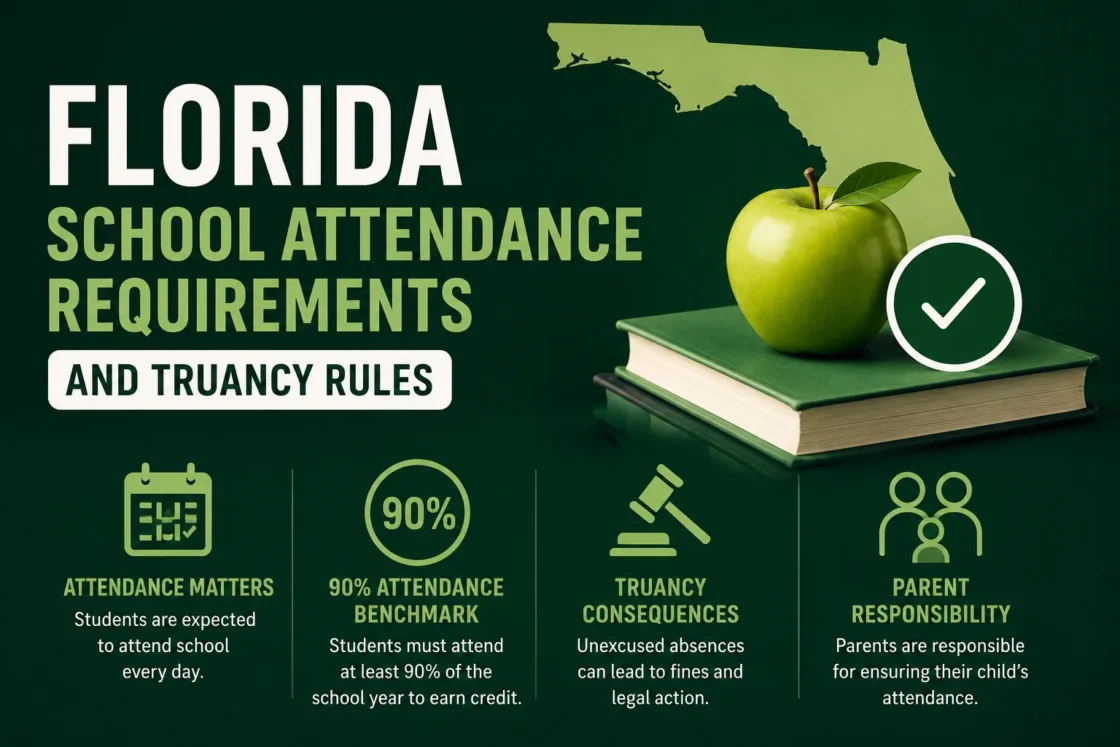
Under the 2026 Florida Statutes, compulsory school attendance generally applies to children who are age 6, will turn 6 by February 1 of the school year, or are older than 6 but have not reached age 16. Florida’s truancy process can begin before a student meets the legal definition of a habitual truant: 5 unexcused absences or absences with an unknown reason in a calendar month, or 10 within 90 calendar days, can trigger school intervention. A habitual truant is defined by 15 unexcused absences within 90 calendar days together with other statutory conditions.
5 in a monthEarly nonattendance trigger
10 in 90 daysEarly nonattendance trigger
15 in 90 daysHabitual-truant absence count
Who Must Attend School in Florida
Florida Statutes §1003.21 requires regular school attendance throughout the school term for children who have reached age 6, will reach age 6 by February 1 of that school year, or are older than 6 but younger than 16, unless a statutory exception applies.
Kindergarten eligibility starts earlier. A child who will be age 5 on or before September 1 may be admitted to public kindergarten, but that eligibility rule is different from the general compulsory-attendance age.
A student who reaches age 16 during the school year does not automatically leave compulsory attendance on the birthday. A student who has not graduated remains subject to the requirement until a formal declaration of intent to terminate enrollment is filed with the district school board. The declaration must be signed by both the student and the parent and must acknowledge the likely effect of leaving school on future earning potential. School personnel must also conduct an exit interview and explain available ways to continue the student’s education.
Florida law recognizes several ways to satisfy regular school attendance. These include attendance at a public school, qualifying private or religious school, home education program, instruction by a private tutor, or a personalized education program when the applicable legal requirements are met.
How Absences Are Classified and Tracked
Florida sets statewide attendance duties, but district school boards define many of the day-to-day rules for excused and unexcused absences. Under §1003.26, a parent must justify each absence, and the explanation is evaluated under the district’s adopted attendance policy.
Public schools must track excused and unexcused absences. For every unexcused absence, or an absence for which the reason is unknown, the principal or a designee must contact the parent to determine why the student was absent.
If an absence is excused under district policy, the school must give the student an opportunity to make up assigned work without an academic penalty, provided the work is completed within a reasonable period.
The statewide truancy thresholds do not create one statewide list of every acceptable excuse. Documentation requirements, treatment of tardiness, and many excused-versus-unexcused decisions are governed by the local district attendance policy, subject to requirements in Florida law.
Florida Truancy Thresholds and School Response
| Attendance event | State rule | Typical required response | Legal basis |
|---|---|---|---|
| Unexcused absence or reason unknown | Each occurrence | School contacts the parent to determine the reason. | §1003.26(1)(a) |
| Possible pattern of nonattendance | At least 5 unexcused or unknown-reason absences within a calendar month | Primary teacher reports the possible pattern to the principal or designee. Referral to the child study team generally follows unless clear evidence shows there is no pattern. | §1003.26(1)(b) |
| Possible pattern of nonattendance | 10 unexcused or unknown-reason absences within 90 calendar days | The same school review and possible child study team referral applies. | §1003.26(1)(b) |
| Habitual-truant absence count | 15 unexcused absences within 90 calendar days | The student may meet the habitual-truant definition if the other statutory conditions are also satisfied. | §1003.01(12) |
Florida’s definition of a habitual truant also requires the student to be subject to compulsory attendance, not qualify for an applicable exemption, and have gone through required intervention activities without successful remediation of the truancy problem.
The 90-day periods in these laws are measured in calendar days, not only instructional days. The early 5-absence and 10-absence thresholds are designed to identify a developing attendance pattern before the habitual-truant definition is reached.
What Happens After a Child Study Team Referral
If the child study team determines that a pattern of nonattendance is developing, a meeting with the parent must be scheduled to identify possible remedies. At this stage, the team may consider the attendance pattern whether the individual absences were classified as excused or unexcused.
If the parent or child does not attend the meeting, the team still holds it and prepares written recommendations based on the information available. Those recommendations must be provided to the parent within 7 days.
If the attendance problem continues, the statutory response can include:
- Repeated communication between the teacher and family.
- Efforts to identify the reasons for nonattendance and connect the family with available services.
- Evaluation for an alternative education program when appropriate.
- An attendance contract.
- Referral to voluntary family services or other agencies when appropriate.
- A recommendation that a truancy petition be filed.
The child study team is directed to continue reasonable intervention efforts before reporting an unresolved case to the district superintendent.
When a Truancy Petition Can Be Filed
A Florida truancy case does not necessarily have to wait until the student has accumulated 15 unexcused absences. Under §984.151, the superintendent or a designee may file a truancy petition seeking early truancy intervention when a student subject to compulsory attendance reaches the 5-in-a-calendar-month or 10-in-90-calendar-days threshold described in §1003.26. The statute also expressly covers a student with more than 15 unexcused absences during a 90-calendar-day period.
A truancy petition is filed in the circuit where the student is enrolled. Once it is filed, the court must hear the petition within 30 days, and both the student and the parent or guardian must attend.
If the court determines that the student missed any of the days alleged in the petition, the court enters an order finding the child to be a truant status offender. The court orders the student to attend school and the parent or guardian to ensure attendance.
The court may also order attendance-related services. Depending on the circumstances, these can include alternative classes, parenting classes, counseling, meetings with school officials, appropriate community services, or vocational and job training. If the student substantially complies with compulsory attendance, the court closes the truancy case.
A truancy finding is based on failure to meet school-attendance requirements. Florida law uses a separate intervention process for truancy rather than treating school nonattendance by itself as a delinquent act.
Parent Responsibilities and Possible Penalties
Florida Statutes §1003.24 makes the parent of a child subject to compulsory attendance responsible for the child’s school attendance. The attendance laws also require the school and district to follow the intervention procedures in §1003.26 before a criminal prosecution based on nonattendance can begin.
Under §1003.27, a parent who refuses or fails to have a minor student under the parent’s control attend school regularly, or refuses or fails to comply with the applicable habitual-truancy requirements, can commit a second-degree misdemeanor. The statute also provides an affirmative defense when the parent can show a bona fide and diligent effort to control the student and keep the student in school.
If a court finds a violation, it must order the parent to send the student to school. Depending on the case, it may also order parent training, counseling, community service, or attendance at school with the student when that does not create undue hardship and is permitted by school board rules or policy.
When a Child Is Not Enrolled
Florida has a separate enforcement sequence when a child who is subject to compulsory attendance is not enrolled. The superintendent must give written notice requiring the child’s enrollment or attendance within 3 days after the notice is received.
If enrollment or attendance does not occur, the case proceeds through the child study team process. If the parent still does not cooperate or enroll the child within 15 days after referral to the child study team, §1003.26 directs the superintendent to report the case to law enforcement and the State Attorney and to provide another written notice concerning prosecution.
Attendance and a Minor’s Driving Privileges
School attendance can also affect driving privileges for minors. Florida Statutes §§1003.27 and 322.091 connect certain reported attendance noncompliance with eligibility for a learner’s driver license or driver license.
This consequence is not simply an automatic license suspension on the fifteenth absence. The required school reporting and the separate requirements of §322.091 apply. When the Department of Highway Safety and Motor Vehicles receives a qualifying notice of noncompliance, it must notify the minor and the parent or guardian of the intent to suspend driving privileges.
The minor or parent generally has 15 calendar days after receiving the notice to provide proof of compliance or request a hardship waiver hearing. Florida law provides for a hardship waiver when a personal or family hardship requires the minor to have a license for employment or medical care.
What Can Vary by School District
Florida’s statutes establish the compulsory-attendance ages, statewide intervention triggers, habitual-truant definition, and routes for court involvement. Local school districts still control many practical attendance rules.
A district attendance policy can determine how common absence reasons are classified, what documentation is required, how tardiness or early departures are handled, and when additional documentation must be provided. Florida law also permits district policies to address accumulated unexcused tardies or early departures and allows earlier child study team intervention in some circumstances.
For that reason, reaching a statewide numerical threshold does not answer every question about an individual student’s attendance status. The student’s official attendance record, the district’s adopted attendance policy, and the applicable Florida statutes determine how a particular case is handled.