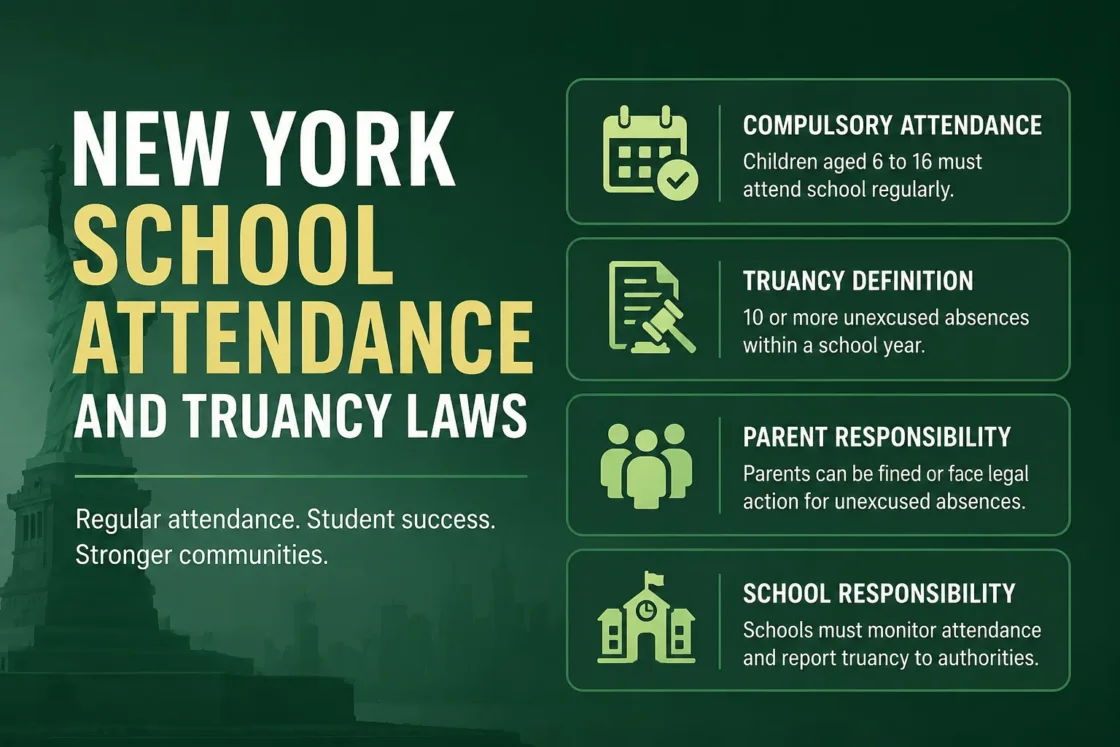
New York requires children of compulsory school age to receive full-time instruction and attend regularly. State law generally covers students from age 6 through the end of the school year in which they turn 16, while a local school district may extend compulsory attendance through the school year in which a student turns 17. New York does not use one statewide number of unexcused absences that automatically makes a student truant; district attendance policies and the circumstances of the absences affect how a case is handled.
| Rule | New York Requirement |
|---|---|
| General compulsory attendance | Age 6 through the end of the school year in which the student turns 16 |
| Local extension | A school district may require certain students to remain in full-time instruction through the school year in which they turn 17 |
| Regular attendance | Students subject to compulsory attendance must attend regularly while required schools or classes are in session |
| Excused vs. unexcused absence | Defined through the school’s or district’s attendance policy rather than one statewide list |
| Statewide truancy threshold | No single fixed number of unexcused absences applies statewide |
Compulsory School Attendance Ages in New York
New York Education Law § 3205 requires each minor from age 6 to 16 to attend full-time instruction. A child who turns 6 on or before December 1 generally becomes subject to compulsory attendance from the start of that school year. A child who turns 6 after December 1 generally begins compulsory attendance when school opens the following September.
The compulsory period does not necessarily end on a student’s 16th birthday. Unless a local extension applies, a student who turns 16 during the school year must remain in required instruction until the last day of that school year.
Section 3205 also allows a school district to require minors from age 16 to 17 who are not employed to continue full-time day instruction through the end of the school year in which they turn 17. Because districts can use this authority, the maximum compulsory attendance age is not identical everywhere in the state.
A student who reaches the applicable compulsory age during a school year generally remains subject to the attendance requirement through the end of that school year. Some districts extend the requirement to age 17.
What New York Law Requires After Enrollment
Education Law § 3210 requires a minor who is subject to compulsory education to attend regularly for the time the appropriate schools or classes are in session. State law also permits absence for religious observance under applicable rules.
A parent, guardian or other person legally responsible for the child also has an attendance duty. Under Education Law § 3212, a person in parental relation generally must cause a child who is subject to compulsory education to attend the required instruction.
Compulsory education does not require attendance at a public school in every case. Eligible children may receive instruction through another legally recognized arrangement, including a nonpublic school or home instruction that meets New York requirements.
What Counts as Truancy in New York?
New York law requires regular attendance, but it does not create a statewide rule such as “five unexcused absences equals truancy” for every school district. The state attendance regulation instead requires schools and local educational agencies to establish attendance rules covering absences, tardiness, early departures, parent notice and responses to attendance problems.
Under New York State Education Department attendance guidance, each local educational agency decides which absences, tardiness and early departures are excused and which are unexcused. Districts may set their own attendance triggers for parent conferences, attendance interventions or other responses.
Local attendance rule
The district or school determines whether the reason for an absence meets its adopted excuse rules.
Attendance-law issue
Repeated or unlawful absence may lead to attendance intervention or other proceedings, but there is no single statewide numeric trigger.
Excused and Unexcused Absences Are Defined Locally
Commissioner’s Regulation 8 NYCRR § 104.1 requires schools to maintain attendance records and classify absences, tardiness and early departures as excused or unexcused according to the attendance policy that applies to the student.
New York State does not give every district one mandatory list of acceptable excuses. NYSED guidance identifies categories that local agencies may consider when developing their rules, such as student illness, family circumstances, religious observance and legal obligations. The actual classification depends on the applicable school policy.
An excused absence is still an absence. The excuse affects how the absence is classified and may affect school consequences or course-credit calculations, but it does not change the attendance record to present.
How Schools Record and Respond to Absences
New York schools must maintain an attendance register showing student attendance, absence, tardiness and early departure. The required frequency depends partly on grade level and school organization. For example, period-by-period attendance generally applies to grades 9 through 12 and to departmentalized schools, subject to the rules in § 104.1.
The school’s attendance policy must also describe how parents will be notified when a student is absent, tardy or leaves early without an acceptable excuse. It must identify procedures for reviewing attendance records and starting appropriate responses when attendance problems appear.
- Schools record attendance under state recordkeeping rules.
- Absences and late or early departures are classified according to local policy.
- Local policies establish procedures for parent notification.
- Schools are expected to examine attendance patterns and use intervention strategies when problems develop.
What Can Happen When Unexcused Absences Continue?
The response to repeated absences is not controlled by one statewide absence count. A school may begin with family contact, attendance meetings, support services or other measures required by its local policy. Attendance personnel have duties under Education Law § 3213 related to children who are unlawfully absent from required instruction.
New York’s Family Court system also recognizes school nonattendance as one circumstance that may be involved in a Person in Need of Supervision, or PINS, case. According to the New York State Unified Court System, a person under age 18 who does not attend school may fall within the PINS process. These cases generally involve services and an effort to resolve the problem outside court before a petition proceeds.
Article 65 also contains statutory penalties for violations of compulsory education requirements. Education Law § 3233 provides a general maximum penalty for a first violation of up to a $10 fine or up to 10 days of imprisonment, with higher limits for subsequent violations. These penalties are not automatic consequences for a particular number of missed school days; enforcement requires the applicable legal process and depends on the facts of the case.
School notices, attendance interventions, PINS proceedings and penalties under the Education Law are separate steps. A student’s legal status cannot be determined from an absence count alone.
Can Absences Affect Course Credit?
New York permits a local educational agency to adopt a minimum attendance requirement for receiving course credit, but NYSED does not require every district to use one.
If a district chooses to establish a course-credit attendance standard, its policy determines how absences are treated. NYSED guidance allows a district, for example, to decide that an excused absence accompanied by completed make-up work will not count against the attendance requirement. A district may instead count both excused and unexcused absences when calculating eligibility for course credit.
The standard must be applied consistently to students who are similarly situated. Different requirements may be established for groups such as elementary, middle and high school students when the distinctions are reasonable and part of the adopted policy.
New York City Has Additional Attendance Rules
New York City extends compulsory attendance through the end of the school year in which a student turns 17. NYC Public Schools Chancellor’s Regulation A-210 also addresses kindergarten attendance for five-year-olds and permits the stated parental deferral option before first grade.
For students already in the NYC public-school system, an absence remains an absence even when it is excused. NYC Public Schools states that medical, religious and emergency reasons may support an excused classification, while the absence remains part of the official attendance record.
The age-17 rule is especially important when comparing New York City with districts that use the statewide age-16 maximum. Families outside New York City should check their own district’s attendance policy to determine whether the district has exercised its authority to extend compulsory attendance to 17.
Chronic Absenteeism and Truancy Measure Different Things
NYSED defines chronic absence as missing 10% of school days, typically about 18 days in a 180-day school year. The count can include both excused and unexcused absences. Truancy concerns unexcused or otherwise unlawful absence under state law and the attendance policy that applies at the school or district level.
The two measures use different criteria. A student may reach the chronic-absence threshold without being classified as truant, while a district may begin responding to recurring unexcused absences before the student has missed 10% of the school year.