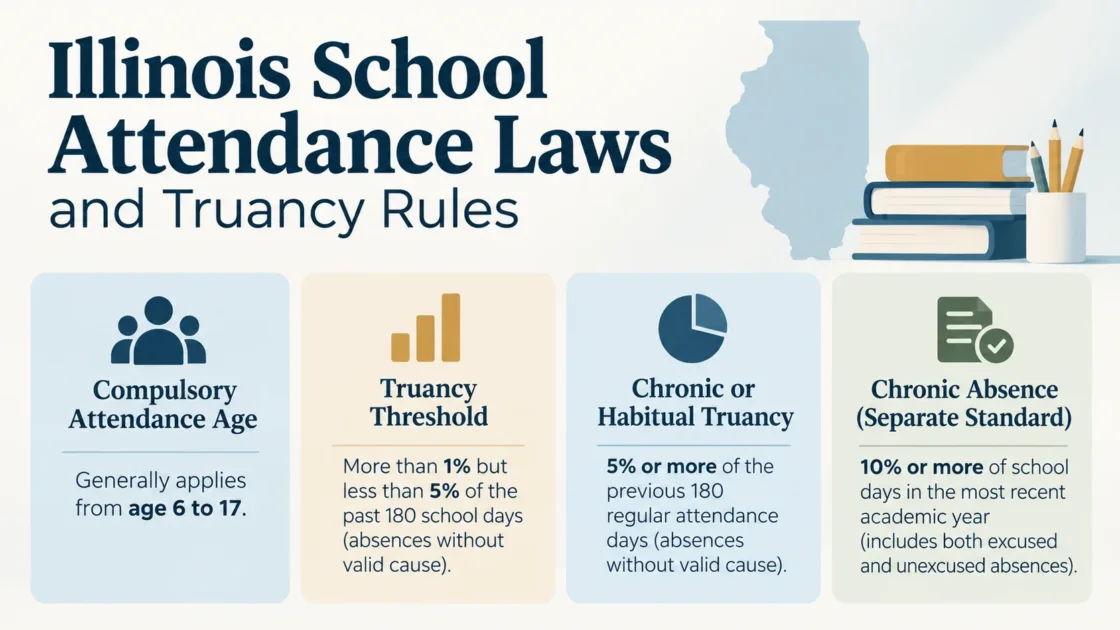
Illinois does not use a single statewide rule such as “10 unexcused days are allowed.” The School Code uses percentages. A child subject to compulsory attendance is a truant when absences without valid cause are more than 1% but less than 5% of the past 180 school days, and a chronic or habitual truant at 5% or more of the previous 180 regular attendance days. In a full 180-day window made up only of whole-day absences, those thresholds correspond to 2–8 unexcused days for the truant range and 9 or more for chronic or habitual truancy. The statute itself uses percentages, so those day counts are illustrations rather than a separate statewide allowance.
Illinois also measures chronic absence, but that is not the same as truancy. Under 105 ILCS 5/26-18, chronic absence reaches 10% or more of school days in the most recent academic school year and includes absences with valid cause, absences without valid cause, and out-of-school suspensions.
Illinois Compulsory Attendance Starts at Age 6
Under 105 ILCS 5/26-1, compulsory attendance generally applies to a child who is age 6 on or before September 1 and continues until the child turns 17, unless the child has already graduated from high school or another statutory exception applies. The Illinois State Board of Education describes the compulsory school-age range as 6–17 and states that a child is no longer of compulsory attendance age upon turning 17.
Enrollment Can Create an Attendance Duty Outside the General Age Range
The age rule does not answer every attendance case. Section 26-2 separately provides that a child younger than 6, or age 17 or older, who is enrolled in kindergarten through grade 12 in an Illinois public school must attend while school is in session unless excused under Section 26-1. A family therefore should not assume that a voluntarily enrolled child may simply stop attending because the child falls outside the general compulsory-age range.
Section 26-1 Includes Specific Attendance Exceptions
Illinois law identifies several situations in which a child is not required to attend the public school in the ordinary way or is entitled to a defined excused absence. The conditions differ by category.
| Situation | Illinois rule |
|---|---|
| Private or parochial education | The child may satisfy the public-school attendance requirement through a qualifying private or parochial school that teaches corresponding branches of education in English. |
| Physical or mental inability to attend | The statute provides an exception when the inability is certified by an authorized professional in the manner required by Section 26-1. |
| Temporary absence for cause | A principal or teacher may excuse a temporary absence for cause. The section expressly includes up to five mental or behavioral health days without a medical note. |
| Necessary and lawful employment | Attendance may be excused when the employment and school approval conditions in Section 26-1 and the Child Labor Law of 2024 are met. |
| Confirmation classes | A child over age 12 and under age 14 may be excused while attending confirmation classes. |
| Religious reasons | A student may be absent for religious observance, religious instruction, or other covered religious reasons. A school board may require advance notice of no more than five days. |
| Qualifying students age 16 or older who are employed | The section contains an exception when necessary and lawful employment is documented and the student is enrolled in a graduation incentives program or an alternative learning opportunities program. |
| Sounding Taps at an Illinois military honors funeral | A student in grades 6–12 may receive an excused absence subject to the notice and other conditions stated in the law. |
| Parent or guardian military deployment | An eligible student receives five excused days per school year, with additional excused days possible at the school board’s discretion for qualifying deployment-related visits. |
| Civic event | A public middle- or high-school student is permitted one school-day excused absence per school year for a qualifying civic event, subject to State Board guidelines and possible local notice or documentation requirements. |
Illinois Truancy Uses a Percentage of 180 School Days
The legal categories in 105 ILCS 5/26-2a should be kept separate. Truancy is based on absence without valid cause. Chronic absence under Section 26-18 uses a different measure and includes both excused and unexcused absences.
| Term | What is counted | Threshold or condition | 180-day whole-day illustration |
|---|---|---|---|
| Truant | Absence without valid cause | More than 1% but less than 5% of the past 180 school days | 2–8 full unexcused days |
| Chronic or habitual truant | Absence without valid cause | 5% or more of the previous 180 regular attendance days | 9 or more full unexcused days |
| Truant minor | Chronic truancy plus the statutory service history | Supportive services and other resources were provided but did not stop chronic truancy, or were offered and refused | No separate day-count threshold |
| Chronic absence | Absences with and without valid cause, plus out-of-school suspensions | 10% or more of school days in the most recent academic school year | 18 days in a 180-day school year |
Illinois statutes define truancy with percentages, not a fixed number of “allowed” unexcused days. The 2–8, 9, and 18-day examples assume a 180-day denominator and whole-day absences. A student’s official attendance record and the applicable school or district attendance rules control how actual attendance is recorded.
Excused Absences Can Still Count Toward Chronic Absence
An absence can be properly excused and still contribute to the chronic-absence measure. Section 26-18 includes absences with valid cause, absences without valid cause, and out-of-school suspensions. The section excludes a student for whom a documented homebound or hospital record is on file during the student’s absence.
A student can reach the chronic-absence threshold without being chronically truant. For example, 18 qualifying excused absence days in a 180-day school year equal 10%, but excused days do not become unexcused truancy simply because the total reaches 10%.
What Illinois Treats as a Valid Cause for Absence
Section 26-2a defines the causes that keep an absence from being treated as truancy when the requirements for that cause are met. Local districts may also recognize situations beyond the student’s control and other circumstances that cause reasonable parental concern for the student’s mental, emotional, or physical health or safety.
General Valid Causes Listed in Section 26-2a
- Illness, including the student’s mental or behavioral health.
- Attendance at a verified medical or therapeutic appointment.
- An appointment with a victim services provider.
- Observance of a religious holiday.
- Death in the immediate family.
- Attendance at a civic event.
- A family emergency.
- Other situations beyond the student’s control as determined by the local board of education.
- Other circumstances that cause reasonable concern to the parent for the student’s mental, emotional, or physical health or safety.
For this section, a civic event is an event sponsored by a nonprofit organization or governmental entity and open to the public. The statutory definition includes examples such as an artistic or cultural performance or an educational gathering that supports the sponsoring nonprofit’s mission.
Parenting Responsibilities and Domestic or Sexual Violence
For a student who is an expectant parent, a parent, or a victim of domestic or sexual violence, the valid-cause definition is broader. The version of Section 26-2a that took effect July 1, 2025 includes parenting responsibilities such as arranging or providing child care, caring for a sick child, attending prenatal or other medical appointments for the expectant student, and taking a child to medical appointments.
It also covers absences needed to address circumstances resulting from domestic or sexual violence. The statutory examples include:
- Experiencing domestic or sexual violence.
- Recovering from physical or psychological injuries.
- Seeking medical attention.
- Seeking services from a domestic or sexual violence organization.
- Obtaining psychological or other counseling.
- Participating in safety planning.
- Temporarily or permanently relocating.
- Seeking legal assistance or remedies.
- Taking another action to improve the student’s safety or health or to protect the student from future domestic or sexual violence.
A school district may require verification under Section 26A-45 before approving a valid cause for an absence of three or more consecutive days that is related to domestic or sexual violence.
Five Mental or Behavioral Health Days Do Not Require a Medical Note
Section 26-1 provides up to five mental or behavioral health days for which a student does not have to provide a medical note. The student must have an opportunity to make up schoolwork missed during those absences. After the second mental health day used, the student may be referred to appropriate school support personnel.
These days are not unexcused truancy when properly taken as an absence for cause. They can still be part of the separate chronic-absence calculation because Section 26-18 counts absences with valid cause.
Schools Must Diagnose Attendance Problems and Offer Support
Illinois law does not treat attendance enforcement as a day-count exercise alone. Under 105 ILCS 5/22-92, each school district, charter school, alternative school, and other school receiving public funds must develop an absenteeism and truancy policy and communicate it annually to students and parents or guardians.
The Policy Must Include Diagnostic Procedures and Services
The required diagnostic process must, at minimum, include interviews with the student, the parent or guardian, and school officials who may know why the attendance problem is occurring. The policy must also identify supportive services for truant and chronically truant students. The statute specifically names parent conferences, student counseling, family counseling, and information about relevant community services.
The same policy must include the state’s chronic-absence provisions. It must be updated every two years and filed with the Illinois State Board of Education and the regional superintendent of schools.
The Attendance Policy Must Be Available to Families
Title 23, Part 207 of the Illinois Administrative Code requires a school or district subject to the rule to post its absenteeism and truancy policy on its website, if it has one, and incorporate the policy into the student handbook. Part 207 also carries out the two-year update and filing requirement.
K–8 Unauthorized Absences Trigger a Two-Hour Contact Rule
Section 26-3b contains a separate notification rule for public-school students in kindergarten through grade 8. If a child is absent, the school has no record of a valid cause, and the school has not been notified that the absence was authorized by the parent, guardian, or legal custodian, a designated school employee or agent must make a reasonable effort to telephone the responsible adult within two hours after the first class in which the child is enrolled.
At enrollment, the district must require at least one and no more than two telephone numbers for this purpose. The section treats the school’s requirement as met when notification has been attempted at the provided number or numbers, even if no one answers.
Formal Truancy Enforcement Uses Notice and a Hearing
The statewide process outside an Article 34 school district has several legal conditions. A first unexcused absence is not the same thing as an immediate court case.
Section 26-7 Specifies What the Formal Notice Must Say
When a person fails to send a child under that person’s custody or control to a lawful school, Section 26-7 directs the truant officer or, where there is no district truant officer, the regional superintendent or designee to give notice in person or by mail as soon as practicable after being notified of the problem. The notice states the date attendance must begin and that attendance must be continuous and consecutive in the district for the remainder of the school year.
Three Unresolved Notices Can Lead to a Truancy Hearing
Section 26-8 applies outside a school district organized under Article 34. A hearing under this section follows only when three notices have been given and not complied with and the person or people with custody or control have knowingly and willfully permitted the truant behavior to continue.
If the regional superintendent finds the child truant at the hearing, the student may be required, when age-appropriate at the superintendent’s discretion, to complete 20 to 40 hours of community service over 90 days. If truancy persists, the statute allows either a complaint against the person with custody or control to the state’s attorney or circuit court, or truancy mediation combined with encouragement to enroll in a graduation incentives program. If the child is beyond the control of the parent, guardian, or custodian and truancy continues after the required notice, Section 26-8 provides for a truancy petition under the Juvenile Court Act of 1987.
Current Law Limits Punitive Action for Truancy
Section 26-12 places support requirements ahead of several punitive responses. It states that punitive action against a truant minor for truancy, including out-of-school suspension, expulsion, or court action, may not be taken unless appropriate and available supportive services and other school resources have been provided to the student.
A Student Cannot Be Referred for a Truancy Fine or Fee
School personnel may not refer a truant, chronic truant, or truant minor to a local public entity, school resource officer, or peace officer for the purpose of having the child receive a fine or fee as punishment for truancy. This restriction concerns a fine or fee imposed on the child for truancy; it does not erase the separate statutory provisions that can apply to an adult with custody or control.
Parent or Custodian Fine Referrals Have Preconditions
A district may refer a person who has custody or control of a truant, chronic truant, or truant minor to a local public entity for a fine or fee only after the district’s truant officer, regional office of education, or intermediate service center has been notified of the truant behavior and appropriate and available supportive services and school resources have been offered to the child.
Current Section 26-12 also requires additional steps before a municipal referral for certain students:
- Homeless student: a meeting involving the student, the person with custody or control, relevant school personnel, and a homeless liaison must address attendance barriers related to the student’s transitional living situation and create a plan to remove those barriers.
- Student with a documented disability: a meeting must review the student’s current needs and the appropriateness of placement and services. For an Article 14 student, this must be an IEP meeting with relevant IEP team members. For a student covered by Section 504, it must be a Section 504 plan review with relevant team members.
- Student being evaluated for a disability, or where the school has the statutory basis of knowledge: the evaluation and eligibility determination must be completed as required by the section.
The district must document the appropriate and available supportive services offered. If a required meeting does not occur, the district must document reasonable efforts to convene it at a mutually convenient time and date and that the conduct of the person with custody or control prevented the meeting.
The 15-Day Rule Now Uses Administrative Withdrawal
Effective July 31, 2026, Public Act 104-743 amended Section 26-12 so the 15-consecutive-day nonattendance provision refers to administrative withdrawal, not expulsion. Older material that describes this provision as a 15-day expulsion rule no longer reflects the current wording.
A truant minor may not be administratively withdrawn for nonattendance unless the student has accumulated 15 consecutive days of absences without valid cause and either the district cannot locate the student, or the district has located the student but cannot compel the student to return after exhausting all available supportive services.
Before an administrative withdrawal under this provision, the district must make at least three documented attempts to notify the parent or guardian of its intent to withdraw the student.
A Separate Class C Misdemeanor Provision Applies to Knowing and Willful Noncompliance
Section 26-10 addresses a person who has custody or control of a child, has received notice of the child’s truancy, and knowingly and willfully permits the child to persist in truancy during that school year. Upon conviction, the offense is a Class C misdemeanor and carries up to 30 days of imprisonment, a fine of up to $500, or both.
The penalty is not triggered automatically by reaching the 5% chronic-truancy threshold. The notice, knowing-and-willful conduct, and conviction requirements in Section 26-10 are separate from the percentage used to classify the student’s attendance.
Chicago Uses an Additional Article 34 Chronic-Truancy Process
Section 26-8 expressly excludes a school district organized under Article 34. Illinois School Code Section 34-4.5 contains the Article 34 chronic-truancy process used for Chicago Public Schools.
The chief executive officer or designee must use a socio-emotional-focused attendance approach aimed at the underlying causes of chronic truancy, and the board may establish an individualized student attendance plan for a chronic truant.
Before truancy intervention services are implemented, the principal or designee must notify the parent or guardian by personal visit, letter, or telephone of each unexcused absence. After notice of the student’s tenth unexcused absence, the parent or guardian must receive a letter by certified mail, return receipt requested, notifying them of truancy intervention services.
Those services may require the student, the parent or guardian, or both to complete a parenting education program, obtain counseling or other supportive services, or comply with an individualized educational or service plan. A parent or guardian who shows that reasonable steps were taken to ensure the student’s attendance is not required to perform those services.
The Attendance Record Controls How the Rules Apply to an Individual Student
A raw count of missed days is not enough to determine a student’s official truancy status. The legal result depends on how the absences were recorded, whether a valid cause was accepted, which statutory category applies, what notices were issued, and what supportive services were offered or provided.
- Confirm the exact dates recorded as unexcused absences.
- Check which absences were accepted as having a valid cause and whether any required verification was completed.
- Check the percentage calculation used for the past or previous 180 school-day truancy measure.
- Distinguish among truant, chronic or habitual truant, truant minor, and chronic absence; the terms do not use the same criteria.
- Review the school’s absenteeism and truancy policy and the attendance codes shown in the student’s record.
- Confirm which diagnostic interviews, conferences, counseling, or other supportive services were offered or provided.
- Match any formal notice to the requirements of Section 26-7 and, where applicable, Section 26-8.
- If administrative withdrawal is being considered, check the 15-consecutive-day condition, the support history, and the three documented notification attempts required by current Section 26-12.
- If homelessness, an IEP, Section 504, or a pending disability evaluation is involved in a proposed municipal fine referral, check the additional steps required by Section 26-12.
- For a Chicago Public Schools student, account for the separate Article 34 process rather than applying the Section 26-8 hearing sequence as though it were statewide without exception.
Schools and districts make attendance entries and apply local procedures within the state rules. An individual student’s official status therefore should be determined from the actual attendance record and the current school, district, regional, and state requirements that apply to that student.