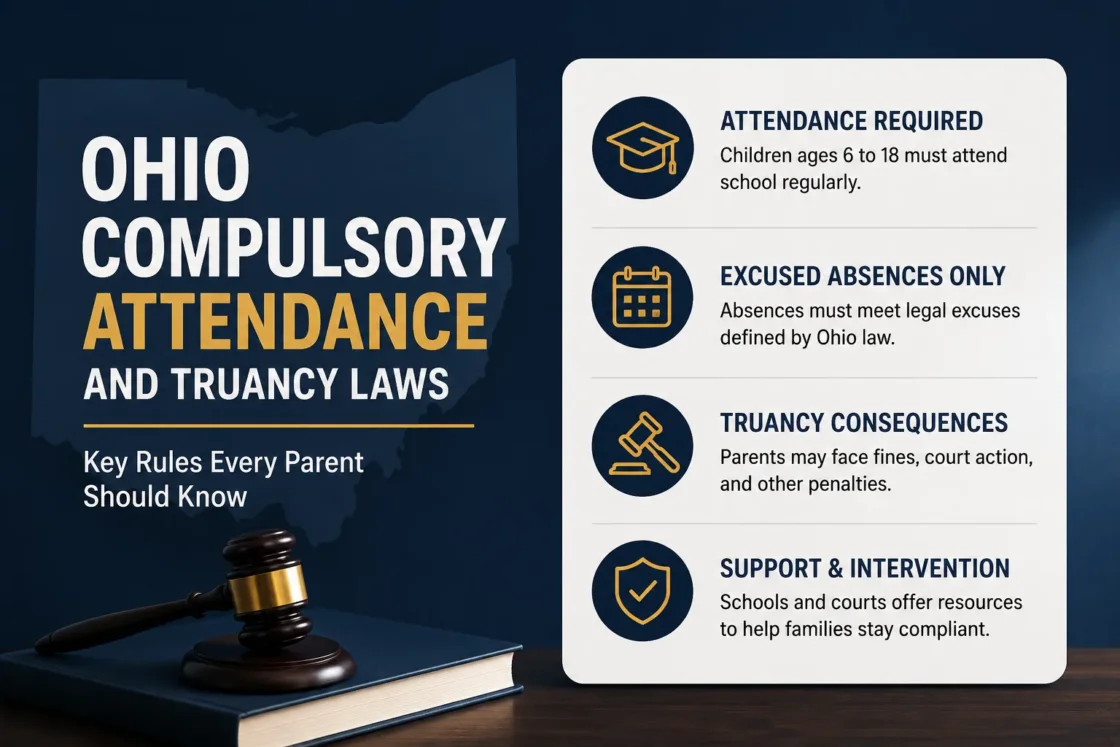
Ohio generally treats a child as being of compulsory school age from age six until age eighteen. During that period, a parent or guardian must ensure the child attends an eligible school, participates in an approved special education program, receives lawful home education, or qualifies for another statutory exception. Ohio measures truancy in hours of unexcused absence, not simply in days missed.
30 / 42 / 72 hoursHabitual truancy thresholds
10%Chronic absence threshold
Compulsory School Age in Ohio
Under Ohio Revised Code Section 3321.01, a child between six and eighteen years of age is considered to be of compulsory school age. The compulsory period begins at the start of the applicable school term or another time established under the district’s rules.
A child younger than six who has already been enrolled in kindergarten is also treated as being of compulsory school age. A parent or guardian may formally withdraw that child from kindergarten after consulting with the child’s teacher and principal.
Ohio law requires a parent of a child of compulsory school age to cause the child to attend school, participate in an eligible special education program, or otherwise receive instruction in accordance with law. The attendance obligation can end before age eighteen in circumstances recognized by Section 3321.03, including completion of high school or another applicable statutory exception.
A child who is subject to compulsory attendance generally must attend for the full time the school or qualifying program is in session. Ohio law provides that the applicable school or program term cannot be fewer than 32 weeks per school year.
When a Student Is Habitually Truant
Ohio defines habitual truancy by the amount of time a compulsory-school-age student is absent without a legitimate excuse. Meeting any one of the three thresholds can satisfy the state’s habitual truancy definition.
| Measurement Period | Unexcused Absence Threshold |
|---|---|
| Consecutive absence | 30 or more consecutive hours |
| One school month | 42 or more hours |
| One school year | 72 or more hours |
These hour-based thresholds appear in Ohio’s habitual truancy definition and in Ohio Revised Code Section 3321.16. The Ohio Department of Education and Workforce describes them as roughly five consecutive school days, seven school days in a month, or twelve school days in a year, although the legal thresholds themselves are stated in hours.
Truancy and Chronic Absence Are Different Measures
Habitual truancy is based on unexcused absence. Chronic absence uses a different calculation. Since September 30, 2025, Ohio law defines a chronically absent student as one who misses at least 10% of the minimum number of school-year hours applicable to the student’s school.
Unexcused hours only
Triggered by the 30-, 42-, or 72-hour thresholds.
All missed hours
Excused and unexcused absences can both count toward the 10% threshold.
An illness or another approved absence therefore may count toward chronic absence even though it does not count toward the habitual truancy thresholds. Ohio’s current distinction is set out in Section 3321.191.
What Happens After a Truancy Threshold Is Reached
Ohio changed parts of its attendance process effective September 30, 2025. When a student is habitually truant, attendance staff should provide written notice to the student and family concerning the legal consequences of truancy.
Under the current version of Section 3321.16, an attendance officer must file a juvenile-court complaint when one of the habitual truancy thresholds has been reached unless the student’s school or district determines that the student and family are making satisfactory progress in improving attendance.
If the school makes that progress determination, a complaint is not filed at that point. If satisfactory progress later stops, the attendance officer must file the complaint.
An absence intervention team is no longer specifically required as the response to a student becoming habitually truant. Under the current law, these teams are part of local policies for working with students who are at risk of becoming chronically absent and their families.
District Attendance Policies Required for 2026–27
Ohio school districts were required to adopt a student absence policy no later than August 1, 2026. The policy must address prevention, family notification and progressively stronger attendance supports.
Under Section 3321.191, the policy must:
- identify strategies for preventing chronic absence;
- establish procedures for notifying parents or guardians about attendance concerns;
- set the notification point no later than when the student has missed 5% of the minimum school-year hours applicable to that school;
- provide tiered interventions and resources for students with greater numbers of absences;
- provide one or more absence intervention teams for students at risk of chronic absence and their families; and
- prohibit keeping a student out of school through suspension, expulsion or similar action based on the student’s absences.
The separate prohibition on suspending, expelling or removing a student solely because of unexcused absences is also stated in Ohio Revised Code Section 3313.668.
Reasons an Absence May Be Excused
Whether an absence is excused can directly affect the habitual truancy calculation. Ohio Administrative Code Rule 3301-69-02 identifies circumstances that may support an approved absence, while local school policies may provide additional details and documentation requirements.
Recognized circumstances include:
- illness of the student;
- illness in the family when the student’s presence is necessary;
- quarantine in the home;
- death of a relative;
- medical, behavioral health or dental appointments;
- religious observance covered by Ohio law;
- certain post-secondary visits;
- certain military-related absences;
- foster-care placement changes or related court proceedings;
- homelessness;
- an emergency or another circumstance accepted as good and sufficient cause; and
- additional reasons permitted by the local board’s attendance policy.
Schools may request supporting documentation when allowed by the rule or local policy. An excused absence generally does not count toward habitual truancy, but the missed instructional time can still count toward chronic absence.
Same-Day Contact for an Unexcused Absence
Ohio has a separate same-day notification rule. When a student is absent without a legitimate excuse at the beginning of the school day, the designated attendance official generally must make at least one attempt to contact the parent, guardian or other person caring for the student within 120 minutes after the school day begins.
The school may use a phone call, automated call, student information system notification, text message, email, home visit or another locally approved procedure. The requirement does not apply when the parent or guardian has already notified the school within that 120-minute period. These requirements are set out in Section 3321.141.
Parent Responsibilities and Possible Penalties
Ohio law places an attendance duty on the parent, guardian or other person responsible for a child of compulsory school age. An attendance officer may investigate suspected truancy and, when required, direct the responsible adult to cause the child to attend school.
Ohio Revised Code Section 3321.38 prohibits a parent, guardian or other responsible person from violating specified compulsory-attendance requirements. If a person violates the applicable provision, Section 3321.99 permits a fine of up to $500 or an order of up to 70 hours of community service.
A juvenile-court case involving habitual truancy can also include requirements directed at the student or parent. The actual outcome depends on the student’s attendance record, the reason for the absences, the school’s determination of satisfactory progress and the orders entered by the juvenile court.
Home Education and Compulsory Attendance
Ohio provides a statutory home-education exemption from the ordinary school-attendance requirement. Under Section 3321.042, home education is education directed by a parent for a child between six and eighteen years old and must cover English language arts, mathematics, science, history, government and social studies.
A parent or guardian generally must notify the superintendent of the child’s district of residence within five calendar days after beginning home education, moving into a new district or withdrawing the child from a public or nonpublic school. A new notice is then required by August 30 each year while home education continues.
State law sets the main attendance and truancy rules, but districts maintain the attendance records and local policies used to classify particular absences. A student’s official attendance status should be determined from the school or district record and the current Ohio rules that apply to that student.