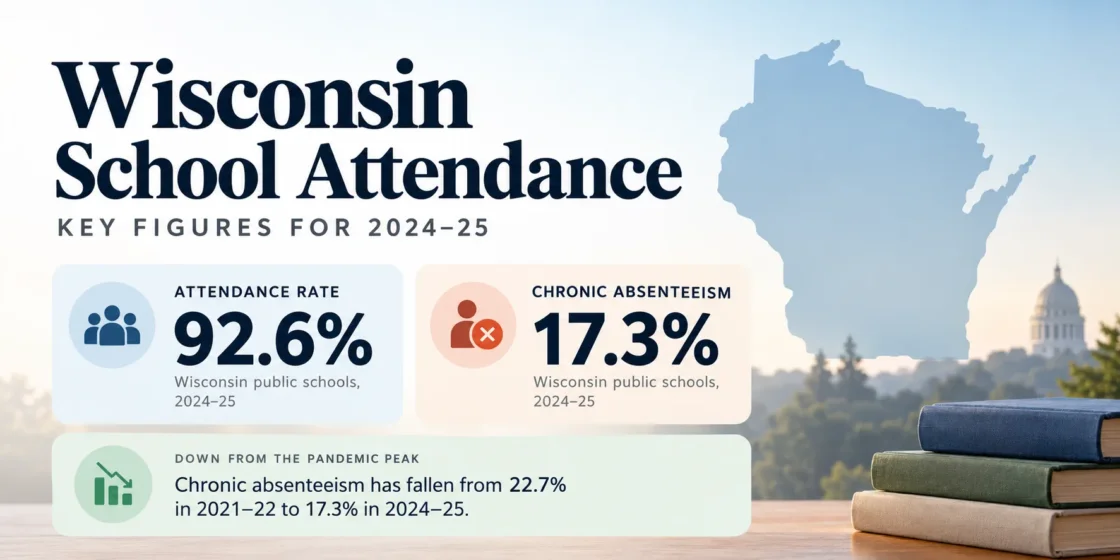
Wisconsin’s latest certified statewide attendance and chronic absenteeism data cover the 2024–25 school year. The public-school attendance rate reached 92.6%, while 17.3% of students were chronically absent. The Wisconsin Department of Public Instruction (DPI) released these figures on March 5, 2026, through its WISEdash Public Portal.1
DPI also released its 2025–26 school and district accountability report cards on November 17, 2026. Those report cards contain attendance and absenteeism measures from earlier school years. Their publication does not make the 2024–25 certified WISEdash figures obsolete or establish a new statewide single-year rate for 2025–26.2
Wisconsin’s Latest Statewide Attendance Rates
92.6%
Wisconsin public schools, 2024–25
17.3%
Wisconsin public schools, 2024–25
Both measures improved from 2023–24. The prior statewide attendance rate was 92.4%, while chronic absenteeism was 17.7%. That equals a 0.2 percentage-point increase in attendance and a 0.4 percentage-point decline in chronic absenteeism in one year.1
| School Year | Attendance Rate | Chronic Absenteeism Rate |
|---|---|---|
| 2023–24 | 92.4% | 17.7% |
| 2024–25 | 92.6% | 17.3% |
The statewide percentages describe two different measures. Attendance rate measures attended school days across the reporting population. Chronic absenteeism measures the share of students who cross Wisconsin’s absence threshold. A 92.6% attendance rate therefore does not mean that 7.4% of students were chronically absent.
Chronic Absenteeism Has Declined Since the 2021–22 Peak
Wisconsin’s chronic absenteeism rate rose sharply during the pandemic period and peaked at 22.7% in 2021–22. It then fell in each of the next three reported school years, reaching 17.3% in 2024–25. The latest certified rate is 5.4 percentage points below the 2021–22 peak, although it remains above earlier levels.
Statewide public-school rates, 2020–21 through 2024–25
The series uses Wisconsin DPI attendance data. Earlier years are documented in state and Wisconsin Policy Forum reporting, while the 2024–25 figure comes from DPI’s March 2026 certified release.31
| School Year | Chronic Absenteeism Rate | Change From Prior Year |
|---|---|---|
| 2020–21 | 16.1% | — |
| 2021–22 | 22.7% | +6.6 pp |
| 2022–23 | 19.5% | −3.2 pp |
| 2023–24 | 17.7% | −1.8 pp |
| 2024–25 | 17.3% | −0.4 pp |
Attendance reporting during 2020–21 was affected by differences in virtual, hybrid, and in-person attendance practices. Wisconsin Policy Forum analysis notes that reporting variation may have affected comparisons with other years.3 The subsequent decline from 2021–22 through 2024–25 is visible in the reported annual series without relying on the disrupted 2020–21 year as the comparison baseline.
How Wisconsin Measures Chronic Absence
Wisconsin’s chronic absenteeism measure focuses on how much school time an individual student misses. DPI’s accountability report cards describe chronically absent students as those who miss more than 10% of possible school days. Both excused and unexcused absences are included, rather than limiting the measure to truancy.4
Days attended
Total attended days divided by total possible attendance days for the reporting population.
Student-level threshold
Measures the share of eligible students whose recorded absences cross the chronic-absence threshold.
DPI accountability calculations include students enrolled in the accountable school for at least 90 total days. Enrollment does not have to be continuous to meet that requirement. The student’s attendance rate is determined from attended days and possible attendance days, while the chronic absenteeism rate measures the share of eligible students meeting the absence definition.5
Wisconsin DPI released the 2025–26 school and district accountability report cards on November 17, 2026. The reports include chronic absenteeism within the On-Track to Graduation priority area. Their absenteeism component score is calculated as 100 minus a weighted average of multiple years of chronic absenteeism rates, using up to three years of data.4
The 2025–26 report cards display single-year absenteeism data for 2022–23, 2023–24, and 2024–25. Their statewide K–12 reference row reports 17.5% for 2024–25, compared with the 17.3% statewide figure in DPI’s March 2026 certified WISEdash release.41 These separately published values should retain their source labels and reporting populations. The difference should not be treated as a new 2025–26 absenteeism result or attributed to a particular calculation rule without matching methodology documentation.
The report card’s multi-year absenteeism score is also not a single-year chronic absenteeism percentage. The 2025–26 report card title identifies the accountability release year, while its attendance measures refer to earlier school years. Wisconsin’s certified WISEdash series remains the basis for the statewide annual trend shown here.
Chronic Absence Varies by Economic Status
The statewide rate does not describe every student group equally. A Wisconsin Office of Children’s Mental Health fact sheet using WISEdash data reported 134,597 chronically absent students in 2023–24. In that school year, chronic absenteeism was 29.5% among economically disadvantaged students and 8.8% among students not classified as economically disadvantaged.6
| Student Group | Chronic Absenteeism Rate |
|---|---|
| Economically disadvantaged | 29.5% |
| Not economically disadvantaged | 8.8% |
The difference between those two groups was 20.7 percentage points. These are 2023–24 figures and should not be presented as a 2024–25 or 2025–26 subgroup comparison.
WISEdash data can also be filtered by grade level, race and ethnicity, economic status, disability status, English proficiency, gender, and migrant status.1 The 2025–26 accountability report cards provide additional student-group attendance information, but their displayed school-year labels and reporting scope must be retained when making comparisons.
Chronic Absence Is Not the Same as Truancy
Chronic absenteeism and truancy can overlap, but Wisconsin does not use the terms for the same purpose. Chronic absenteeism is an attendance-data measure that can include absences with an acceptable excuse. Truancy is based on absence without an acceptable excuse under state attendance law and local attendance procedures.
Excused and unexcused absences
Measures students who miss a defined share of possible school time.
Unexcused absence
A legal and administrative attendance category governed by Wisconsin law and district procedures.
Under Wisconsin’s attendance rules, truancy generally means an absence for part or all of one or more school days when the absence does not have an acceptable legal excuse. A habitual truant is a pupil absent without an acceptable excuse for part or all of five or more school days during a semester. Wisconsin DPI explains these requirements in its compulsory school attendance guidance.7
Local policy still matters. A district may define what counts as part of a school day and applies its attendance procedures within state law. A student can therefore meet the chronic absenteeism definition without meeting the habitual-truancy definition, especially when many absences are excused.
Wisconsin Compulsory Attendance Requirements
Wisconsin generally requires children between ages 6 and 18 to attend school regularly unless a statutory exception applies or the student has already graduated. Attendance is required through the end of the school term, quarter, or semester in which the student turns 18. A child enrolled in five-year-old kindergarten is also subject to the attendance requirement while enrolled.8
| Rule | Wisconsin Standard |
|---|---|
| General compulsory-attendance ages | Ages 6 through 18, subject to statutory exceptions and graduation |
| Truancy | Absence for part or all of one or more days without an acceptable excuse or legal cause |
| Habitual truancy | Unexcused absence for part or all of five or more school days during a semester |
| Parent-authorized absence under Wis. Stat. § 118.15(3)(c) | Up to 10 school days per year when the written excuse is provided before the absence |
State definitions establish the general rules, but a student’s attendance classification depends on recorded absences, applicable exceptions, acceptable excuses, and district procedures. The school or district record is the controlling source for an individual student’s attendance or truancy status. Statewide chronic absenteeism rates and accountability scores cannot determine an individual student’s legal attendance status.