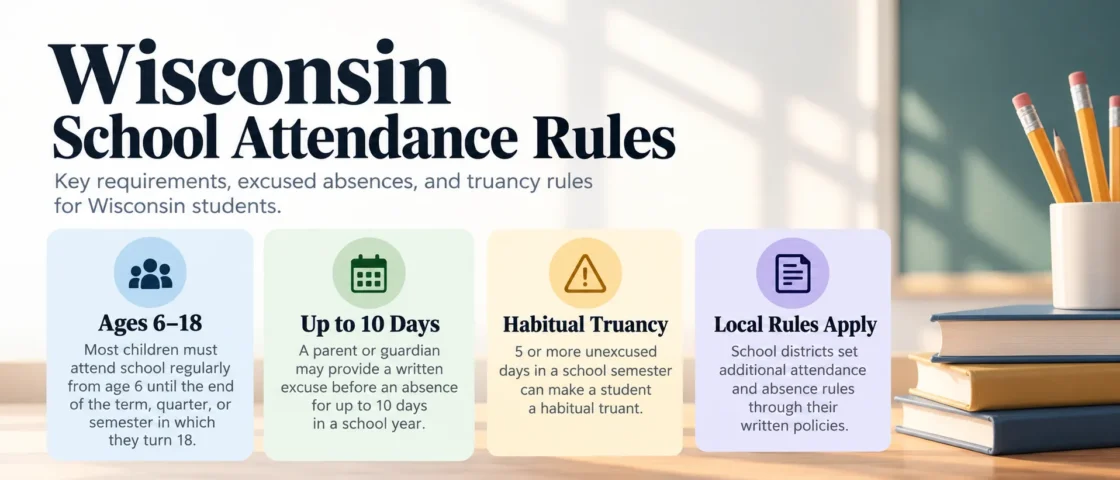
Most Wisconsin children must attend school regularly from age 6 through the end of the school term, quarter, or semester in which they turn 18, unless they graduate earlier or qualify for an exception in state law. A child who is enrolled in 5-year-old kindergarten is also subject to regular attendance requirements. Wisconsin law separately allows a parent or guardian to excuse a child in writing before an absence for up to 10 days in a school year, while school districts set additional attendance and absence rules through their written policies.
Who Must Attend School in Wisconsin
Wis. Stat. § 118.15 sets the main compulsory-attendance rule. A person having control of a child between ages 6 and 18 generally must cause the child to attend the public, private, or tribal school in which the child should be enrolled for the full period and hours that school is in session. Religious holidays are excepted.
| Situation | State Rule |
|---|---|
| Children ages 6–18 | Regular school attendance is generally required unless the child has graduated or qualifies for an exception allowed by law. |
| 5-year-old kindergarten | A child enrolled in 5-year-old kindergarten must attend regularly for the full period and hours that kindergarten is in session, subject to statutory exceptions. |
| Religious holidays | The compulsory-attendance provisions expressly except religious holidays. |
| Student turns 18 | The attendance obligation generally continues through the end of the school term, quarter, or semester in which the student turns 18. It does not automatically end on the student’s 18th birthday. |
| Home-based private education | A qualifying home-based private educational program meeting the requirements of Wis. Stat. § 118.165 may substitute for attendance at a public or private school. |
When an Absence May Be Excused
Wisconsin does not use one statewide list for every ordinary excused absence. Each public school board must maintain a written attendance policy stating the reasons for which students may be permitted to be absent. State law also creates several specific absence provisions that districts must apply.
| Type of Absence | Requirement | Limit or Condition |
|---|---|---|
| Parent or guardian pre-excuse | The parent or guardian provides a written excuse before the absence. | Up to 10 days in a school year. The student must complete missed coursework. |
| Temporary physical or mental condition | The school board may excuse a child who is temporarily not in proper physical or mental condition to attend and is expected to return when the condition improves. | The attendance officer may request written proof from a health professional named in the statute. The written excuse may not be valid for more than 30 days. |
| School-board attendance policy | The board may excuse a student under its written attendance policy with written approval from the parent or guardian. | The written excuse may not extend beyond the current school year. Truancy, discipline, school achievement problems, or a disability may not themselves be used as the reason for this statutory type of excuse. |
The statutory parent-excuse provision applies when the parent or guardian excuses the child in writing before the absence. It is not a general rule allowing any 10 absences to be converted to excused absences afterward.
For temporary physical or mental conditions, current law permits the attendance officer to request a statement from specified professionals such as a physician, naturopathic doctor, dentist, chiropractor, optometrist, psychologist, physician assistant, advanced practice registered nurse, or qualifying Christian Science practitioner. A 2026 change is relevant here: 2025 Wisconsin Act 101, effective September 1, 2026, removed registered nurses from the list of providers authorized to supply this written statement while leaving advanced practice registered nurses in the statute.
Truancy and Habitual Truancy Thresholds
Wisconsin treats truancy as an unexcused-attendance issue. Under Wis. Stat. § 118.16, truancy can involve part or all of a school day. A student becomes a habitual truant after reaching a separate statutory threshold.
Part or all of a day
An absence without an acceptable excuse can qualify as truancy under Wisconsin attendance law.
5 or more days
The student is absent without an acceptable excuse for part or all of five or more days on which school is held during a school semester.
The phrase part of a day is especially relevant for tardiness and partial-day absences. Wisconsin DPI guidance explains that school districts determine what constitutes part of a day for their attendance procedures. As a result, a late arrival or missed portion of the school day may be treated differently from one district to another. The district’s written attendance policy should be checked for the local definition and recording procedure.
A suspension or expulsion is treated differently for the truancy calculation. Section 118.16 states that time missed because of a suspension or expulsion is not an absence without an acceptable excuse for purposes of the habitual-truancy definition and is not an absence without legal cause for the statutory truancy definition.
What Schools Must Do After Unexcused Absences
The school attendance officer has specific duties when a student is absent without an acceptable excuse. The officer must determine daily which enrolled students are absent and whether the absence is excused.
- Initial truancy notice: the parent or guardian generally must be notified before the end of the second school day after the attendance officer receives a report of the unexcused absence. The notice directs the parent or guardian to return the child to school no later than the next school day or provide an excuse allowed under state law.
- Habitual-truancy notice: when the student first meets the habitual-truancy threshold, the attendance officer must send the required notice to the parent or guardian. The notice includes the family’s attendance responsibility, information about possible program or curriculum modifications, and a request for a meeting with school personnel.
- Meeting timeline: the habitual-truancy meeting is generally scheduled within five school days after the notice is sent. With the parent’s or guardian’s consent, the meeting may be extended by up to another five school days.
Wisconsin law also places steps between habitual truancy and many court proceedings. Before a proceeding covered by § 118.16(5) may be brought, school personnel generally must be able to show that they met with or attempted to meet with the parent or guardian, provided an opportunity for educational counseling, considered whether curriculum changes could help, evaluated possible learning problems when required, and evaluated whether social problems may be contributing to the attendance problem. The statute contains limited exceptions when those activities cannot be completed.
Five qualifying days meet the statutory definition of habitual truancy, but Wisconsin law separately requires notices and school-level steps before many truancy proceedings can move forward. Local procedures also depend on the district’s truancy plan and any applicable municipal or county ordinance.
Absences, Course Credit, and Missed Work
Wisconsin law does not allow a public school to deny course or subject credit solely because of a student’s unexcused absences or suspensions. The district’s attendance policy must state the conditions under which a student may take examinations missed during ordinary absences.
Students who are suspended must be permitted to take quarterly, semester, or grading-period examinations and complete coursework missed during the suspension. Separately, a student using the statutory parent-written excuse of up to 10 days must complete coursework missed during those absences.
These rules do not prevent a district from applying ordinary academic requirements. A student’s official grade can still depend on completed assignments, examinations, course requirements, and other academic work rather than the absence by itself.
What Changes at Ages 16, 17, and 18
Turning 16 does not create a general right to stop attending school in Wisconsin. State law provides certain alternative arrangements for older students, including approved technical-college participation and program or curriculum modifications, but these options have eligibility, parental-approval, school-board, and written-agreement requirements.
Some options differ for students who are 16 and students who are 17 or older. They are alternatives created within the compulsory-attendance statute rather than a general dropout exemption.
For a student who has not already graduated, the main compulsory-attendance requirement generally ends at the close of the school term, quarter, or semester of the school year in which the student turns 18.
Which Attendance Rules Can Differ by District
State law establishes the compulsory-attendance ages, the 10-day parent pre-excuse provision, the habitual-truancy threshold, required notices, and several other statewide rules. Local school boards still control many practical details through their written attendance policies.
- Which additional absence reasons the district accepts as excused.
- How parents or guardians must report an absence.
- What documentation the school requires under its local procedures.
- What amount of missed time counts as part of a school day.
- How tardiness and early departures are recorded.
- Conditions for making up examinations missed during an absence.
- Local attendance-improvement and truancy procedures.
Wisconsin counties, cities, villages, and towns may also enact truancy ordinances under Wis. Stat. § 118.163, so enforcement procedures and available court dispositions are not identical in every community.
The Wisconsin Department of Public Instruction compulsory-attendance guidance provides additional statewide interpretation, but the student’s school attendance record and the applicable district policy determine how a particular absence is officially classified.