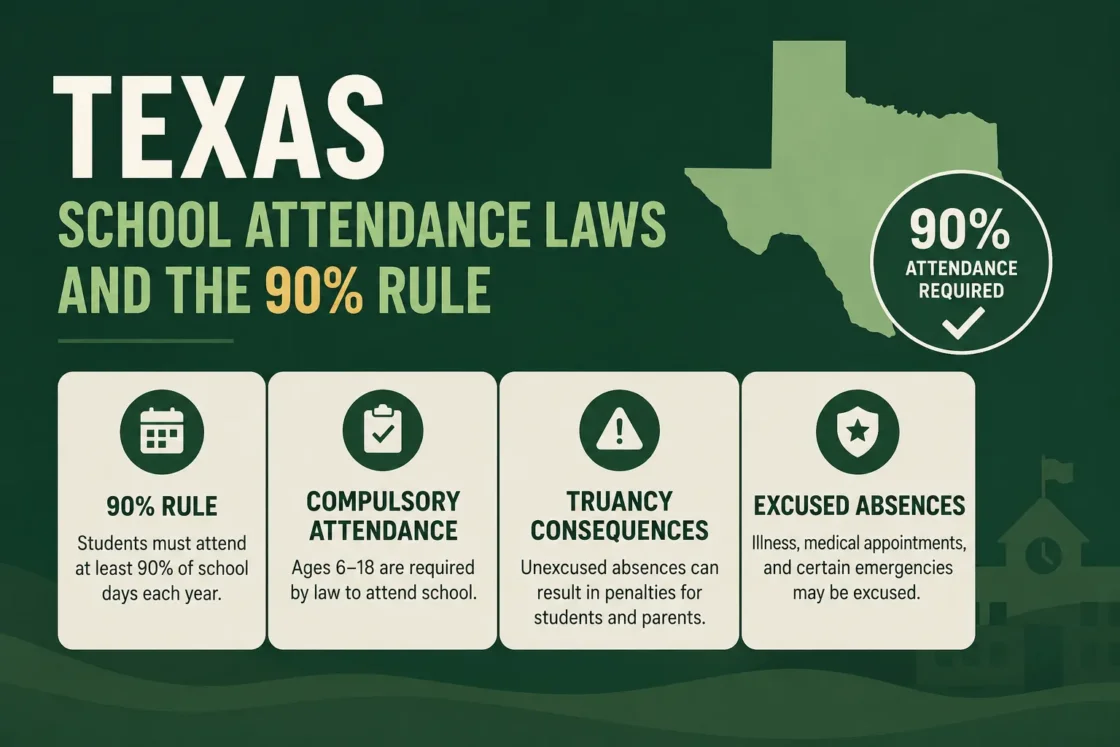
Texas law ties class credit and final grades to attendance. For most students covered by Texas Education Code Section 25.092, a student must attend at least 90% of the days a class is offered to satisfy the state attendance requirement for credit or a final grade. Falling below 90% does not always mean credit is permanently lost, because Texas law provides attendance-recovery routes.
A kindergarten through grade 12 student covered by the rule generally must attend at least 90% of the days a class is offered. The rule is based on attendance in the individual class, not simply the student’s overall school attendance rate.
The Texas 90% Attendance Rule
Texas Education Code Section 25.092 states that, except where the statute provides otherwise, a student from kindergarten through grade 12 may not receive credit or a final grade for a class unless the student attends at least 90% of the days the class is offered.
The percentage is calculated against the days that particular class is offered. A class offered on 90 instructional days, for example, normally requires attendance on at least 81 of those days to reach 90%. A course with a different schedule has a different numerical attendance threshold.
| Attendance Level | What the State Rule Provides |
|---|---|
| 90% or more | The student meets the statutory attendance threshold for class credit or a final grade. |
| 75% to less than 90% | Credit or a final grade may still be earned by completing a principal-approved plan that meets the instructional requirements of the class. |
| Below 75% | The principal-plan provision for the 75%–90% range does not apply, but the student may still have access to an attendance-committee process under district policy. |
The percentages are thresholds for attendance-related credit eligibility. They do not replace academic requirements. A student must still satisfy the course’s academic requirements for the school to award credit or a final grade.
What Happens When Attendance Falls Below 90%
A student who attends at least 75% but less than 90% of the days a class is offered may receive credit or a final grade after completing a plan approved by the school principal. The plan must allow the student to meet the instructional requirements of the class.
State law does not prescribe one identical recovery activity for every district. Local policies can establish alternative ways to make up work or regain credit. The district’s board must provide at least one recovery option that does not require the student to pay a fee.
- Recovery may involve additional academic work, instructional time, tutorials, or another option allowed by local policy.
- Completion of a recovery plan does not mean credit is automatic unless the plan’s requirements are actually met.
- A district may consider the circumstances behind the absences when applying its local attendance policies.
Students who do not receive credit through the principal-approved plan can petition an attendance committee. Texas law requires school district boards to appoint one or more attendance committees, with classroom teachers making up a majority of each committee. The committee may award credit or a final grade because of extenuating circumstances.
If an attendance committee denies credit or a final grade, Section 25.092 also provides an appeal to the district’s board of trustees. District policy determines many of the practical steps and deadlines, so the student’s official attendance record and local attendance policy remain central to an individual case.
Do Excused Absences Count Toward the 90% Rule?
An absence being marked excused does not generally mean that it disappears from the 90% calculation. The Texas Education Agency’s attendance guidance explains that excused absences can still be counted when determining compliance with the attendance requirement for class credit, while local policies may take the excused nature of an absence into account when deciding whether credit should be restored.
There is a statutory exception for certain serious medical situations. Under Sections 25.087(b)(3) and 25.092(a-3), an excused absence resulting from a serious or life-threatening illness or related treatment is not considered when determining whether the student satisfies the 90% or 75% attendance levels when the statutory certification requirements are met.
For the 90% rule, the reason an absence is excused and whether a specific statutory exception applies can matter. A normal excused absence and an absence specifically excluded from the Section 25.092 calculation are not necessarily the same thing.
Texas Compulsory School Attendance
The 90% rule is only one part of Texas attendance law. Section 25.085 addresses the separate duty to attend school. Unless an exemption applies, a child who is at least six years old and has not reached the child’s 19th birthday is generally required to attend school each school day for the full period of instruction.
The law also states that once a child is enrolled in prekindergarten or kindergarten, the child must attend school even if the child is younger than the ordinary compulsory-attendance age. The Texas Education Agency’s current general attendance information likewise identifies ages six through under 19 as the general compulsory-attendance range, subject to statutory exemptions.
Compulsory attendance and the 90% rule serve different purposes. One determines when attendance at school is legally required. The other determines whether attendance is sufficient for class credit or a final grade.
The 90% Rule Is Not the Texas Truancy Threshold
The 90% rule should not be confused with truancy. A student can have an attendance problem under Section 25.092 without meeting the state’s truancy threshold, and the calculations use different standards.
| Rule | Measure | Main Effect |
|---|---|---|
| 90% rule | Percentage of days a class is offered | Determines attendance eligibility for class credit or a final grade. |
| Early truancy intervention | Three or more unexcused days or parts of days within four weeks | Triggers truancy-prevention measures and related parent notification requirements. |
| Truant conduct threshold | 10 or more unexcused days or parts of days within a six-month period in the same school year | Can lead to a referral to truancy court under the applicable statutory process. |
Texas Education Code Sections 25.0915, 25.095, and 25.0951 contain the school notice, prevention, and referral provisions. Texas Family Code Section 65.003 defines truant conduct using the 10-day threshold for a child who is subject to compulsory attendance.
This distinction also explains why an excused absence can affect the 90% class-credit calculation while not being treated as an unexcused absence for the truancy process.
District Attendance Policies Still Matter
Section 25.092 establishes statewide rules, but school districts have responsibility for many recovery details. A district’s board sets guidelines for extenuating circumstances and adopts alternative ways for students to make up work or regain a credit or final grade lost because of absences.
Local policy can therefore affect issues such as:
- what documentation the school requests for an absence;
- how attendance-recovery plans are assigned and completed;
- what the district considers an extenuating circumstance;
- how a student petitions the attendance committee;
- deadlines for completing recovery work or filing an appeal; and
- how partial-day or class-period absences are recorded.
A student’s current campus or district attendance record is the practical starting point for determining the student’s percentage. The statutory threshold alone cannot establish whether an individual student has earned credit because enrollment dates, class schedules, excluded absences, completed recovery work, and local attendance decisions may change the result.
Charter, Virtual, and Hybrid Course Rules
The 90% rule does not operate identically in every Texas public-school setting. TEA guidance states that Section 25.092 does not directly apply to open-enrollment charter schools, although a charter school may have incorporated a similar requirement into its charter or policies.
Texas also created a separate rule for courses offered under the state’s virtual and hybrid education provisions. Texas Education Code Section 30B.056, enacted in 2025, provides that a school district or open-enrollment charter school offering a hybrid or virtual course under Chapter 30B must establish the participation necessary to earn credit or a grade for that course, notwithstanding Section 25.092.
For a student enrolled in a virtual, hybrid, charter, or other nontraditional course arrangement, the applicable school or course participation policy should therefore be checked before assuming that the standard classroom 90% calculation controls.