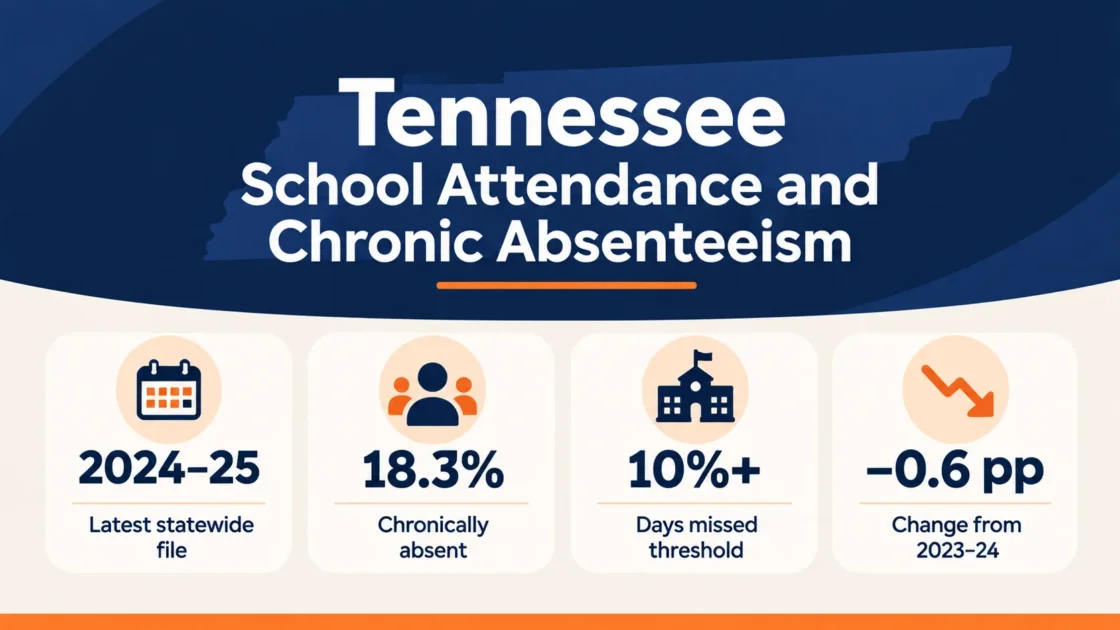
18.3%Chronically absent
10%+Days missed threshold
−0.6 ppChange from 2023–24
Tennessee’s statewide chronic absenteeism rate was 18.3% in the 2024–25 school year. The rate has declined for three consecutive years since reaching 20.3% in 2021–22, but it remains 5.2 percentage points above the 13.1% recorded in 2018–19.
As of October 2026, the Tennessee Department of Education data download page lists 2024–25 as the newest released statewide chronic absenteeism file. A final statewide 2025–26 chronic absenteeism file is not yet listed there.
Tennessee Chronic Absenteeism by School Year
Tennessee’s chronic absenteeism rate was fairly stable before the pandemic, moving from 13.6% in 2016–17 to 13.1% in 2018–19. It rose to 15.5% in 2020–21 and then reached 20.3% in 2021–22. Since that peak, the statewide rate has moved downward.
Statewide rate for school years with a full-year measure shown in the series.
The 2019–20 rate is omitted from the line because Tennessee calculated that year only through March 2, 2020, before statewide school disruptions. Tennessee treats that file as informational rather than a normal full-year comparison.
| School Year | Rate | Reporting Note |
|---|---|---|
| 2016–17 | 13.6% | Full-year statewide measure |
| 2017–18 | 13.3% | Full-year statewide measure |
| 2018–19 | 13.1% | Full-year statewide measure |
| 2019–20 | 13.0% | Calculated only through March 2, 2020; informational use |
| 2020–21 | 15.5% | Pandemic-era school year |
| 2021–22 | 20.3% | Highest rate in this series |
| 2022–23 | 19.6% | Down 0.7 percentage points |
| 2023–24 | 18.9% | Down 0.7 percentage points |
| 2024–25 | 18.3% | Down 0.6 percentage points |
The earlier portion of the series is documented in Tennessee Comptroller analyses of Department of Education data. The current school-year files are published through the Department of Education’s chronic absenteeism downloads. The post-2021–22 decline totals 2.0 percentage points, while the 2024–25 rate remains above the pre-pandemic level.
How Tennessee Measures Chronic Absenteeism
Tennessee classifies a student as chronically absent when the student is absent for 10% or more of the instructional days for which the student is enrolled in a Tennessee public school or district. The Department of Education also refers to the accountability measure as the Chronically Out of School indicator.
The state’s 2024–25 Federal Accountability Protocol states that the measure is intended to capture lost class time. Attendance records used in the calculation are drawn from Tennessee’s Education Information System after the school year.
The accountability calculation can include excused absences, unexcused absences, medically excused absences and other attendance codes treated as absent under Tennessee’s reporting rules. Chronic absenteeism therefore does not depend on whether an absence was excused.
Because the threshold is based on a percentage of days enrolled, there is no single number of missed days that applies to every student. A student enrolled for a typical 180-day school year reaches 10% at about 18 missed days. A student enrolled for fewer days reaches the threshold after fewer absences.
Chronic Absenteeism and Truancy Are Different Measures
Tennessee uses chronic absenteeism and truancy for different purposes. Chronic absenteeism is primarily an attendance and accountability measure based on total instructional time missed. Truancy concerns unexcused absences and is connected to compulsory-attendance requirements.
10% of enrolled instructional days
Counts qualifying absences regardless of whether they are excused or unexcused.
5 unexcused absences
Tennessee uses unexcused absences to trigger required truancy interventions.
A student can therefore become chronically absent without being truant. For example, a student with repeated excused medical absences may cross the 10% chronic absenteeism threshold even though those absences do not produce five unexcused days. Conversely, a student may reach Tennessee’s five-unexcused-absence truancy threshold before missing 10% of the school year.
The Tennessee Department of Education chronic absenteeism guidance describes truancy as a legal term involving unexcused absences and chronic absenteeism as a measure that includes absences for any reason.
Tennessee Compulsory School Attendance Ages
Tennessee’s compulsory attendance law generally applies to children from age 6 through age 17, inclusive, subject to statutory exceptions. Kindergarten may begin earlier, but compulsory attendance generally begins no later than the academic year following a child’s sixth birthday.
Tennessee law generally requires a parent, guardian or other legal custodian responsible for a child between ages 6 and 17 to ensure that the child receives education through an eligible public, private, church-related or home-school arrangement, subject to the exceptions provided by state law.
Attendance classifications and documentation rules can also depend on local school district policy. Families reviewing a particular absence should use the attendance policy of the student’s school or local education agency because local rules determine how many common absence situations are documented and classified.
What Happens After Five Unexcused Absences
Under Tennessee Code § 49-6-3009, local boards of education must maintain progressive truancy plans before a student is referred to juvenile court for attendance-related violations.
The state structure begins with schoolwide prevention supports for enrolled students. When a student accumulates five unexcused absences, the second tier of intervention must be implemented as specified in the local education agency’s plan. State law requires this tier to include several elements:
- A conference involving the student and the parent, guardian or other person responsible for the student.
- An attendance contract describing the school’s attendance expectations and possible consequences for additional absences.
- Follow-up meetings to review the student’s progress.
- An individual assessment of the reasons for the student’s absences.
- Referral to counseling, community services or other school-based or outside services when needed.
If tier-two interventions do not resolve the attendance problem, tier three may use options such as school-based community services, restorative justice programs, school-based teen court, or Saturday or after-school attendance and behavior programs. Tennessee law requires the progressive plan to be used before a normal juvenile-court referral based on truancy, with specified exceptions when a parent or guardian does not cooperate with the intervention process.
The five-day rule applies to Tennessee’s truancy process. Chronic absenteeism is calculated separately using the 10% threshold and includes excused as well as unexcused absences.
How Chronic Absenteeism Enters Tennessee School Accountability
Tennessee began using chronic absenteeism in school and district accountability in the 2017–18 school year. The state reports it as the Chronically Out of School indicator.
For 2024–25 reporting, Tennessee calculates school and district Chronically Out of School rates and publishes results for all students as well as several student groups. These include economically disadvantaged students, English learners, students with disabilities, Black students, Hispanic students, Asian students, White students and other groups defined in the state accountability system.
The school and district calculations also apply enrollment rules. The state accountability protocol generally assigns a student to a school or district rate when the student meets the applicable enrollment-duration requirements. These rules are one reason a simple enrollment total should not automatically be used as the denominator for an accountability chronic absenteeism rate.
School Years That Need Extra Context
The 2019–20 Tennessee chronic absenteeism file should not be treated as an ordinary full-year data point. The Department of Education calculated chronic absenteeism only through March 2, 2020, the final instructional calendar day before statewide disruptions associated with tornadoes and COVID-19 closures. Tennessee labels those results as informational.
The 2020–21 school year also occurred under unusual attendance conditions. It is included in the published statewide series, but comparisons with pre-pandemic years should account for changes in schooling and attendance patterns during that period.
For longer trend comparisons, the 2018–19 rate of 13.1% provides a useful pre-pandemic reference point. Tennessee’s 2024–25 rate of 18.3% is lower than the 2021–22 peak, but it remains 5.2 percentage points above that earlier level.
Where Tennessee Publishes Attendance Data
The Tennessee Department of Education publishes chronic absenteeism files at the state, district and school levels through its Data Downloads & Requests page. The page currently provides chronic absenteeism files from 2016–17 through 2024–25.
The Tennessee State Report Card provides another route for viewing school and district performance information. When comparing schools or districts, the school year and reporting population should be kept the same because attendance rates from different years or different enrollment rules are not directly interchangeable.