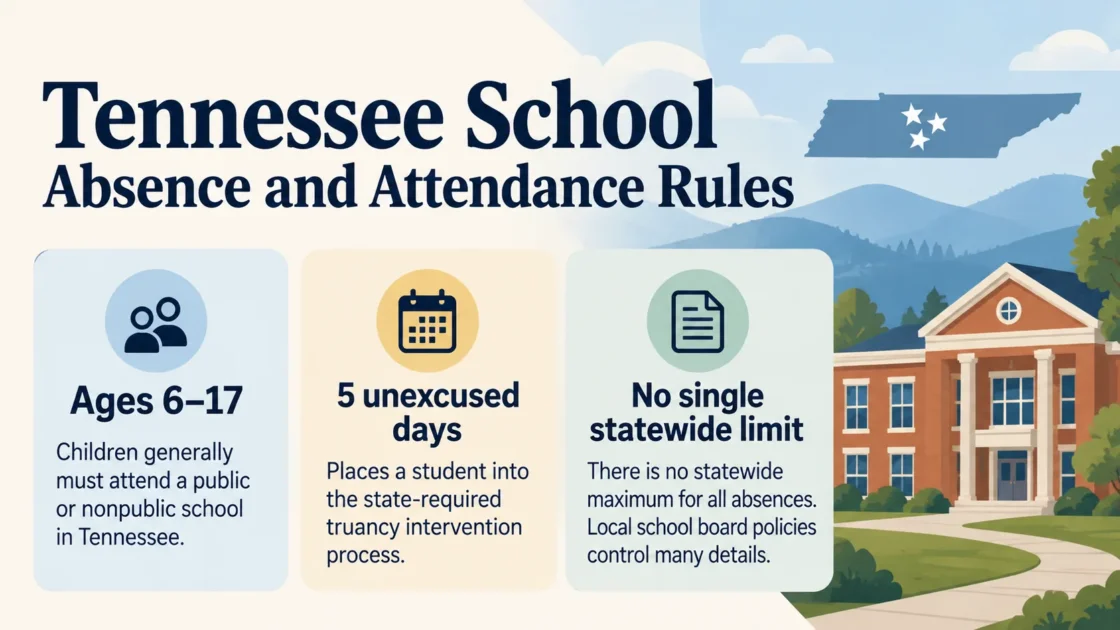
For the 2026–27 school year, Tennessee generally requires children ages 6 through 17 to attend school. Five unexcused absences during a school year, which do not have to be consecutive, place a student into the state-required truancy intervention process. Tennessee does not set one statewide maximum for all absences. Local school board policies control many details involving ordinary excused absences, documentation deadlines, parent notes, medical notes, tardiness, and other attendance procedures.
Statewide Attendance Thresholds
| Threshold | Attendance Rule | What It Means |
|---|---|---|
| Ages 6–17 | Compulsory attendance | Children generally must attend a public or nonpublic school unless a statutory exception applies. |
| 3 unexcused days | School reporting | A public school principal must report the student to the director of schools or attendance supervisor. Written attendance notice may be sent at this point. |
| 5 unexcused days | Truancy intervention threshold | Written notice is required. After adequate time to provide documentation that could excuse the absences, the student becomes subject to Tier 2 of the local progressive truancy plan. |
| More than 5 unexcused days | Attendance appeal | Local boards must provide an opportunity to appeal the classification of excessive unexcused absences. |
| 10% of instructional days | Chronic absenteeism | This attendance measure counts days missed for any reason. It is different from the legal truancy process, which focuses on unexcused absences. |
The five-day truancy threshold is cumulative within the school year. A student does not need to miss five consecutive days. Local education agencies may also begin attendance interventions before the student reaches five unexcused absences.
Five unexcused days is the statewide truancy threshold, but it is not a statewide limit on all excused and unexcused absences combined. District attendance policies may establish additional procedures for excessive absences.
Excused and Unexcused Absences
Each Tennessee local board of education must adopt its own attendance policy. State rules establish several situations that local policies must recognize, while allowing districts to address additional reasons and documentation requirements.
State-required or state-authorized attendance provisions include:
- Absences required by a summons, subpoena, court order, or another qualifying legal requirement.
- Absence for the observance of a sacred day recognized by the student’s religious denomination when the religion calls for observance of that day.
- Qualifying absences connected with the federal active-duty deployment, return, rest and recuperation leave, or deployment-cycle visitation of a parent or legal guardian serving in the armed forces, National Guard, or a reserve component.
- Qualifying released-time courses under Tennessee law.
- Certain non-school-sponsored extracurricular activities when the local education agency authorizes them and the required documentation, advance request, and written approval requirements are met.
For a qualifying non-school-sponsored extracurricular activity, the written request generally must be submitted no later than seven business days before the absence. A principal may limit the number and duration of these absences and may excuse no more than ten such absences during a school year.
Tennessee does not impose one statewide parent-note limit, medical-note threshold, bereavement rule, or tardy-to-absence conversion for every school district. Those details should be checked in the student’s current district attendance policy and school handbook.
When Missed Class Time Can Be Counted as Present
Some situations are recorded as present rather than as an excused or unexcused absence. State rules include students serving an in-school suspension while receiving educational services, students receiving medical or educational homebound instruction, General Assembly pages, and students participating in qualifying school-sponsored activities. Certain 4-H activities also qualify. An LEA may additionally adopt a policy allowing qualifying postsecondary school visits to be counted as present.
What Happens After Unexcused Absences
Tennessee requires local boards of education to use a progressive truancy plan before the ordinary juvenile-court referral process. The three tiers do not all begin at the same absence count.
| Tier | When It Applies | Required or Permitted Actions |
|---|---|---|
| Tier 1 | All enrolled students | Schoolwide, prevention-oriented attendance supports. |
| Tier 2 | At 5 unexcused absences | A student and parent or guardian conference, an attendance contract, follow-up meetings, an individual assessment of the reasons for the absences, and referrals to services when needed. |
| Tier 3 | If Tier 2 is unsuccessful | May include school-based community services, restorative justice programs, a school-based teen court, or Saturday or after-school courses intended to improve attendance and behavior. |
In-school or out-of-school suspension cannot be used as a progressive truancy intervention for an unexcused absence from school or class.
When a Case Can Reach Juvenile Court
If the LEA has applied its progressive truancy plan and the interventions fail to meaningfully address attendance, the director of schools must provide written notice to the parent or guardian and report the unlawfully absent student to the appropriate juvenile judge. A referral may occur without completing later intervention tiers when an earlier intervention has failed and the school can document repeated unwillingness by the parent or guardian to cooperate with the truancy process.
A juvenile-court referral is not an automatic consequence of the fifth unexcused absence. Five unexcused absences start the required intervention stage; court involvement generally follows unsuccessful intervention or circumstances specifically addressed by state law.
Tennessee law treats a parent or guardian’s violation of the compulsory-attendance provisions as educational neglect, a Class C misdemeanor. If a K–12 student is adjudicated unruly because of five or more unexcused days during a school year, a judge may assess the parent or legal guardian a fine of up to $50 or community service. The outcome depends on the formal legal process rather than the absence count alone.
Absences Follow Students Who Transfer During the School Year
Changes effective July 1, 2026 prevent a student’s unexcused-absence count from restarting simply because the student changes Tennessee public schools or LEAs during the same school year.
When a student enrolls after the school year has begun, the receiving LEA or public school must determine whether the student attended another Tennessee LEA or public school earlier in that school year. It must request the attendance records, and a former school or LEA must provide the requested school-year attendance records within five business days. Prior unexcused absences from that school year are added to the student’s current total, and the receiving school must apply the appropriate truancy tier when applicable.
The 2026 change also addresses students who leave an LEA while receiving Tier 3 truancy intervention and do not transfer to another LEA. In that situation, the director of schools must report the student’s absences to the juvenile judge in the county where the student resides, subject to the statutory referral requirements.
Truancy and Chronic Absenteeism Measure Different Things
Unexcused absences
Tennessee’s legal attendance process reaches the statewide intervention threshold at five unexcused absences during the school year.
All reasons for absence
Tennessee education reporting uses the common measure of missing 10% or more of instructional days, including excused and unexcused absences and qualifying disciplinary absences.
A student can therefore be chronically absent without reaching the truancy threshold. For example, a large number of properly excused absences may count toward chronic absenteeism even though they do not count as unexcused days for the five-day truancy trigger.
Make-Up Work and Attendance Appeals
Students receiving an excused absence must be given an opportunity to complete missed assignments. Tennessee’s attendance rule also states that local attendance policies cannot be used to penalize students academically. For assignments missed during an unexcused absence, however, the LEA decides whether make-up work will be allowed.
Students with more than five unexcused absences must have access to an attendance appeal process adopted by the local board. At minimum, the student or parent or guardian must receive written or actual notice and an opportunity to be heard. The burden of proof in that attendance-classification appeal rests with the student or parent or guardian.
The local board’s attendance policy must be posted on its website and referenced in school handbooks. That local policy is the controlling place to check rules that Tennessee leaves to districts, including acceptable illness documentation, deadlines for submitting notes, parent-note limits, tardiness procedures, and additional attendance interventions.