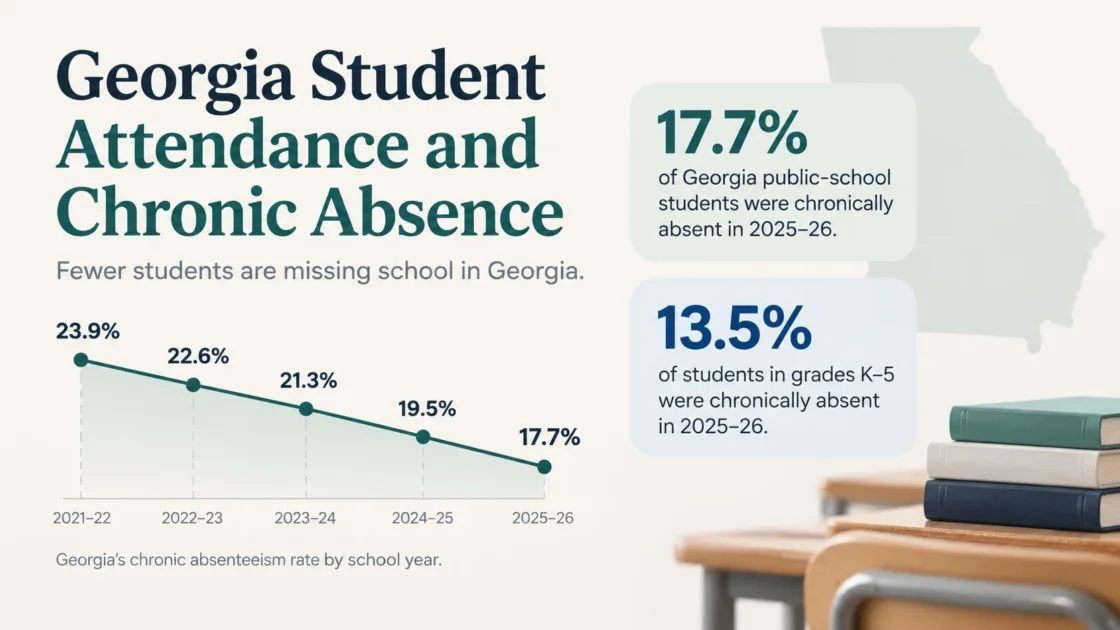
Georgia’s public-school chronic absenteeism rate was 17.7% in 2025–26, down from 19.5% in 2024–25. Among students in grades K–5, the rate was 13.5%. Georgia reports a student as chronically absent when absences reach 10% or more of enrolled days.1
Statewide Chronic Absence Has Fallen Since the 2021–22 Peak
| School Year | Chronic Absenteeism Rate | Change From Prior Year |
|---|---|---|
| 2021–22 | 23.9% | — |
| 2022–23 | 22.6% | −1.3 pp |
| 2023–24 | 21.3% | −1.3 pp |
| 2024–25 | 19.5% | −1.8 pp |
| 2025–26 | 17.7% | −1.8 pp |
Percentage of public-school students absent for 10% or more of enrolled days.
The series fell 6.2 percentage points from 2021–22 to 2025–26.12
The decline accelerated in the two most recent school years shown: the statewide rate dropped 1.8 percentage points in 2024–25 and another 1.8 points in 2025–26. The 2025–26 K–5 rate of 13.5% was 4.2 percentage points below the statewide rate.1
Georgia Measures Chronic Absence Against Days Enrolled
Georgia law defines a chronically absent student by the share of enrolled school days missed, not by one fixed statewide number of days. Total absences count whether they are excused or unexcused, and the threshold is reached when those absences equal or exceed 10% of the student’s enrolled days during the school year.3
| Days Enrolled | 10% of Enrolled Days |
|---|---|
| 180 | 18 days |
| 170 | 17 days |
| 160 | 16 days |
| 150 | 15 days |
| 120 | 12 days |
| 100 | 10 days |
| 60 | 6 days |
| 50 | 5 days |
A student enrolled for 180 days reaches 10% at 18 absences. A student enrolled for fewer days reaches the same percentage at a lower number of absences. The percentage of enrolled days is the controlling measure.
The chronic-absence definition includes both excused and unexcused absences. Whether an absence is excused matters for truancy and local attendance procedures, but an excused absence does not automatically disappear from the chronic-absence calculation.3
Chronic Absence, Truancy, and Daily Attendance Measure Different Things
| Measure | What It Counts | Georgia Rule or Formula |
|---|---|---|
| Chronic absence | Total absences for an individual student, including excused and unexcused absences | At least 10% of the student’s enrolled days |
| Truancy | Unexcused absences for a child subject to compulsory attendance | More than five unexcused days during the school calendar year |
| Average daily attendance | Days present across a student group | Total days present divided by total days enrolled |
A student can therefore be chronically absent without being truant if enough absences are excused. The reverse can also occur: six unexcused absences meet Georgia’s truancy definition, but six days would still be well below the 10% chronic-absence line for a student enrolled for most of a 180-day school year.
Georgia Uses Separate Student, System, and School Thresholds
The 10% chronic-absence rule for an individual student should not be confused with the percentages Georgia uses to determine when attendance review teams are required. The school-system and school triggers are based on the previous school year’s chronic absenteeism rate.3
| Level | Threshold | What the Threshold Does |
|---|---|---|
| Individual student | 10% of enrolled days | Defines the student as chronically absent |
| Local school system | 10% or higher | Requires an attendance review team for the school system |
| Individual school | 15% or higher | Requires an attendance review team for that school |
Local school systems must maintain procedures to identify students who are chronically absent or at risk of becoming chronically absent and provide appropriate supports. Required attendance review teams meet at least monthly, review individual cases, and develop intervention plans for students and their parents or guardians.3
Georgia law states that a public-school student may not be expelled solely because of absences from school.3
Compulsory attendance remains in effect from a child’s sixth through sixteenth birthdays. A 2026 change added state policy language encouraging families to have children attend school or a home study program beginning at age five; it did not lower the compulsory-attendance starting age to five.6
Georgia attendance rules require a school system to notify the parent or guardian when a student reaches five unexcused absences. Truancy is defined as more than five unexcused days. Neither rule replaces the 10% chronic-absence calculation.4
Georgia and Federal Chronic-Absence Rates Are Not One Series
Georgia’s state attendance series and the federal ED Data Express series should not be spliced together. The difference is visible even when the school year is the same.
| School Year | Georgia State Series | ED Data Express | Federal Minus State |
|---|---|---|---|
| 2021–22 | 23.9% | 27.5% | +3.6 pp |
| 2022–23 | 22.6% | 26.2% | +3.6 pp |
The Georgia Insights Attendance Dashboard says its attendance measures use the same raw data as the College and Career Ready Performance Index and are based on the Student Record collection.5 ED Data Express calculates its displayed chronic-absence percentage by dividing the reported chronic-absence count by a membership denominator. Its methods notes warn that membership is collected at a point in time while chronic absenteeism covers the school year, and that double counting can occur when the data are aggregated.7
Use Georgia’s state series for Georgia year-to-year trend analysis and keep federal ED Data Express values labeled as federal reporting. A federal value should not be inserted into a missing state-series year simply because both sources use the term chronic absenteeism.