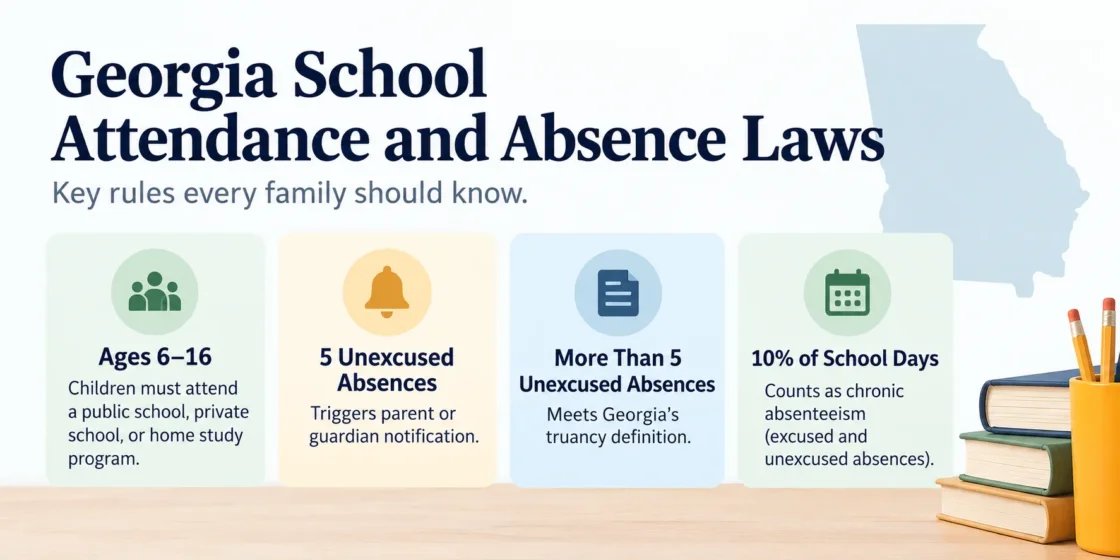
Georgia generally requires children to attend a public school, private school, or home study program from their sixth birthday until their sixteenth birthday. The state does not give students a single statewide number of absences they may use without consequence. Georgia instead applies different rules to unexcused absences, truancy, chronic absenteeism, parent notification, and prolonged nonattendance.
The number five is tied to unexcused-absence notification. Georgia defines a truant student as a child subject to compulsory attendance who has more than five unexcused absences during the school calendar year. Excused absences are handled differently, and both excused and unexcused days can count toward chronic absenteeism.
Who Must Attend School in Georgia?
Under O.C.G.A. § 20-2-690.1, compulsory attendance generally applies between a child’s sixth and sixteenth birthdays. The requirement may be satisfied through a public school, private school, or qualifying home study program. A child who has completed the requirements for a high school diploma is not required to remain enrolled solely because the child has not yet reached age 16.
Age Five Is Encouraged, Not Generally Compulsory
Georgia law encourages parents and guardians to begin a child’s education at age five, but the general compulsory-attendance starting age remains six. A five-year-old is therefore not automatically treated the same as a child who has reached the compulsory-attendance age.
Public-School Attendance Can Trigger the Rule Before Age Six
There is an exception for a younger child who has already started public school. A child under age six who has attended a Georgia public school for more than 20 days becomes subject to the compulsory-attendance provisions. Families should not assume that a child can simply stop attending without attendance consequences after that point because the child is still five.
Leaving School After Compulsory Age
Reaching age 16 ends the general compulsory-attendance age range, but it does not make withdrawal from school entirely informal. An unemancipated minor who is older than the compulsory-attendance age, has not completed high school, and wants to withdraw must have written permission from a parent or legal guardian. The principal or a designee must hold a conference with the student and parent or guardian within two school days after receiving notice of the intended withdrawal. The conference addresses the consequences of leaving school without a diploma.
Georgia Uses Different Attendance Thresholds for Different Purposes
The most common attendance numbers in Georgia refer to different rules. Treating them as one escalating absence limit can produce the wrong result.
| Threshold | What It Applies To | What It Means |
|---|---|---|
| 5 unexcused absences | Parent or guardian notification | The school system must notify the parent or guardian about the consequences and penalties connected with continued unexcused absence. |
| More than 5 unexcused absences | State truancy definition | A compulsory-attendance-age student meets Georgia’s definition of truant during that school calendar year. |
| 10% of enrolled school days | Chronic absenteeism | Excused and unexcused absences are counted together for this measure. |
| 10 consecutive unexcused absences | Enrollment withdrawal in specified cases | A school may process withdrawal when the rule’s conditions are met and there is no evidence of enrollment elsewhere or a qualifying home study program. |
| 30 consecutive days | Additional referral requirements in specified nonattendance cases | The State Board enrollment rule can require referrals when a student remains out of school and the listed withdrawal or enrollment conditions have not been satisfied. |
The fifth unexcused absence and the truancy threshold are especially easy to confuse. Five unexcused absences trigger the statutory notification duty. “More than five” means the sixth unexcused absence is the first day that places a student above five for the state truancy definition, assuming the student is subject to compulsory attendance.
Which Absences Can Be Excused?
Georgia State Board of Education Rule 160-5-1-.10 establishes statewide minimum reasons that local school systems must recognize as excused when the applicable conditions are met. Local boards may recognize additional circumstances under their own attendance policies.
| Reason | How the Rule Applies |
|---|---|
| Personal illness | An absence may be excused when the student is personally ill or when attendance would endanger the student’s health or the health of others. |
| Serious illness or death in the immediate family | The absence may be excused when the family circumstance makes the student’s absence necessary. |
| Court order or government mandate | An absence may be excused when a court or governmental agency requires the student to be away from school. |
| Religious holiday | An absence may be excused when the student’s religious observance requires absence from school. |
| Unsafe or impossible attendance conditions | Conditions that make school attendance impossible or hazardous to health or safety can qualify. |
| Registering to vote or voting | A qualifying student may receive up to one school day for this purpose. |
| Military-parent deployment or qualifying leave | A student may receive up to five school days per school year to visit a parent or legal guardian before deployment or during qualifying leave connected with military service. |
| Other locally approved circumstances | A local board may excuse additional circumstances it considers meritorious under its adopted policy. |
When a Doctor’s Note May Be Required
Georgia’s statewide rule identifies illness as an excusable reason, but it does not create one universal documentation procedure for every district and every illness. A local school system may require medical or other documentation under its attendance policy, especially after repeated absences or when the school needs to validate the reason for absence. The district’s written policy controls the local submission deadline and the type of documentation it accepts.
Some Qualifying Activities Are Counted as Present
An excused absence still records that the student was absent. Georgia also recognizes several situations in which an eligible student is treated as present rather than absent. That difference affects how attendance totals are recorded.
| Activity | Attendance Treatment |
|---|---|
| Serving as a page of the Georgia General Assembly | The qualifying student is counted present for attendance purposes. |
| Foster-care court proceedings | A foster-care student attending a court proceeding related to the student’s foster-care status is counted present. |
| 4-H sponsored activities or programs | Qualifying participation is counted as attendance rather than an absence. |
| Student Teen Election Participant program | Successful participation can be counted present for up to two school days in a school year. |
| Armed Forces or National Guard testing or physical examinations | Qualifying time away for these examinations is treated as present rather than as an excused or unexcused absence. |
Five Unexcused Absences Trigger Notice; More Than Five Means Truant
Georgia’s truancy rule is based on unexcused absences, not total absences. A child subject to compulsory attendance is considered truant after accumulating more than five unexcused absences during the school calendar year.
What the School Must Tell the Parent or Guardian
Once a student has five unexcused absences, the school system must notify the parent, guardian, or other person who has control of the child about the possible consequences and penalties connected with continued nonattendance. The law also provides written-mail procedures after unsuccessful contact attempts and requires certified-mail notice before judicial proceedings are started.
Public schools also provide parents or guardians with a written summary of the possible consequences of noncompliance with compulsory-attendance requirements and obtain an acknowledgment of receipt. A student who is age 10 or older by September 1 is also required to sign an acknowledgment that the attendance information was received.
Court Referral Is Not Automatic on the Sixth Unexcused Day
Meeting the state definition of truant does not by itself mean that a student or parent is automatically sent to court. Georgia’s attendance rule requires local systems to use a progressive discipline process and parental-involvement steps before referral to a juvenile or other court. The exact intervention sequence can differ by local attendance protocol.
The student may meet the statewide definition of truant at that point, while notice, school interventions, parent involvement, and local protocol still affect what happens next.
Parent or Guardian Liability Under Compulsory Attendance Law
Georgia places the legal duty to ensure attendance on a parent, guardian, or other person who has control of a child who is subject to compulsory attendance. A violation can be prosecuted as a misdemeanor. On conviction, the statute allows a fine of $25 to $100, imprisonment for up to 30 days, community service, or a combination of those penalties, at the court’s discretion.
After the school system has notified the responsible adult that the child has five unexcused absences, each later day of unlawful absence can constitute a separate offense. These are possible court-imposed consequences. They are not automatic school penalties issued as soon as the attendance record reaches a particular number.
The 10% Chronic Absenteeism Rule Counts Excused and Unexcused Days
Georgia separately defines chronic absenteeism in O.C.G.A. § 20-2-690.3. A student is chronically absent when the student misses 10% or more of the school days for which the student has been enrolled during the current school year. Excused and unexcused absences both count toward that percentage.
| Days Enrolled | 10% of Enrolled Days | Interpretation |
|---|---|---|
| 180 | 18 | 18 missed days equals 10% of 180 enrolled days. |
| 120 | 12 | 12 missed days equals 10% of 120 enrolled days. |
| 90 | 9 | 9 missed days equals 10% of 90 enrolled days. |
| 60 | 6 | 6 missed days equals 10% of 60 enrolled days. |
The 18-day example is not a statewide allowance. It is simply 10% of a 180-day enrollment period. A student who enrolled later in the year has a smaller denominator, so the number of missed days that reaches 10% is also smaller.
Truancy and Chronic Absenteeism Measure Different Things
When Attendance Review Teams Are Required
Georgia also uses chronic-absence rates to determine when local attendance review teams are required. If a local school system’s chronic absenteeism rate for the previous school year is at least 10%, the system must establish an attendance review team. If an individual school’s previous-year rate is at least 15%, an attendance review team is required for that school. These teams meet at least monthly, review cases involving chronically absent students, and develop intervention plans for students and their parents or guardians.
A student reaches chronic absenteeism at 10% of the student’s enrolled days. A 10% system rate and a 15% school rate are separate thresholds used to determine when attendance review teams are required. The 15% figure is not an individual student absence limit.
Long Nonattendance Can Lead to Withdrawal From Enrollment Records
Georgia’s enrollment and withdrawal rule addresses students who stop attending without completing a normal withdrawal process. When a parent or custodian has not formally withdrawn the student, and the school has no evidence that the student enrolled in another school, private school, or home study program, 10 consecutive unexcused absences can lead to withdrawal from the school’s enrollment record under the conditions set by State Board Rule 160-5-1-.28.
The rule includes parent-notification requirements before the withdrawal is completed. A withdrawal for prolonged nonattendance is an enrollment-record action; it is not the same as expulsion. Georgia law separately provides that a public-school student may not be expelled solely because of absences.
Thirty Consecutive Days Can Trigger Additional Referrals
The same enrollment rule addresses certain students who remain out of school for 30 consecutive days without an established transfer, private-school enrollment, or compliant home study arrangement. In the circumstances listed by the rule, the school system must refer the matter to the Division of Family and Children Services and the regional educational service agency student affairs officer.
- The parent or custodian has not properly notified the school of withdrawal.
- The school has no evidence that the student enrolled in another school or qualifying home study program.
- A home study withdrawal occurred without the required Declaration of Intent.
- A student old enough to seek voluntary withdrawal stopped attending before completing the required withdrawal conference process.
Excused Absences and Hospital/Homebound Services Are Treated Differently
A student cannot be withdrawn under the prolonged-nonattendance rule merely because of excused absences. A student receiving Hospital/Homebound services also cannot be withdrawn for nonattendance under that rule. These protections prevent the enrollment-withdrawal process from being applied as though medically or otherwise excused nonattendance were the same as unexplained consecutive unexcused absence.
A student who was enrolled in the previous school year but never physically attends at the start of the new year can also be treated as a no-show under the enrollment rule rather than accumulating ordinary absences from the first day. Once the student physically attends, normal attendance recording applies.
Excused Absences, Make-Up Work, and Final Grades
Georgia’s attendance rule protects a student from having a final course grade reduced solely because of an absence when two conditions are met: the absence is justified and validated as excusable, and the student satisfactorily completes the required make-up work. Local school systems are not required by the state rule to provide make-up work for unexcused absences.
An excused absence therefore does not erase every academic responsibility. The attendance coding protects the absence status, while the student may still need to complete assigned work under the school’s make-up procedures.
What State Law Sets and What Local Districts Still Decide
Georgia law creates statewide attendance requirements, but day-to-day attendance administration still depends partly on local board policy. A district cannot replace the state’s legal thresholds with its own definition of statewide truancy, but it can adopt procedures that operate before, alongside, and after those thresholds.
A rule such as “three tardies equal one absence” should not be treated as a Georgia statewide rule unless the applicable district policy actually says so. The same caution applies to medical-note deadlines and the number of parent notes a school will accept. For an individual student, the official attendance record and the district’s adopted policy determine how each day is coded and which local action follows.