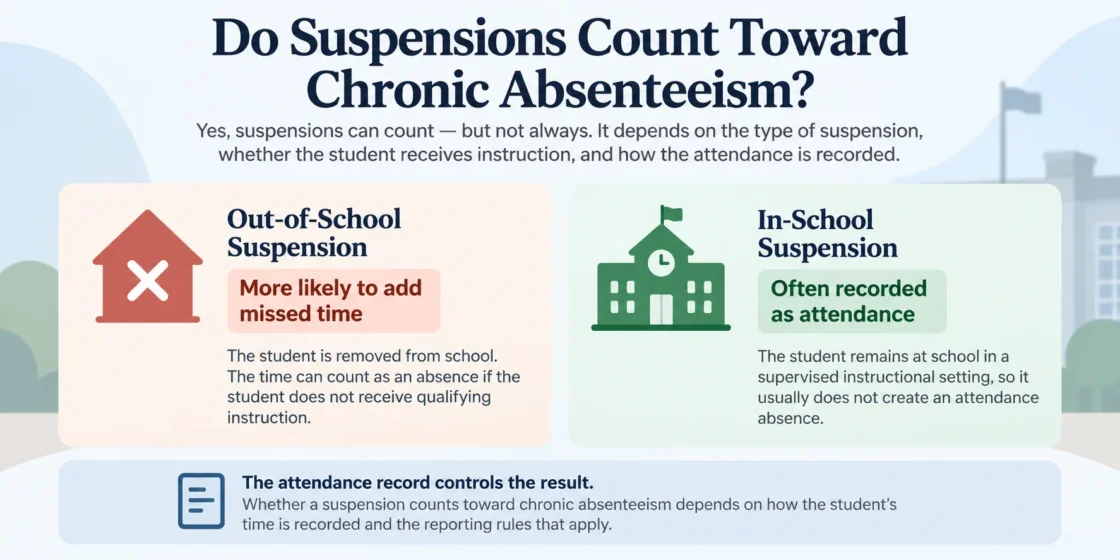
Suspensions can count toward chronic absenteeism, but a suspension day is not automatically an absence in every attendance system. Out-of-school suspension is more likely to add missed instructional time when the student does not receive qualifying instruction. In-school suspension is often treated as attendance because the student remains in an instructional setting. The official result depends on the attendance record and the reporting rules that apply, not on the discipline label alone.
Out-of-School and In-School Suspension Are Counted Differently
Chronic absenteeism generally measures the share of school time a student misses. The U.S. Department of Education commonly describes a student as chronically absent after missing at least 10% of school days for any reason, including excused and unexcused absences. Its EDFacts reporting specification adds an operational detail: a student is absent when the student is neither physically on school grounds nor participating in instruction or instruction-related activities at an approved off-campus location for at least half of the school day.
That definition makes the student’s access to instruction relevant when a suspension is recorded.
More likely to add missed time
The student is removed from the regular school setting. Whether the time counts as absence can depend on whether qualifying instruction continues elsewhere.
Often recorded as attendance
The student remains at school or another supervised instructional setting, so the disciplinary removal may not create an attendance absence.
When Out-of-School Suspension Adds to the Absence Total
An out-of-school suspension can contribute to chronic absenteeism when the student loses school time that the applicable attendance system records as absent. A three-day suspension that produces three countable absence days can therefore be added to illness, family, transportation, or other absences when the chronic-absence percentage is calculated.
The situation changes when an educational agency provides recognized instructional services during the removal. Approved instruction at another location, an alternative educational placement, or another qualifying arrangement can be treated differently from a day when the student receives no qualifying instruction.
A worksheet, textbook assignment, or online task sent home does not by itself reveal how the day will be counted. The relevant question is whether the activity qualifies as instruction under the applicable attendance rules and how the student’s attendance was actually recorded.
Why In-School Suspension May Not Count as an Absence
In-school suspension removes a student from the regular classroom without necessarily removing the student from school or instruction. A student may spend the day in a separate room, supervised program, or other designated setting while remaining officially present.
California provides a clear example. For its Chronic Absenteeism Indicator, out-of-school suspension is included among the absence categories used in the numerator, while days attended during in-school suspension are not counted as absences. Ohio’s 2025–26 attendance methodology likewise counts in-school suspension as attendance hours.
The Attendance Record Controls More Than the Discipline Label
A school can maintain information about discipline and attendance separately. Seeing OSS, ISS, suspended, or another disciplinary code therefore does not always reveal whether the same time entered the chronic absenteeism calculation as an absence.
The practical sequence is:
- The school records the disciplinary action.
- The student’s presence, absence, or instructional participation is recorded for the affected time.
- The state or local reporting method determines which attendance categories enter the chronic-absence calculation.
- The countable missed time is compared with the student’s applicable enrollment or expected-attendance denominator.
This is also why two students with the same length of suspension can end up with different attendance results. One may receive qualifying instructional services throughout the removal while another may have the same hours recorded as absent.
California, Ohio, and New York Show the Range of Suspension Rules
There is no safe nationwide rule that every suspension day should simply be added to the absence total. Current state systems illustrate several ways the same disciplinary event can be handled.
| System | Out-of-School Suspension | In-School Suspension | What Determines the Attendance Result |
|---|---|---|---|
| California Chronic Absenteeism Indicator | Counted as an absence category | Days attended in ISS are not counted as absences | California’s reported attendance categories distinguish OSS from attendance during ISS |
| Ohio 2025–26 report-card methodology | Attendance hours when instructional services are provided; otherwise the hours are reported as an unexcused absence | Counted as attendance hours | Whether the student receives instructional services during the suspension |
| New York 2025–26 accountability Attendance indicator | Suspension itself is not classified as an excused or unexcused absence because suspended students are required to receive instruction | Suspension status alone does not create an absence | The attendance associated with the instruction provided during the suspension |
California therefore gives a direct example of OSS entering a chronic-absence numerator. Ohio makes the treatment of OSS dependent on instructional services. New York’s current accountability attendance calculation separates the suspension itself from absence status because instruction is required during the suspension.
A school’s official state reporting method may use days, hours, expected attendance days, attendance codes, or another defined unit. The rule for one state does not establish how another state must count a suspended student.
A Suspension Can Push a Student Across the 10% Threshold
When suspension time is counted as absence, it joins the student’s other countable missed time. The reason for each absence does not have to be the same. A student can be below the chronic-absence threshold before a suspension and reach it once the suspension time is included.
| Enrollment or School Days | Other Absence Days | Countable Suspension Days | Total Missed Days | Final Absence Rate |
|---|---|---|---|---|
| 90 | 6 | 3 | 9 | 10.0% |
| 150 | 11 | 4 | 15 | 10.0% |
| 180 | 13 | 5 | 18 | 10.0% |
In the 180-day example, 13 other absences equal about 7.2% of the school year. Adding five countable suspension days produces 18 missed days, or 10%. The disciplinary removal is therefore the portion of missed time that moves the student across the commonly used chronic-absence mark.
This does not imply that the student voluntarily chose to miss all 18 days. Chronic absenteeism is a measure of missed school time; it does not assign one reason or one form of responsibility to every absence included in the calculation.
Ten percent of 180 days is 18 days, but a student enrolled for 150 applicable days reaches 10% at 15 days. Systems that measure attendance in hours require an hour-based calculation instead.
Partial-Day Suspensions May Be Counted by Days, Hours, or Attendance Periods
A suspension does not always cover a full school day. A student may be sent home after part of the day, removed for several class periods, or assigned a shortened disciplinary schedule. The amount that enters an attendance calculation depends on the unit used by that system.
For federal EDFacts chronic absenteeism reporting, the absence definition uses at least half of the school day when determining whether a student was absent under the applicable definition. A state can use a different operational system for its own reporting. Ohio, for example, measures chronic absence through attendance hours rather than simply counting full calendar days.
Because of those differences, a statement such as “three missed periods always equal one absence day” is not reliable nationwide. The attendance record should show how the partial time was converted or accumulated.
Making Up Schoolwork Does Not Automatically Remove a Suspension Absence
Academic work and attendance records serve different purposes. Completing assignments missed during a suspension can protect academic progress without automatically changing an absence that was already recorded.
The same distinction applies to attendance-recovery programs. California’s Attendance Recovery program allows qualifying students to recoup certain absences for attendance-accounting purposes, but suspension absences are specifically ineligible for Attendance Recovery. California also states that Attendance Recovery does not change the chronic absenteeism figures used for the 2026 Dashboard or DataQuest; those recovery days are collected separately for an alternative chronic absenteeism rate.
For a student receiving instruction during the suspension itself, the issue is different. If the applicable reporting system recognizes that instruction as attendance, the time may never become a countable absence in the first place.
A Suspension Can Affect Chronic Absence Without Counting Toward Truancy
Chronic absenteeism and truancy do not ask the same question. Chronic absenteeism generally measures how much school time was missed. Truancy usually concerns unexcused attendance under state or local rules.
Ohio provides a direct example. Its current attendance guidance says hours missed because of an out-of-school suspension can contribute to chronic absence when they are recorded as missed time, while those suspension hours do not count toward the state’s habitual-truancy triggers. A student can therefore accumulate chronic-absence time from a suspension without those same hours being treated as truancy.
A chronic-absence calculation should not be used by itself to decide whether a student has met a truancy threshold. Truancy status follows the applicable state law and local attendance rules.
What to Check When Suspension Days Appear in an Attendance Total
The most useful record is the student’s official attendance history for the exact suspension dates. The following details can show why the days were included or excluded:
- Suspension type: confirm whether the action was recorded as in-school or out-of-school suspension.
- Attendance code: check whether each affected day or hour is marked present, absent, excused, unexcused, suspended, or under another local code.
- Instructional services: determine whether the student received instruction that the school or state recognizes for attendance purposes during the removal.
- Measurement unit: identify whether the system calculates missed time by full days, partial days, hours, or another attendance unit.
- Enrollment denominator: use the student’s applicable enrolled or expected-attendance time rather than assuming every calculation uses a 180-day school year.
- Reporting method: distinguish the attendance total visible in a local student portal from any separate method used for state reporting or accountability.
- Record corrections: if a suspension was shortened, rescinded, or recorded incorrectly, verify whether the related attendance entries were also corrected.
For an individual student, the official attendance record and the rule used by the relevant school system or state determine whether suspension time enters the chronic absenteeism calculation. A suspension code by itself is not enough to establish the answer.