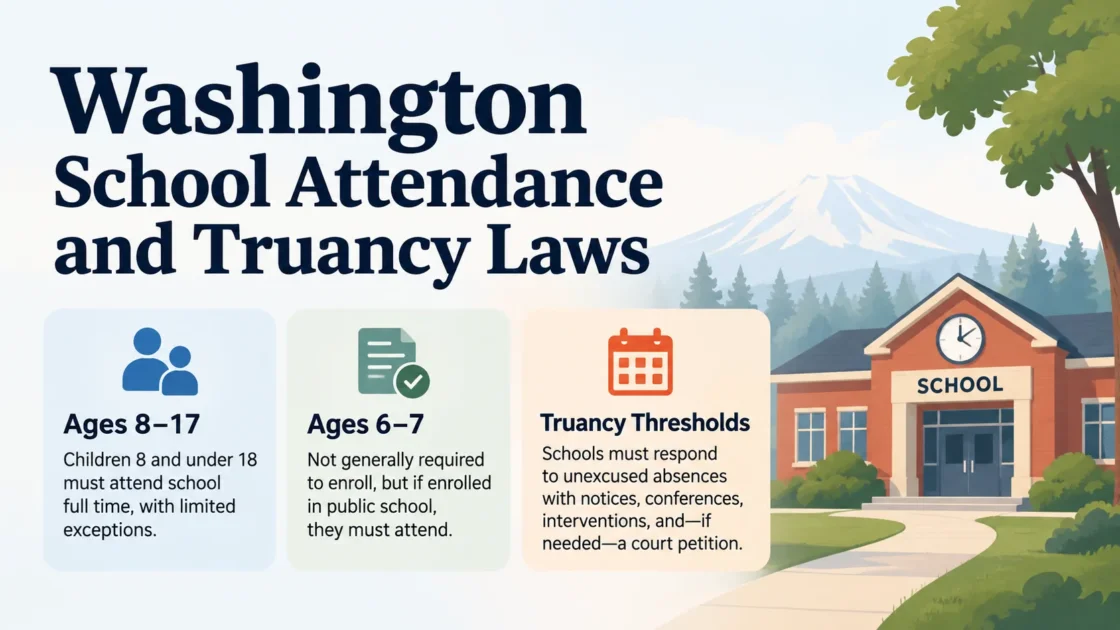
Who Must Attend School in Washington?
Washington’s compulsory attendance law generally applies to children who are 8 years old and under 18. A parent, guardian, or person with legal custody must ensure that a child covered by the law attends school full time unless a statutory exception applies.1
Recognized alternatives and exceptions include attendance at an approved private school, qualifying home-based instruction, certain education centers, an approved temporary excuse, and limited circumstances for students age 16 or older. A student who is at least 16 may qualify for an exception if the student meets specified employment and parental or emancipation conditions, has completed graduation requirements, or has received a certificate of educational competence.1
Washington does not generally require a six- or seven-year-old child to enroll in school. Once a parent enrolls a child of that age full time in public school, however, the child must attend. A parent may formally withdraw the child before age eight if a truancy petition has not already been filed.2
Washington Truancy Thresholds
Washington’s truancy process is based on unexcused absences. The law requires schools to respond before a case reaches the juvenile court stage.
| Attendance Point | Required School or District Response |
|---|---|
| 1 unexcused absence in a month | The school must notify the parent in writing or by telephone and explain the possible consequences of additional unexcused absences.3 |
| 3 unexcused absences in a month | The school must schedule a conference with the parent and child to examine the causes of the absences. If the parent does not attend, the conference may proceed with the student and a school official.3 |
| After the 2nd and before the 7th unexcused absence | The school must take data-informed steps intended to eliminate or reduce the absences. The required response varies with the student and may include assessment, program changes, services, or referral for additional support.3 |
| No later than the 7th unexcused absence in a month | The district must enter into an attendance agreement with the student and parent, refer the student to a community engagement board, or file a truancy petition when the statutory conditions for filing are met.4 |
| 7 unexcused absences in a month / 15 in the school year | For a child under 17, if the required district interventions have not substantially reduced the absences, the district must file a juvenile-court petition after the seventh unexcused absence in a month and no later than the fifteenth unexcused absence in the school year. The statute does not prevent a district from filing for a 17-year-old.4 |
What Counts as an Unexcused Absence?
For the compulsory-attendance chapter, an unexcused absence generally involves a student missing the majority of hours or periods in an average school day, or failing to comply with a more restrictive district policy, while also failing to meet the district’s rules for an excused absence. Separate attendance requirements apply to alternative learning experience programs.3
Washington administrative rules require absences to be excused for several identified reasons. These include physical or mental health symptoms or appointments, a family emergency, religious or cultural purposes, court proceedings, certain postsecondary visits, circumstances connected with homelessness or foster care, specified military-family activities, student safety concerns, migrant status, and other approved activities. Districts may establish additional categories for excused absences, and the principal or designee determines whether an absence meets state and district criteria.5
A student can accumulate many total absences without reaching Washington’s truancy petition thresholds if those absences are excused. Schools may still be required to respond to excessive excused absences, particularly in elementary school.
Excessive Excused Absences in Elementary School
For an elementary student covered by Washington’s attendance laws, the district generally must schedule an attendance conference when the child reaches five or more excused absences in one month or ten or more excused absences during the school year. The purpose is to identify barriers to regular attendance and determine what support may help the student and family.6
The conference is not required when prior notice of the excused absences has been provided to the school, or a doctor’s note has been provided, and an academic plan is in place so the student does not fall behind.6
What Schools Must Do Before Court Action
Washington law requires more than simply counting absences. After the second and before the seventh unexcused absence, the school must use data-informed steps to reduce the attendance problem.3
- For middle and high school students, the process must include the Washington Assessment of the Risks and Needs of Students, known as WARNS, or another assessment completed by the district’s designee.
- For a student with an existing IEP or Section 504 plan, the IEP or 504 team must be convened to consider the reasons for the absences.
- Available responses can include instructional changes, individualized or remedial instruction, vocational or work-experience options, supplementary services, an alternative program, or referral to a community engagement board.
These interventions are drawn from the same statutory duties that govern the early stages of the truancy process.3
What Happens When a Truancy Petition Is Filed?
A truancy petition does not automatically lead directly to a contested court hearing. When a petition is filed under Washington’s truancy statutes, the juvenile court generally places the petition on an initial stay and refers the child and parent to a community engagement board or another coordinated intervention established between the court and school district.7
When the case is referred to a community engagement board, the board must meet with the child, a parent, and the school district representative and work toward an agreement addressing the truancy within 20 days of the referral. If no agreement is reached, or the agreement is not followed within its timeline, the matter may return to juvenile court and the stay may be lifted.7
Possible Court Orders and Parent Penalties
If the juvenile court assumes jurisdiction, it may order an older child subject to the truancy petition to attend school and may use other education, assessment, or service-based measures permitted by statute. If the child later fails to comply with a court order, the court may use responses such as community restitution, nonresidential programs with intensive wraparound services, mentoring, or other appropriate services and interventions.8
A parent who violates the compulsory-attendance provisions may be fined up to $25 for each day of unexcused absence. State law also provides defenses, including showing reasonable diligence in trying to cause the child to attend school or showing that the school did not perform its required attendance duties. A court may use community restitution instead of a fine, and a fine may be suspended when the parent participates in a supervised attendance plan or required attendance conferences.8
Truancy Rules for Enrolled Six- and Seven-Year-Olds
The court process is different for younger children. If a six- or seven-year-old is voluntarily enrolled full time in public school and remains subject to the attendance requirement, the school must provide notice after one unexcused absence in a month, request a conference after three unexcused absences in a month, and take steps to reduce the absences.2
After the child’s seventh unexcused absence in a month and no later than the fifteenth unexcused absence during the school year, the district must file the civil petition described by law against the parent. Washington’s statutory court-order provisions for the child do not apply to a six- or seven-year-old covered by this rule.28
Do Absences Reset After a School District Transfer?
No. When a student transfers from one Washington school district to another during the school year, the receiving district must include the unexcused absences accumulated in the previous district when applying the state truancy requirements. The sending district must also provide relevant truancy assessments, intervention history, and the most recent required truancy information.3
Washington law establishes statewide attendance duties and truancy thresholds, but local districts maintain attendance procedures and may use more restrictive rules when defining an unexcused absence. Whether a particular absence is excused, how documentation is submitted, and how a student’s attendance record is coded should be checked with the student’s school or district.