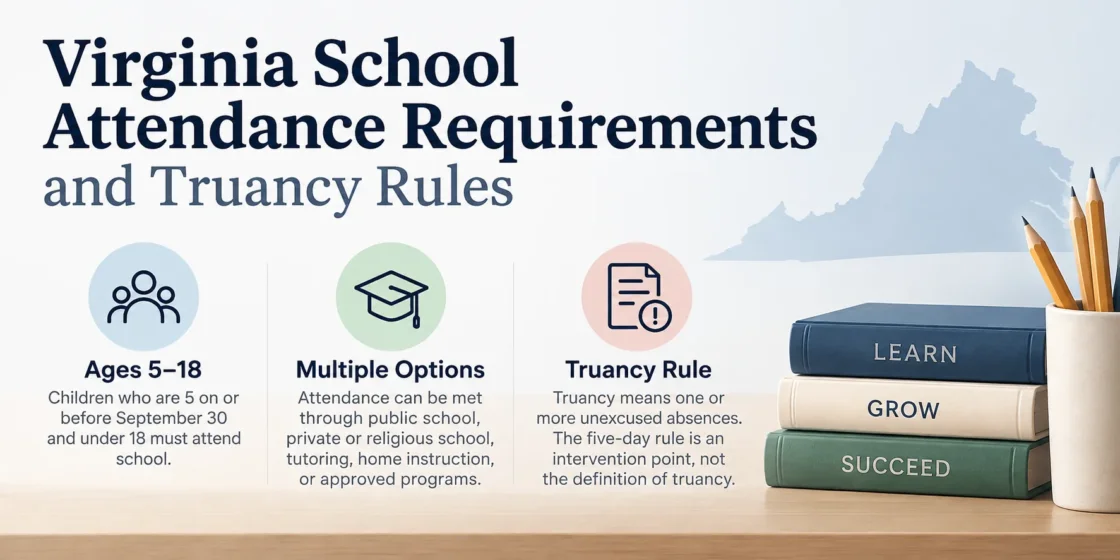
Virginia generally requires a child who reaches age five on or before September 30 and has not passed age eighteen to satisfy the Commonwealth’s compulsory attendance requirement. Attendance may be satisfied through public school, qualifying private or religious school, approved tutoring, lawful home instruction, or certain alternative education arrangements. Virginia also allows a one-year delay for some children who have not reached age six by September 30 when the parent or guardian gives the required notice.1
Under the current Virginia Administrative Code, truancy means accruing one or more unexcused absences. The five-day rule found in Virginia’s attendance statute is an intervention point under specific circumstances; it is not the definition of truancy.
Who Is Required to Attend School in Virginia?
The general compulsory-attendance rule applies when a child will have reached the fifth birthday on or before September 30 of the school year and has not passed the eighteenth birthday. The parent, guardian, or other person responsible for the child must arrange a form of education allowed by Virginia law.1
The requirement does not mean every covered child must attend a traditional public-school building. Virginia recognizes several ways to satisfy compulsory attendance, including:
- attendance at a public school;
- attendance at a private, denominational, or parochial school;
- instruction by a tutor or teacher who meets applicable requirements;
- home instruction that complies with Virginia law; and
- certain approved alternative study or work-study programs.
For a five-year-old who is subject to compulsory attendance, attendance at an eligible public or private prekindergarten program, including a Head Start program, can also satisfy the requirement.1
Some Five-Year-Olds May Delay Attendance for One Year
A child who will not have reached age six on or before September 30 may delay school attendance until the following year if the parent or guardian notifies the appropriate school board that the child is not mentally, physically, or emotionally prepared to attend school. The statute places this decision with the parent or guardian, subject to the notice requirement.1
This provision should not be read as a general rule that kindergarten or school attendance is optional for every five-year-old. It applies to the specific one-year delay described in the statute.
Turning 16 Does Not Automatically End Compulsory Attendance
Virginia does not create a general right to stop attending school simply because a student turns sixteen. A local school board may allow a student who is at least sixteen to satisfy the attendance requirement through an individual student alternative education plan developed with the student, parent, and school principal or designee.1
The statutory plan includes career guidance counseling, enrollment and attendance in an approved high-school-equivalency preparation or alternative education program, work toward an approved career and technical education credential, completion of economics and personal finance, counseling about the economic effects of failing to complete high school, and procedures for reenrollment.
A student who receives such a plan and then fails to comply with its conditions can again be in violation of the compulsory-attendance law.1
Excused, Unexcused, and Truant Mean Different Things
Virginia’s current administrative rules define these terms separately. The classification of an absence matters because the truancy rules focus on unexcused absence, while other attendance measures can count missed time regardless of the reason.2
Reason accepted by the school
An entire assigned instructional school day missed for a reason provided by the parent and accepted by school administration.
State definition is more specific
A full scheduled instructional day is missed and the conditions in Virginia’s administrative definition are met.
An unexcused absence can result when the student misses the entire scheduled instructional school day and school personnel receive no indication within five days that the parent is aware of and supports the absence. It can also result when the parent gives a reason that the school administration finds unacceptable.2
The school administration may later change an unexcused absence to excused when an acceptable reason is provided or the school determines that extenuating circumstances apply.
Examples listed in the state regulation for an excused absence include illness, mental-health or substance-abuse illness, injury, a funeral, legal obligations, medical procedures, suspension, religious observance, and military obligation. These are examples within the state definition; the reason still has to satisfy the applicable attendance rule unless another statute specifically requires the absence to be excused.2
Truancy Can Begin With the First Unexcused Absence
Virginia’s current definition of truancy is the act of accruing one or more unexcused absences.2
A student does not have to reach five unexcused absences before the term truancy can apply. Five scheduled school days appears in the separate statutory process governing parent contact and an attendance plan when additional conditions are present.
Older Virginia materials may refer to 8VAC20-730 for truancy-related definitions and reporting. Chapter 730 was repealed effective November 6, 2025. The current definitions are contained in 8VAC20-720.3
What Happens When Unexplained Absences Accumulate?
Virginia’s statutory attendance process is conditional. The number of days matters, but so do parent awareness, school contact attempts, continued nonattendance, and what happens after direct contact. A simple rule such as “five absences means court” does not describe the statute accurately.4
The School First Tries to Explain an Unreported Absence
When a student fails to report on a regularly scheduled school day and the school has no indication that the parent is aware of and supports the absence, the principal, attendance officer, other school personnel, or designated volunteers must make a reasonable effort to contact the parent by telephone and obtain an explanation.4
Five Scheduled School Days Can Trigger an Attendance Plan
If the student has failed to report for a total of five scheduled school days during the school year, the school has no indication that the parent is aware of and supports the absences, and reasonable efforts to notify the parent have failed, the principal or designee must make a reasonable effort to establish direct contact with the parent.4
The school explains the consequences of continued nonattendance. The principal or designee, student, and parent then jointly develop a plan intended to resolve the nonattendance. The plan must document the reasons for the student’s nonattendance.
The statutory five-day provision is written around five scheduled school days of nonattendance plus specific parent-notification conditions. Separately, an absence can be classified as unexcused when a parent supplies a reason that the school finds unacceptable. The two provisions should not be collapsed into a single five-unexcused-days rule.
Continued Absence Can Lead to a Conference
After direct contact with the parent, if the student is absent for more than one additional day and the school still has no indication that the parent is aware of and supports the absence, the principal or designee must schedule a conference with the student, parent, and school personnel. An attendance officer and community service providers may also participate.4
The conference must be held no later than 10 school days after the student’s tenth absence. It can proceed even if the parent does not approve of the conference. The team may continue monitoring attendance and meet again if attendance does not improve.
An Attendance-Officer Referral Is Not Automatic at a Single Number
A referral to the attendance officer is required when the parent is intentionally noncompliant with compulsory-attendance requirements or when the student resists the parent’s attempts to comply. The attendance officer then schedules a conference with the student and parent within 10 school days and may pursue the court options authorized by the statute.4
Possible action includes a complaint alleging that the student is a child in need of supervision or proceedings against the parent. When a complaint involving the student is filed, the attendance officer must provide written documentation of the school’s efforts to comply with the attendance-intervention requirements.
The tenth absence appears in the deadline for holding an attendance conference. Court involvement depends on the later statutory conditions and actions; it is not an automatic consequence of reaching ten absences.
Virginia Law Specifically Protects Several Types of Absence
Some absence situations are addressed directly in § 22.1-254 rather than being left only to the ordinary local excused-absence process.1
| Situation | State Rule |
|---|---|
| Mental or behavioral health | Subject to Department guidelines, an absence due to the student’s mental or behavioral health must be excused. |
| Religious holiday | Each local school board must maintain policies for excusing students for religious-holiday observance and protecting specified academic opportunities when the absence is properly verified. |
| Civic event | A middle or high school student must be permitted one full-day excused absence per school year to participate in a civic event, subject to Department guidelines. A division may allow additional days. |
| Qualifying tribal pow wow | An eligible student who is a member of a state- or federally recognized tribal nation headquartered in Virginia must receive one excused absence per academic year to attend the tribal nation’s pow wow when the required advance notice is provided. |
| Military-family deployment visit | A student with an immediate family member on active duty who has deployment orders, is on leave from deployment, or recently returned from deployment outside the United States is allotted five excused absences for visitation connected with the deployment. The division may request written verification. |
The five-day military-family provision is part of the current version of § 22.1-254 and took effect July 1, 2026.1
Local school divisions still administer attendance records and may establish procedures for reporting an absence, supplying documentation, or requesting approval. A parent notifying the school does not by itself guarantee that every reason will be recorded as excused when the decision remains subject to school-administration acceptance.
Truancy and Chronic Absenteeism Measure Different Problems
Virginia’s truancy rules focus on unexcused absence. Chronic absenteeism instead measures the amount of school a student misses for any reason.
Unexcused absence
Virginia’s administrative definition begins when a student accrues one or more unexcused absences.2
10% of the academic year
Virginia defines chronic absenteeism as missing 10% or more of the academic year for any reason, including excused absences, unexcused absences, and suspensions.5
For a 180-day school year, 10% is about 18 days. A student can therefore be chronically absent because of repeated medically excused absences without those excused days becoming truancy. The reverse distinction also matters: one unexcused absence can fall within Virginia’s truancy definition even though the student is nowhere near the chronic-absence threshold.
Possible Consequences for the Student and Parent
Virginia’s attendance law emphasizes notification, direct contact, an attendance plan, a conference, and attendance-officer involvement before the later enforcement options described in § 22.1-258. Court action should therefore not be treated as the automatic result of a particular raw absence count.4
Truancy Alone Cannot Be the Sole Reason for Suspension or Expulsion
Virginia law states that sufficient cause for suspension or expulsion cannot consist only of truancy. A school may have other lawful grounds for discipline in a particular case, but truancy by itself cannot be the sole basis for suspending or expelling the student.6
Continued attendance violations can instead lead to the attendance-officer and juvenile-court processes described in the compulsory-attendance statutes.
A Parent Can Face Proceedings for Noncompliance
Virginia law permits proceedings against a parent in circumstances covered by the compulsory-attendance statutes. A violation of specified compulsory-attendance provisions can constitute a Class 3 misdemeanor. A knowing and willful violation following a previous conviction for specified attendance-law violations can constitute a Class 2 misdemeanor.7
The misdemeanor provision concerns violations of specified attendance-law duties. It does not convert every student absence, every unexcused day, or every attendance notice into a criminal case.
What to Check After Receiving a Virginia Attendance Notice
An attendance notice is easier to evaluate when the school record, absence classifications, and stage of the statutory process are separated.
- Check the dates. Confirm which full school days the school recorded as absent.
- Check each classification. Determine which days are marked excused and which are marked unexcused.
- Check what the school received. A parent explanation may affect the record, but a reason that the administration does not accept can still result in an unexcused absence.
- Distinguish a contact notice from an attendance plan. An initial parent-contact attempt is not the same stage as the five-day attendance-plan process.
- Read any attendance plan. The plan should address the reasons for nonattendance and the steps intended to resolve it.
- Check whether a conference has been scheduled. A conference is part of the intervention process and is different from a court filing.
- Separate truancy from chronic absence. The school may be tracking both, but the two measures use different definitions.
- Check the local division policy. Local procedures can affect how parents report absences, what documentation is requested, and how the school’s official attendance record is maintained.
State Law Sets the Main Rules, but the School Record Still Matters
Virginia law supplies the compulsory-attendance requirement, statewide attendance definitions, intervention process, and certain protected excused absences. Local school divisions maintain the student’s attendance record and apply their attendance procedures within those state requirements.
A particular student’s legal or administrative status cannot be determined from an absence count alone. Enrollment dates, the dates actually missed, whether full instructional days were missed, the school’s classification of each absence, explanations and documentation supplied by the parent, prior contact attempts, an existing attendance plan, and any formal notices can all affect where the student is in the attendance process.
For that reason, the school’s current attendance record and the applicable division policy should be read together with Virginia’s current statutes and regulations when evaluating an individual attendance case.