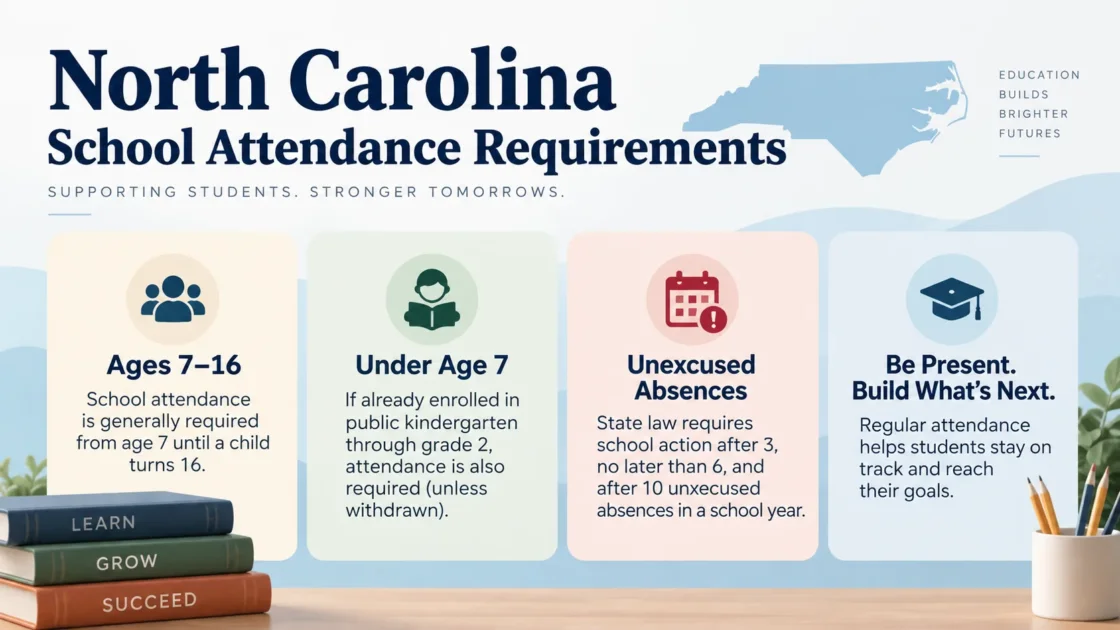
North Carolina generally requires school attendance from age 7 until a child turns 16. A child under 7 who is already enrolled in a public school in kindergarten through grade 2 must also attend unless the child is withdrawn. For unexcused absences, state law requires school action after 3, no later than 6, and after 10 accumulated unexcused absences in a school year.
Who Must Attend School in North Carolina?
North Carolina General Statutes § 115C-378 places the attendance duty on the parent, guardian, or custodian of a child who is between ages 7 and 16. In practical terms, the general compulsory-attendance period covers ages 7 through 15, ending when the child turns 16.
| Student situation | State attendance requirement |
|---|---|
| Under age 7 and not enrolled in public K–2 | The general compulsory-age requirement has not yet begun. |
| Under age 7 and enrolled in public kindergarten, grade 1, or grade 2 | Attendance is required while the child remains enrolled, unless the child is withdrawn from school. |
| Age 7 through age 15 | The child is within North Carolina’s general compulsory-attendance ages. |
| Age 16 or older | The student is outside the general compulsory-age range, but an enrolled student can still be subject to school attendance, course-credit, promotion, and other applicable requirements. |
A parent, guardian, or custodian must also tell the school the reason for each known absence in the manner required by the local school board’s policy. Reporting an absence does not automatically make it excused. The reason must qualify under state attendance rules or an applicable local policy.
When Is a Student Counted Present for the Day?
For North Carolina public schools, the Department of Public Instruction’s 2026–27 School Attendance and Student Accounting Manual requires attendance to be recorded each school day. For ordinary on-site attendance, a student generally must be present for at least one-half of the school’s instructional day to be recorded present for that day. Certain state attendance codes receive separate treatment, including some approved off-site or instructional situations.
The same 50% threshold applies to an on-site student’s initial enrollment day. Remote and blended instruction have separate attendance procedures, so a simple seat-time calculation does not cover every instructional setting.
Tardies and Early Checkouts
North Carolina records excused and unexcused tardies and early checkouts separately, with the student’s time present recorded. A public school unit may not create an SIS policy that converts a fixed number of unexcused tardies into an unexcused absence. A rule such as “three tardies equal one unexcused absence” is therefore not a statewide North Carolina attendance rule and may not be used to convert SIS attendance records in that way.
The half-day attendance rule still applies to the student’s daily present-or-absent status. A very late arrival or early departure can affect whether the student was present for enough of the instructional day, even though tardies themselves cannot simply be converted into absences by a local numerical formula.
Which Absences Can Be Excused?
North Carolina law and State Board attendance rules identify lawful reasons for missing school. The school may require satisfactory evidence or advance notice where the rule calls for it, and local procedures can determine how documentation is submitted.
| Reason | Main rule or condition |
|---|---|
| Illness or injury | State law includes physical or mental illness; NCDPI also maintains an illness-or-injury attendance code. |
| Medical or dental appointment | An absence for the student’s medical or dental appointment may be coded lawful. |
| Death in the immediate family | NCDPI recognizes an absence caused by the death of a member of the student’s immediate family. |
| Required quarantine | A quarantine ordered by an authorized health authority can be treated as a lawful absence. |
| Court or administrative proceeding | Applies when the student is a party to the proceeding or is under subpoena as a witness. |
| Religious observance | Principals must authorize at least two excused absences each academic year for qualifying religious observances, with an opportunity to make up missed tests or work. |
| Valid educational opportunity | Requires demonstrated educational value and approval before the absence. Travel can qualify, but it is not automatically excused. |
| Immediate demands of the farm or home | NCDPI allows up to five days in certain seasons under stated documentation and approval conditions. |
| Equestrian or agricultural event | Principals must authorize at least two excused absences each academic year for qualifying equestrian sporting events, livestock shows, or similar agricultural events, with make-up work available. |
| Qualifying military leave | At least two excused absences each academic year are required when the statutory active-duty, deployment, and academic-risk conditions are met. |
| Illness or medical appointment of a student’s child | NCDPI provides a lawful code when the student is the custodial parent. |
| Inaccessible roads after a natural disaster | NCDPI provides a lawful absence code when roads are inaccessible because of a natural disaster. |
“Excused” describes the legal or attendance-code status of the missed time. It does not automatically mean the student was present, and it does not guarantee that every local course-credit or promotion requirement is satisfied.
Educational Travel Requires Approval Before the Absence
NCDPI lists travel as an example of a possible valid educational opportunity, but the educational value must be demonstrated and approval must be granted before the absence occurs. A family vacation does not become excused merely because travel is involved. The school must approve it under the educational-opportunity rule or another applicable lawful category.
Released-Time Religious Instruction in 2026–27
Beginning with the 2026–27 school year, Session Law 2026-41 added released-time religious instruction to North Carolina’s excused-absence rules. The law defines it as religious instruction offered by a private entity during the school day and requires public school units to adopt a policy allowing qualifying absences. Session Law 2026-61 later clarified the weekly time limit.
- The parent or guardian must provide the school’s signed consent form and is responsible for transportation to and from the instruction location.
- The parent or guardian must provide written documentation confirming attendance for each day the student is absent for the instruction.
- The student must make up missed schoolwork.
- The public school unit may not use State or local funds to facilitate attendance, apart from minor administrative costs allowed by law.
- A private entity generally may not provide the instruction on school property unless a neutral facility-use policy permits it.
- The public school unit must authorize excused absences for at least one, but no more than four, hours of released-time religious instruction per calendar week.
What Happens After 3, 6, and 10 Unexcused Absences?
North Carolina does not wait for a student to reach 10 unexcused absences before requiring school action. G.S. 115C-378 establishes an escalating process during the school year.
Parent or guardian notification
The principal or designee must notify the parent, guardian, or custodian that the child has excessive absences.
Mailed compulsory-attendance warning
The principal or designee must notify the parent, guardian, or custodian by mail that the compulsory-attendance law may be violated and prosecution may be possible if the absences cannot be justified. The attendance counselor then works with the student and family to examine the causes and determine steps or services that may resolve the attendance problem.
Good-faith review
The principal or designee reviews the attendance reports and, if possible, confers with the student and family to determine whether notice was received and whether the parent, guardian, or custodian made a good-faith effort to comply with the law.
Ten Unexcused Absences Do Not Create an Automatic Court Outcome
The 10-absence point starts a required review; it is not a rule saying that the parent is automatically prosecuted on the tenth unexcused absence. If the principal determines that the parent, guardian, or custodian did not make a good-faith effort to comply, the principal must notify the district attorney and the director of social services for the county where the child resides.
If a good-faith effort was made, the principal may instead file a complaint with the juvenile court counselor alleging that the child is habitually absent from school without a valid excuse.
North Carolina law provides that a parent, guardian, or other person who violates the compulsory-attendance provisions can be guilty of a Class 1 misdemeanor, subject to the statute’s exceptions. That penalty is not an automatic result of reaching 10 unexcused absences; the statutory review and enforcement steps still apply.
The State Board’s Ten-Day Rule Is a Different 10-Day Measure
North Carolina uses another “10-day” rule for student accounting. It should not be confused with the compulsory-attendance process based on 10 accumulated unexcused absences.
10 accumulated unexcused absences
Counted across the school year. This triggers the G.S. 115C-378 good-faith review and possible enforcement steps.
10 consecutive unlawful absences
This is a student-accounting rule tied to funded membership and average daily membership. The student remains enrolled and continues to receive the appropriate absence code.
At least 10% of days enrolled
For North Carolina public-school reporting, a student enrolled at least 10 school days is chronically absent after missing at least 10% of enrolled days for any reason, including excused, unexcused, or disciplinary absences.
The statute’s 3–6–10 process focuses on unexcused absences and enforcement. The State Board Ten-Day Rule focuses on 10 consecutive unlawful absences and funded membership. Chronic absenteeism is a reporting measure based on missed days for any reason. One student can fall under more than one measure, but the measures do not have the same purpose or threshold.
There Is No Single Statewide Maximum Number of Absences
North Carolina does not give every student one statewide number of “allowed absences” that controls every attendance consequence. Several rules operate at the same time: the 3–6–10 unexcused-absence process, the 10-consecutive-day student-accounting rule, the chronic-absence measure, and local requirements affecting course credit or promotion.
NCDPI states that local boards may establish or authorize minimum-days-of-attendance policies for course credit or promotion when no controlling State Board policy or state law sets a different rule. A student can therefore have an absence that is lawfully excused but still need to satisfy academic attendance requirements or make-up rules under the applicable local policy.
In the North Carolina SIS, an out-of-school suspension is an excused absence for attendance coding. A suspension absence may not be used for a compulsory-attendance violation action, and suspension days do not count toward the State Board Ten-Day Rule.
When an Attendance Record Appears Incorrect
Because North Carolina distinguishes full-day attendance, tardies, early checkouts, lawful absences, and unlawful absences, a record dispute should focus on the exact entry rather than only the total number of missed days.
- Check the date and the amount of time the student was actually present.
- Confirm that the reason for the absence was reported under the local board’s procedure.
- Check whether documentation was required and whether it was submitted.
- For an educational opportunity, confirm that approval was obtained before the absence.
- For released-time religious instruction, confirm that the consent and attendance-documentation requirements were met.
- Ask the school to verify whether the record is coded as excused, unexcused, tardy, early checkout, or another applicable state attendance status.
Individual determinations about a student’s official attendance status, compulsory-attendance compliance, course credit, promotion, or related action depend on the school’s official record and the state and local rules that apply to that student.