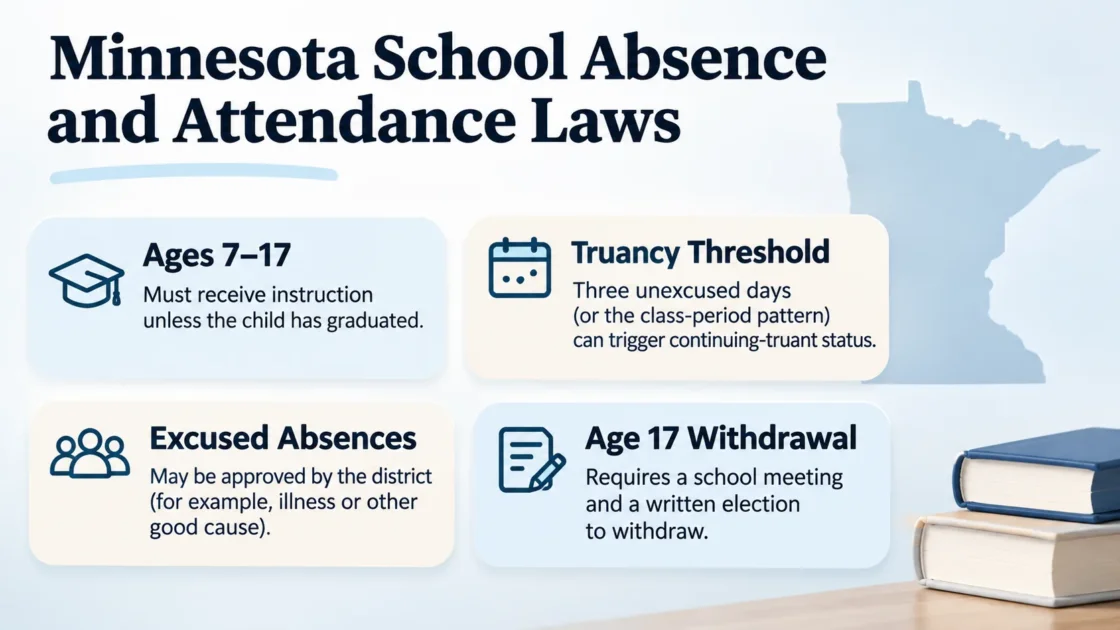
Minnesota school attendance law combines compulsory-instruction rules, lawful excuses, local district attendance policies, truancy thresholds, and separate child-welfare reporting requirements. The statutory wording generally requires children between ages seven and 17 to receive instruction unless they have graduated, while special rules apply to younger enrolled children and to 17-year-olds who want to withdraw from school.1 Truancy is based on absences without a valid or lawful excuse and begins at lower thresholds than the later habitual-truancy and attendance-concern reporting stages.2
Three unexcused days or the applicable class-period pattern can trigger continuing-truant status. Seven unexcused absences can bring separate habitual-truancy or educational-neglect rules into play, depending on age and circumstances. A 15-consecutive-school-day absence also has a separate enrollment-record consequence.
Who Is Required to Attend School in Minnesota?
Minnesota’s compulsory-instruction statute states that every child between seven and 17 years of age must receive instruction unless the child has graduated. Instruction may be provided through a qualifying public school, nonpublic school, religious organization, or home school that complies with the applicable requirements.1
| Student Situation | Minnesota Rule |
|---|---|
| Age 7 to 17 | Must receive instruction unless the child has graduated. |
| Child under age 7 enrolled in kindergarten | The child may become subject to compulsory attendance, subject to the under-seven provisions and any applicable district exemption policy. |
| Child under age 7 being withdrawn | Where the compulsory-attendance provision applies, a parent or guardian may withdraw the child for good cause by notifying the district. Good cause includes enrollment in another school or the child’s immaturity and is not limited to those examples. |
| Student age 17 seeking to leave school | The student and parent or guardian must attend a meeting with school personnel about available educational opportunities and sign a written election to withdraw. |
For students under seven, enrollment matters. Once a child under seven is enrolled in kindergarten or a higher grade in a public school, the child is subject to the statutory provision unless the district board has a policy exempting children under seven. Where the provision applies, withdrawal for good cause ends that compulsory-attendance obligation for the withdrawn pupil.1
A 17-year-old therefore should not simply stop attending. Minnesota law provides a formal withdrawal process involving both a school meeting and a written election.1
Which School Absences Can Be Excused?
A parent, guardian, or other person having control of a child may apply to the district to have the child excused for all or part of the time school is in session. The application may be made to a truant officer or the school official designated by the principal. A district attendance policy may require written verification of the reason for an absence.1
Minnesota’s statutory grounds include circumstances in which a child’s physical or mental health prevents attendance or required study. Listed examples include:
- the child’s illness;
- medical, dental, orthodontic, or counseling appointments, including appointments conducted through telehealth;
- family emergencies;
- the death, serious illness, or funeral of an immediate family member;
- active duty in any military branch of the United States;
- a condition requiring ongoing treatment for a mental health diagnosis; and
- other exemptions included in the district’s school attendance policy.
A note from a physician or licensed mental health professional stating that the child cannot attend school is a valid excuse under the statute. Section 120A.22 lists grounds for excusing attendance rather than creating one statewide annual allowance of a particular number of excused days.1
Family travel or vacation is not listed as a separate statewide statutory category. Minnesota law allows districts to include other exemptions in their attendance policies, so the treatment and documentation of these absences can differ by district.
The law also permits an absence for instruction conducted by a Tribal spiritual or cultural adviser or qualifying religious school for periods totaling no more than three hours in a week. Separately, districts must make reasonable efforts to accommodate a student who wishes to be excused from a curricular activity for a religious observance or American Indian cultural practice, observance, or ceremony, and school boards must provide annual notice of the district policy covering those absences.3
When Does an Unexcused Absence Become Truancy?
Minnesota uses the term continuing truant once a student subject to compulsory instruction reaches a specific pattern of absences without a valid excuse during one school year.2
| School Level | Absence Without Valid Excuse | Result |
|---|---|---|
| Elementary school | Three days within one school year | Continuing truant |
| Middle school, junior high, or high school | Three or more class periods on three days within one school year | Continuing truant |
Schools do not have to wait until the statutory threshold is reached before contacting a family or addressing attendance problems. Section 260A.02 expressly allows a district or charter school to notify a parent or guardian and respond to attendance concerns before the student becomes a continuing truant.2
These thresholds concern unexcused attendance. A medically excused absence or another absence accepted under state law and district policy is not converted into truancy simply because the student has missed several school days.
What Happens After a Student Becomes a Continuing Truant?
When a child is initially classified as a continuing truant, the school attendance officer or another designated school official must notify the parent or legal guardian by first-class mail or another reasonable means.4
The notice must tell the parent or guardian, among other things:
- that the child is truant;
- that the school should be informed if a valid excuse exists for the absences;
- that the parent or guardian has an obligation to compel attendance;
- that alternative educational programs or services may be available;
- that the parent or guardian has a right to meet with appropriate school personnel to discuss solutions;
- that continued truancy may lead to juvenile court proceedings; and
- that juvenile proceedings may include possible consequences involving the child’s driving privilege.
The statutory notice also recommends that the parent or guardian accompany the child to school and attend classes with the child for one day.4
If truancy continues after the required notice, Minnesota law permits further intervention. Depending on the local structure, this can involve community-based services, a school attendance review board, a county attorney truancy mediation program, or a referral to the county attorney.5
The three-day threshold establishes continuing-truant status and triggers the statutory notification process. Later intervention depends on continued attendance problems, the student’s circumstances, and the procedures used by the school, county, or attendance program.
Minnesota also provides a petty-misdemeanor provision for a person who fails or refuses to provide required instruction to a child in that person’s legal custody after being notified by a truant officer or other official. The same statute addresses inducing a child to be unlawfully absent and knowingly harboring or employing a child who is unlawfully absent while school is in session.6
What Changes After Seven Unexcused Absences?
Seven unexcused absences matter under several Minnesota provisions, but they should not be treated as one universal rule.
Under the school-attendance concern reporting law enacted in 2025, a person who is a mandated reporter under Minnesota’s maltreatment-reporting chapter must immediately report to the local welfare agency, Tribal social services agency, or designated partner when the person knows or has reason to believe that a child required to be enrolled has at least seven unexcused absences in the current school year and is at risk of educational neglect under the statutory standard.7
A report alleging seven or more unexcused absences receives a child-welfare response under that section. The agency must offer services addressing the attendance concern or may work with a county attorney’s office, community organization, or other partner. If unexcused absences continue and the family does not engage after multiple varied attempts at engagement, the statute provides for an educational-neglect report and further response procedures.7
Minnesota also uses the child’s age when distinguishing truancy from possible educational neglect. For a child under 12, after the school has made appropriate efforts to resolve the attendance problem, absence is presumed to result from the parent, guardian, or custodian failing to comply with compulsory-instruction laws. That presumption can be rebutted by clear and convincing evidence that the child is habitually truant. For a child age 12 or older, an absence without lawful excuse is presumed to result from the child’s intent to be absent, subject to a corresponding rebuttal based on clear and convincing evidence of parental failure to comply with compulsory-instruction requirements.8
| Student | Current Statutory Rule |
|---|---|
| Child under age 12 | May meet the habitual-truant definition after seven school days without lawful excuse when clear and convincing evidence shows the absences are not due to the parent, guardian, or custodian failing to comply with compulsory-instruction laws. |
| Age 12 to under 18 in middle school, junior high, or high school | Habitual-truant definition applies to absence without lawful excuse for one or more class periods on seven school days per school year. |
| Age 17 | The seven-school-day class-period rule applies when the student has not lawfully withdrawn under the statutory withdrawal procedure. |
The current habitual-truant definition is therefore age- and school-level specific. A statement such as “seven absences automatically makes every Minnesota student habitually truant” leaves out the statutory distinctions, particularly for children under 12 and the educational-neglect rules.9
What Happens After 15 Consecutive School Days of Absence?
Minnesota has a separate enrollment-record rule for extended absence. A student who has been absent from school for 15 consecutive school days during the regular school year is dropped from the attendance roll and classified as withdrawn in accordance with the applicable funding statute.5
This enrollment action should not be confused with permission for a compulsory-school-age child simply to stop receiving instruction. Minnesota’s reporting statute expressly states that its provisions do not remove the obligations imposed by the compulsory-instruction law.10
A related reporting provision applies when a student is dropped from the roll for unexcused absences exceeding 15 consecutive school days. The district must notify the local welfare agency, provide the student’s most recent contact information on file, and contact the student’s family to encourage reenrollment. If the welfare agency cannot contact the student or family, it must inform the school, after which the district must notify the Minnesota Department of Education and provide the most recent contact information on file.10
How Minnesota Counts a Student as Attending
State law directs a district to count a student as in attendance on each day the student receives supervision, instruction, or services from school staff during scheduled school hours. The principal must also issue and maintain an attendance record under rules established by the school board.1
This rule helps distinguish physical presence in a particular classroom from the broader legal concept of receiving school supervision, instruction, or services. District procedures still determine how families report absences, how attendance records are corrected, and what documentation is requested under local policy.
Chronic Absenteeism Is Different from Truancy
10% of enrolled time missed
Minnesota’s state attendance measurement includes missed time regardless of whether individual absences are excused or unexcused.
Unexcused absence
Minnesota truancy statutes use absences without a valid or lawful excuse and apply specific legal thresholds.
The Minnesota Department of Education treats a student who misses 10 percent or more of the time the student is enrolled as chronically absent for its attendance measurement. A student attending more than 90 percent of enrolled time is considered consistently attending for that measurement.11
That 10 percent measure is not Minnesota’s legal truancy threshold. A student can accumulate many excused absences and meet the chronic-absence definition without meeting the continuing-truant definition. Conversely, the statutory continuing-truant threshold can be reached through a smaller number of unexcused absences.
Which Attendance Rules Can Vary by School District?
State statutes establish the compulsory-attendance obligation and several core absence and truancy rules, but local attendance policies still affect how individual absences are recorded and reviewed. Section 120A.22 expressly permits a district to request written verification of an absence and allows additional exemptions to be included in the district’s attendance policy.1
Local policy can therefore matter for issues such as:
- how and when a parent must report an absence;
- what written verification the school requests;
- whether travel or another locally recognized circumstance qualifies as an excused absence;
- how partial-day attendance and tardiness are recorded;
- the school’s early-intervention process before statutory truancy thresholds are reached; and
- procedures for correcting an attendance record when an absence was recorded incorrectly.
A physician or licensed mental health professional’s note stating that a child cannot attend school is expressly recognized as a valid excuse, but the state statute does not specify one fixed statewide number of ordinary illness absences after which every student must produce such a note. Verification procedures can therefore depend on the applicable district policy and the circumstances of the absence.1
Whether a particular absence is excused, whether a statutory threshold has been reached, and whether a student has been formally classified or referred should be determined from the student’s school or district attendance record and the rules applicable to that student.