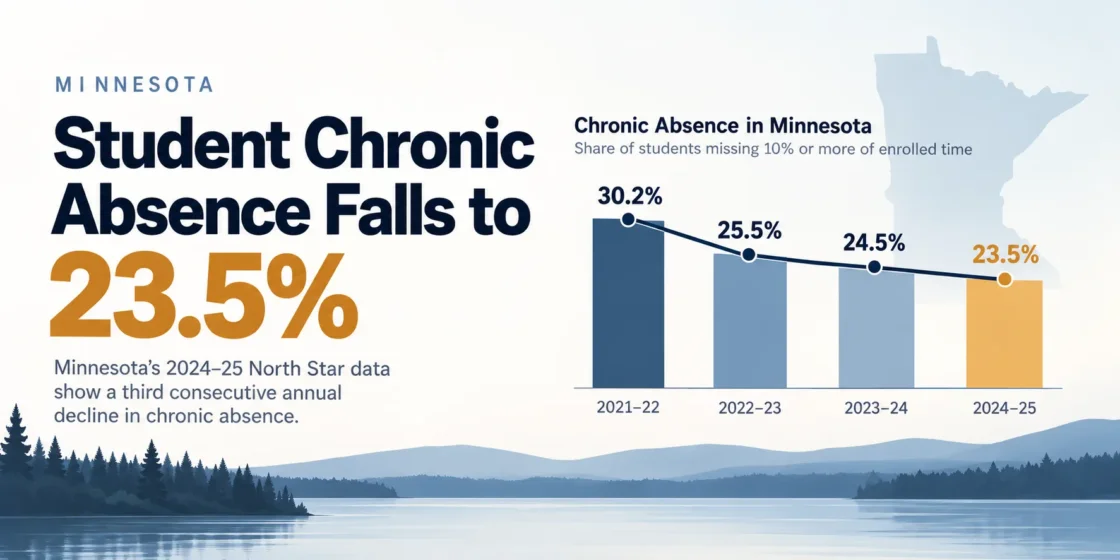
Minnesota’s latest public North Star attendance data indicate that about 23.5% of students were chronically absent in 2024–25 under the state accountability measure. The figure is the inverse of the Minnesota Department of Education’s 76.5% consistent-attendance rate released on September 30, 2026. Under the state measure, a student is chronically absent when the student misses 10% or more of the time enrolled.
The 2024–25 rate is the newest statewide figure available as of October 29, 2026. It marks the third consecutive annual decline in chronic absence after the sharp post-pandemic increase, but Minnesota has not yet returned to its pre-pandemic attendance level. MDE reported the latest attendance data in its 2026 assessment and accountability release.
Minnesota Chronic Absence Trend
Statewide consistent attendance fell to 69.8% in 2021–22, meaning about 30.2% of students in the North Star calculation were chronically absent. Attendance has improved in every reporting year since then.
Share of students not meeting Minnesota’s consistent-attendance threshold
Chronic absence values are calculated as 100% minus MDE’s published statewide consistent-attendance rate. Percentages are shown to one decimal place.
| School Year | Chronic Absence | Consistent Attendance | Reporting Note |
|---|---|---|---|
| 2018–19 | About 15% | About 85% | Pre-pandemic statewide level described by MDE |
| 2019–20 | — | — | Consistent attendance was not calculated for statewide accountability |
| 2020–21 | — | — | Consistent attendance was not calculated for statewide accountability |
| 2021–22 | 30.2% | 69.8% | First post-pandemic statewide release |
| 2022–23 | 25.5% | 74.5% | Attendance improved by 4.7 percentage points |
| 2023–24 | 24.5% | 75.5% | Second consecutive year of improvement |
| 2024–25 | 23.5% | 76.5% | Latest public statewide data |
The annual post-pandemic figures are based on MDE’s 2023, 2024, 2025, and 2026 accountability releases.
From 2021–22 to 2024–25, Minnesota’s chronic absence rate fell by 6.7 percentage points, from 30.2% to about 23.5%. That is a relative decline of roughly 22%. The latest rate nevertheless remains about 8.5 percentage points above the roughly 15% level implied by MDE’s pre-pandemic statewide consistent-attendance benchmark.
Minnesota did not calculate consistent attendance for the 2019–20 and 2020–21 reporting periods because pandemic conditions disrupted attendance definitions and collection practices. Those years should not be filled with estimated values.
How Minnesota Measures Chronic Absence
Minnesota’s North Star system reports consistent attendance rather than publishing chronic absence as the headline indicator. MDE defines a student as consistently attending when the student attends more than 90% of the days enrolled. Chronic absence is the inverse: attendance at or below 90%, or missing at least 10% of enrolled time. MDE explains the calculation on its Consistent Attendance page.
The calculation uses Average Daily Attendance divided by Average Daily Membership. For accountability purposes, the current North Star rules apply the attendance indicator to grades 1–12 and include a student at a school only when the student has been enrolled there for at least half of the academic year.
Misses 10% or more
Measures missed enrolled time and is not limited to unexcused absences.
Attends more than 90%
Minnesota’s North Star indicator and the inverse of chronic absence.
Chronic absence is also different from truancy. Truancy concerns unexcused absences under attendance law and local procedures, while chronic absence is a data measure based on how much enrolled time a student misses. An excused absence can therefore contribute to chronic absence even though it may not be treated as truancy.
Attendance Differences Across Student Groups
Minnesota’s North Star data can be disaggregated by student group, including major racial and ethnic groups, English learners, students receiving special education services, and students eligible for free or reduced-price meals. The state’s June 2025 MnMTSS Attendance Guidebook notes that post-pandemic chronic absence has affected some groups more heavily, including students with disabilities, multilingual learners, Black students, and Indigenous students.
Group-level percentages need to be matched to the same school year and North Star inclusion rules before they are compared with the statewide rate. Older subgroup rates should not be treated as current simply because a newer statewide total is available.
Why Minnesota Absence Rates Can Differ Between Data Sources
A Minnesota chronic absence percentage found in another dataset may not match the 23.5% North Star figure. The main reason is often the denominator.
Minnesota’s accountability calculation includes students who meet its enrollment rules, including the half-academic-year requirement. A rate based on total enrollment, October enrollment, or another reporting population is not automatically comparable.
The metric also should not be confused with an average daily attendance rate. A school can have a high overall daily attendance percentage while still having a sizable group of students who individually miss at least 10% of their enrolled days.
For year-to-year comparisons, the school year, attendance threshold, enrollment requirement, population, and reporting method should all match. Using the same North Star measure across years avoids mixing the statewide accountability rate with broader enrollment-based calculations.
Latest Reporting Year
MDE’s September 30, 2026 public release reported consistent attendance for the 2024–25 school year. The 2025–26 statewide consistent-attendance figure was not part of that release, so 2024–25 remains the latest public North Star attendance year as of October 29, 2026.
The latest data show continued recovery: chronic absence has moved from 30.2% in 2021–22 to about 23.5% in 2024–25. The direction has improved for three consecutive reporting years, while the statewide rate remains above the level Minnesota reported before the pandemic.