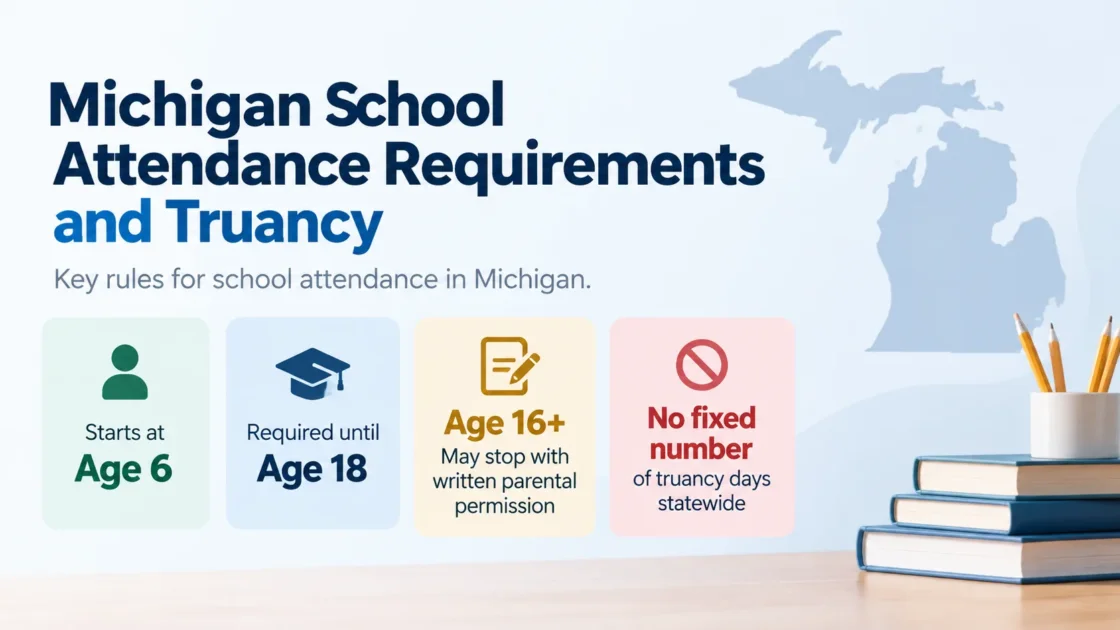
Michigan generally requires current school-age children to attend school from age 6 until age 18 unless an exemption applies. Reaching age 16 does not automatically end the attendance requirement: a student who is at least 16 may stop attending only when the parent or legal guardian gives the resident school district written notice granting permission. Michigan also does not define truancy with one statewide rule such as “5 days” or “10 days” of unexcused absence.1
Age 18General upper age for current school-age students
Age 16+Possible withdrawal with written parental permission
No fixed numberNo single statewide truancy-day threshold
Who Must Attend School in Michigan?
Michigan Revised School Code Section 380.1561 sets the compulsory-attendance rule. For children covered by the current age provision, a parent, guardian, or other person having control of the child must ensure school attendance through the school year from age 6 until the child’s eighteenth birthday, unless one of the statute’s exceptions applies. Attendance is described as continuous and consecutive during the school year established by the district.1
When the Age-6 Requirement Begins
The enrollment date depends on when the child turns 6. A child who becomes 6 before December 1 must be enrolled on the first school day of the school year in which the sixth birthday occurs. If the sixth birthday falls on or after December 1, enrollment is required on the first school day of the following school year.1
| Sixth Birthday | When Compulsory Enrollment Begins |
|---|---|
| Before December 1 | First school day of the school year in which the child turns 6 |
| December 1 or later | First school day of the following school year |
This compulsory-attendance starting point is separate from kindergarten eligibility rules. A child may be eligible to attend school before compulsory attendance begins.
Turning 16 Does Not Automatically End Attendance
Michigan’s general upper compulsory-attendance age is 18 for current school-age students, but Section 380.1561 contains an exception for a student who is at least 16. The parent or legal guardian must provide written notice to school officials in the district where the child resides stating that the student has permission to stop attending school.1
A student does not become exempt from compulsory attendance simply by reaching the sixteenth birthday. The statutory exception depends on written permission from a parent or legal guardian being provided to the resident district.
When Public-School Attendance Is Not Required
Compulsory attendance does not mean every child must attend a conventional public-school building. Section 380.1561 recognizes several circumstances in which the public-school attendance requirement does not apply.1
| Situation | What Michigan Law Provides |
|---|---|
| Qualifying nonpublic school | A child regularly attending and being taught in a qualifying state-approved nonpublic school may satisfy the statutory exception. |
| Home education | A parent or legal guardian may educate the child at home through an organized educational program covering the subjects specified by state law. |
| Graduation completed | A child who has graduated from high school or fulfilled all high-school graduation requirements is no longer required to attend under this section. |
| Student age 16 or older | The requirement can cease when the parent or legal guardian gives the resident district written notice permitting the student to stop attending. |
| Child under age 9 living outside the 2½-mile range | A narrow exception applies when the child does not reside within 2½ miles by the nearest traveled road of a public school, unless transportation is furnished for pupils in the district. |
| Confirmation classes at ages 12 or 13 | A limited exception applies to confirmation classes conducted for no more than five months. |
| Religious instruction while enrolled in public school | Up to two class hours per week may be used for qualifying off-campus religious instruction when the statutory conditions are met. |
For home education under the parent-or-guardian exemption, the statute identifies reading, spelling, mathematics, science, history, civics, literature, writing, and English grammar as required subject areas.1
Michigan Has No Single Statewide Truancy-Day Threshold
Michigan law does not state that every student becomes legally truant after the same fixed number of unexcused days. Section 380.1586 instead addresses a child who is “repeatedly absent from school without valid excuse”. The statute does not convert that phrase into one statewide 5-day, 10-day, or similar numerical threshold.2
This is different from states that define habitual truancy through a specific statewide number of hours or days. A Michigan district may use numerical attendance triggers for letters, meetings, intervention plans, attendance-officer referrals, or other local responses, but a local trigger should not be presented as a universal Michigan statutory truancy threshold.
If a Michigan school handbook says that a response begins after a certain number of unexcused absences or tardies, that number may come from local attendance policy. The statewide statute uses repeated absence without valid excuse rather than one numerical truancy definition.
Excused Absences, Unexcused Absences, and Tardies Can Vary by District
The Michigan Department of Education’s July 2026 Student Attendance and Engagement Guidance explains that local attendance policies often determine how much time passes before a tardy becomes an absence, how many tardies equal an absence, and what the district considers an excused or unexcused absence.3
That local role matters because Michigan does not provide one statewide list that resolves every absence classification for every district. A district policy may address illness documentation, family emergencies, medical appointments, religious observance, transportation problems, tardiness, make-up work, and other attendance situations.
| Issue | Main Source of the Rule |
|---|---|
| General compulsory-attendance ages | Michigan law |
| Written permission to stop attending at age 16 or older | Michigan law |
| Whether a particular absence is excused | Often district attendance policy |
| Documentation requested for an absence | Often district attendance policy |
| When a tardy becomes an absence | Often district attendance policy |
| Early attendance-warning thresholds | Often district or intermediate-district practice |
| Formal attendance-officer process | Michigan law |
How Michigan’s Statutory Attendance Process Can Progress
Repeated nonattendance does not begin with a statewide automatic court referral after a specified number of missed days. Michigan’s Revised School Code describes an investigation and notice process involving school officials and an attendance officer.2
Investigation and the Parent Meeting
Under Section 380.1586, an attendance officer investigates a reported case of nonattendance. If the child is not exempt under Section 380.1561, the officer proceeds under the compulsory-attendance provisions.2
If a child is repeatedly absent without valid excuse and attempts to confer with the parent or other person in parental relation have failed, the superintendent may request that the attendance officer send a registered-mail notice asking the parent to attend a meeting about the child’s irregular attendance. Section 380.1586 also applies this meeting provision in certain cases involving failing schoolwork or behavior problems.2
Formal Notice Requires Attendance on the Next Regular School Day
Section 380.1587 provides a more formal notice when a parent or other person in parental relation fails to send a child to a school recognized under the compulsory-attendance statute. The attendance officer must give written notice in person or by registered mail. The notice requires the child to appear at school on the next regular school day after the notice is received and to continue regular and consecutive attendance.2
What Happens if the Formal Notice Is Not Followed
After formal notice is given, Section 380.1588 requires the attendance officer to determine whether the parent or other person in parental relation complied. If the notice is not followed, the attendance officer makes a complaint to the court with jurisdiction in the county of residence for refusal or neglect to send the child to school. The statute then provides for the court to proceed with the case under its jurisdiction.2
Who Handles Attendance Enforcement?
Michigan law requires an intermediate school board to select one or more attendance officers for the intermediate school district. A local school district with at least 1,000 pupils on the latest pupil membership count day may employ its own attendance officers. When a local district does not employ one, the intermediate school district attendance officer performs the attendance-officer duties for that constituent district.4
Section 380.1571 also states that an intermediate or local attendance officer has the powers of a deputy sheriff within the applicable district while performing official duties.4 This provision describes the officer’s statutory authority; it does not turn every attendance concern into a criminal or court matter.
Parent Responsibility and the Current Statutory Penalty
Michigan places the compulsory-attendance duty on the parent, guardian, or other person who has control and charge of the child. Under Section 380.1599, a parent or other person in parental relation who fails to comply with Part 24 of the Revised School Code can be guilty of a misdemeanor punishable by a $5 to $50 fine, imprisonment for not more than 90 days, or both.5
Some older Michigan attendance materials quote a minimum jail term of two days. The current Section 380.1599, as amended by 2020 Public Act 384, states imprisonment for not more than 90 days; it does not state a two-day minimum.5
The penalty provision should not be read as an automatic consequence of reaching a particular absence count. The attendance record, applicable exemptions, local classification of absences, statutory notices, and the facts of an individual case all affect whether an enforcement matter progresses.
Student Truancy and Juvenile-Court Jurisdiction Are a Separate Route
Michigan’s Juvenile Code contains a separate provision concerning the student. Under MCL 712A.2(a)(4), juvenile-court jurisdiction can apply when a juvenile willfully and repeatedly absents himself or herself from school or another learning program intended to meet the juvenile’s educational needs, or repeatedly violates the program’s rules.6
The statute also requires more than the existence of repeated absences. The court must find on the record that the juvenile, parent, guardian or custodian, and school officials or learning-program personnel have met about the juvenile’s educational problems and that educational counseling and alternative-agency help have been sought.6
Compulsory-attendance compliance
Part 24 addresses the duty of the parent or person in parental relation and includes investigation, notice, complaint, and a misdemeanor provision.
Willful and repeated absence
The Juvenile Code separately addresses court jurisdiction over a juvenile after the statutory conditions concerning meetings and support efforts are met.
Truancy and Chronic Absenteeism Measure Different Problems
Truancy should not be treated as another name for chronic absenteeism. Michigan’s truancy-related statutes focus on attendance compliance, including repeated absence without valid excuse and, in the Juvenile Code, willful and repeated absence. Chronic absenteeism measures the amount of school a student misses regardless of whether every absence is classified as excused or unexcused.
Attendance-law and policy issue
Unexcused or willful nonattendance is central to the legal provisions. Michigan does not use one statewide numerical truancy-day threshold.
Missed instructional time
Michigan’s 2026 attendance guidance uses the measure of missing at least 10% of the school year, including absence time that may be excused.3
A student can therefore accumulate enough missed time to be chronically absent without necessarily meeting the conditions for a truancy enforcement action. An excused illness, for example, may contribute to chronic absenteeism while being treated differently from an unexcused absence under district attendance rules.
Michigan’s 2026 Guidance Places Support Before Court Intervention
The Michigan Department of Education’s July 2026 guidance tells schools and districts to examine the reasons behind attendance problems and use prevention, family engagement, and targeted supports. It states that legal intervention should be a last resort and notes that traditional truancy-court referrals and juvenile-justice involvement do not reliably improve attendance.3
The same guidance encourages schools to consider the cause of the absence rather than selecting an intervention only from the number of missed days. Transportation, physical or behavioral health needs, housing instability, academic problems, school engagement, family circumstances, and other barriers may call for different responses.3
This guidance does not repeal the compulsory-attendance statutes or eliminate the formal attendance-officer process. It describes how Michigan currently encourages districts to address attendance problems before relying on legal enforcement.
Which Rule Should Be Checked for an Individual Attendance Case?
| Question | Where the Answer Usually Comes From |
|---|---|
| Is the child old enough to be subject to compulsory attendance? | Michigan Revised School Code |
| Can a student age 16 or older stop attending? | Michigan Revised School Code and the required written parental notice |
| Does a homeschool or nonpublic-school arrangement qualify for an exception? | Michigan law and the requirements applicable to that educational arrangement |
| Is a particular absence excused? | The student’s district attendance policy and official attendance record |
| How are tardies converted into absences? | Local attendance policy |
| Has a local warning or intervention threshold been reached? | District or intermediate-district policy and attendance records |
| Can formal attendance enforcement proceed? | Michigan statutory requirements together with the facts and records of the case |
| Is the student officially considered truant in an individual case? | The applicable school, district, attendance officer, and court process rather than a statewide day-count calculator |
A district handbook can therefore contain a specific number of absences that triggers a warning, attendance meeting, letter, or referral even though Michigan law itself does not define statewide truancy with that number. For an individual student, the school or district attendance record, the local policy used to classify the absences, and the applicable Michigan statutes determine the official status.