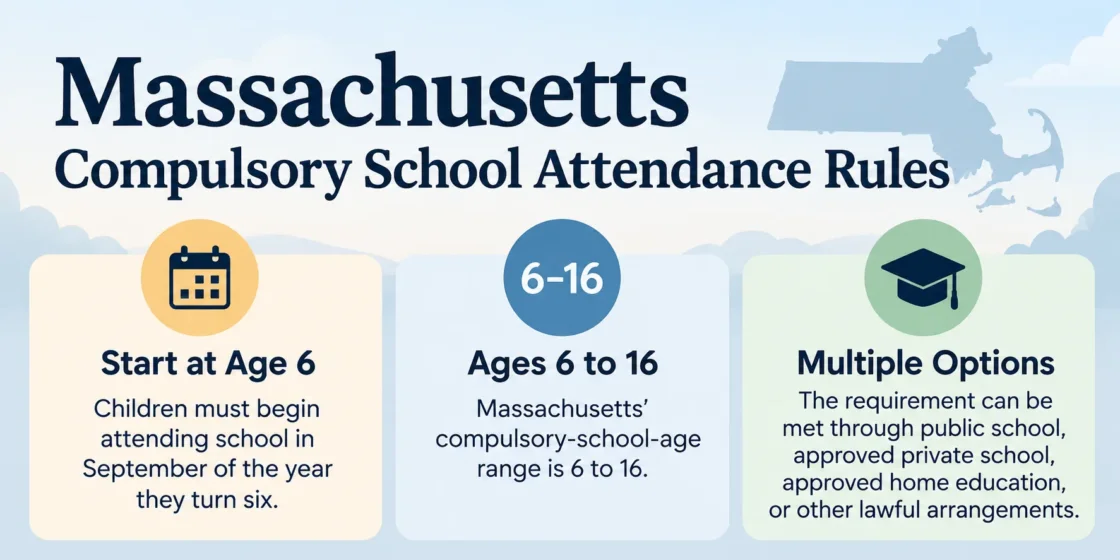
Massachusetts generally requires school attendance beginning in September of the calendar year in which a child turns six and continuing until age 16. The rule does not require every child to attend a traditional public school: approved private schooling, approved home education, and certain other lawful arrangements can satisfy the attendance requirement.
Massachusetts Compulsory Attendance Age
Under 603 CMR 8.02, a child must begin attending school in September of the calendar year in which the child reaches age six. A local school committee may permit children to begin school at a younger age, but it may not establish a mandatory starting age later than the state minimum.
The Massachusetts Department of Elementary and Secondary Education identifies the state’s compulsory-school-age range as ages 6 to 16. Massachusetts law still contains additional procedures for students age 16 or older who leave school before graduating, but those procedures are different from the compulsory-attendance requirement itself.
Massachusetts districts must provide kindergarten for eligible children, but the statewide compulsory-attendance starting point is tied to the calendar year in which a child turns six. Local enrollment policies may allow children to enter school earlier.
Ways to Meet the Attendance Requirement
Massachusetts General Laws Chapter 76, Section 1 requires children within compulsory school age to attend a qualifying educational program for the required school year. Public school attendance is one option, but it is not the only one.
- Local public school: A student may attend the public day school serving the town where the student resides.
- Approved private school: Attendance at a private school approved under Massachusetts law can satisfy the requirement.
- Authorized attendance elsewhere: State law permits certain arrangements involving attendance outside the student’s town of residence.
- Approved home education: A child may be educated outside a traditional school when the instructional arrangement has been approved in advance by the superintendent or school committee.
- Other statutory exceptions: Chapter 76 includes limited exceptions involving a child’s physical or mental condition and certain employment-permit situations.
Home education is therefore not treated simply as an absence from school. Massachusetts requires the home education arrangement to be approved in advance. The state’s home-schooling legal guidance also summarizes the Massachusetts court decisions governing local review of home education plans.
A parent-directed home education program is governed by the approval requirement in Chapter 76. A public school student who must remain at home or in a hospital for documented medical reasons may instead qualify for school-provided educational services under separate Massachusetts education regulations.
State Rules for Unexcused Absences
Massachusetts uses several attendance thresholds for different purposes. A parent-contact requirement, an attendance meeting, a truancy-related court process, and a parent’s statutory duty are not triggered by the same number of absences.
| Attendance event | State rule | What follows |
|---|---|---|
| School has not received notice explaining a student’s absence | Within 3 days of the absence | The school’s absence-notification program must notify the parent or guardian. |
| Student has days with 2 or more unexcused periods missed | At least 5 such days in the school year | The district’s required parent-notification policy applies. |
| Student misses full school days without excuse | 5 or more unexcused school days in the school year | The principal, headmaster, or designee must make a reasonable effort to meet with the parent or guardian and develop attendance action steps. |
| Student willfully fails to attend and is not excused under school rules | More than 8 school days in a quarter | The student can meet the Massachusetts definition of a habitually truant child for a Child Requiring Assistance proceeding. |
The first three requirements come from Chapter 76, Section 1B. When a student reaches five or more unexcused full-day absences, the attendance action steps are intended to be developed with the student and parent or guardian, with input from relevant school personnel and, when appropriate, other agencies or organizations.
The more-than-eight-days threshold serves a different purpose. Under Massachusetts General Laws Chapter 119, Section 39E, a school district may initiate a Child Requiring Assistance application when a child has willfully failed to attend for more than eight school days in a quarter without being excused under the school’s lawful and reasonable attendance rules.
The five-day rule in Chapter 76 concerns school notification and attendance action steps. The Child Requiring Assistance law uses a separate standard involving more than eight school days in a quarter and willful, unexcused nonattendance.
Parent or Guardian Attendance Duty
Chapter 76, Section 2 places responsibility on the person in control of a child covered by the compulsory-attendance law to cause the child to attend as required.
The statute provides that if the person fails to cause attendance for seven day sessions or fourteen half-day sessions within a six-month period, a supervisor of attendance may bring a complaint. The statutory fine is no more than $20.
This provision should not be read as a rule allowing seven unexcused absences. It is an enforcement provision concerning the responsible adult. School notification requirements, local attendance procedures, truancy rules, and educational consequences can apply under different standards.
Attendance Officers and School Enforcement
Massachusetts school committees appoint supervisors of attendance. Under Chapter 76, Section 20, these officers investigate attendance matters covered by state law and may take action permitted by the statute.
The law also authorizes a supervisor of attendance to take a truant or absentee student found wandering in streets or public places back to school without a warrant. In practice, attendance concerns may also lead to school-family meetings, referrals to support services, attendance plans, or a Child Requiring Assistance application when the statutory conditions are met.
For a school district seeking a Child Requiring Assistance order, state law requires more than simply listing absences. The application must describe matters such as steps the district has taken to support attendance, applicable referrals, and the court intervention the district is requesting.
Leaving School at Age 16 or Older
Reaching age 16 ends the general compulsory-attendance period, but an ungraduated student is not automatically treated as having permanently left public school after stopping attendance.
Under Chapter 76, Section 18, when a student who has not graduated reaches a tenth consecutive absence, the school must send notice within five days to the student and the parent or guardian. To the extent practicable, the notice must be provided in both English and the parent or guardian’s primary language.
The notice must initially offer at least two dates and times for an exit interview. The interview is intended to discuss why the student is leaving and available alternative education or placement options. It normally must occur within 10 days after the notice is sent, although a parent or guardian may request an extension of up to 14 days.
The statute also makes clear that this process does not permanently prevent a student from returning to education.
School Calendar Requirements Are Not an Absence Allowance
Massachusetts public school calendar rules are sometimes confused with individual attendance limits. Under 603 CMR 27.03, school committees must schedule at least 185 school days and operate district schools for at least 180 school days during the school year.
Those numbers regulate the school calendar. They do not mean that an individual student may miss five days without attendance consequences.
Massachusetts structured-learning-time rules also require public schools to schedule at least 900 hours per school year for elementary students and 990 hours for secondary students. Kindergarten programs operating under the separate kindergarten provision must provide at least 425 annual hours of structured learning time.
Where Local District Attendance Policies Apply
State law establishes compulsory attendance duties and several statewide notification and enforcement triggers, but local school districts still maintain their own attendance policies. A district handbook may address matters such as how parents report an absence, which documentation the school requests, how tardiness is recorded, procedures for making up missed work, and how the district classifies absences under its attendance rules.
A local policy may therefore become relevant before a family reaches one of the state thresholds described above. The student’s official attendance record, the district’s current handbook, and communications from the school should be checked when the issue concerns a particular absence or student’s status.