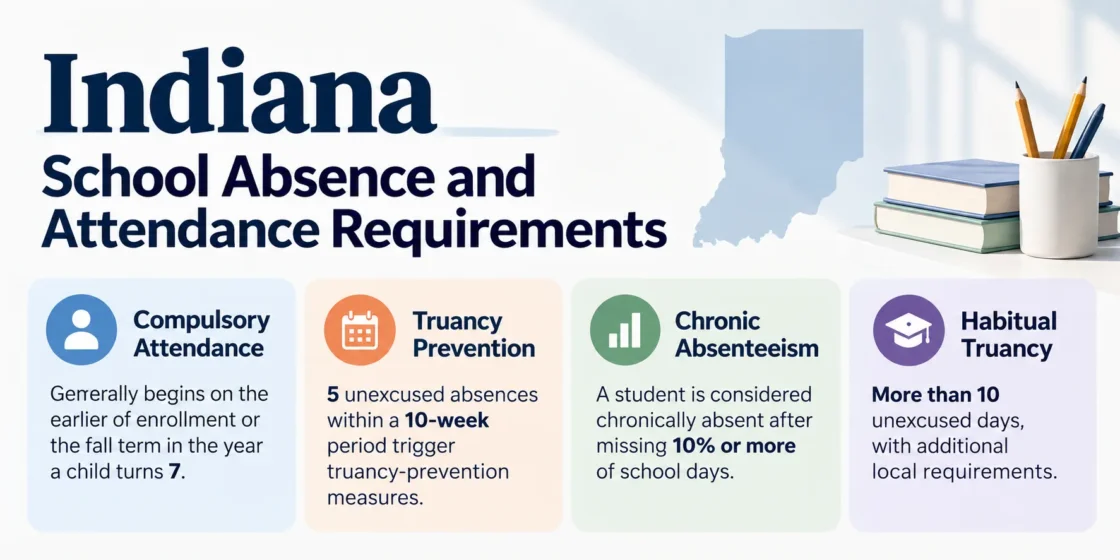
For the 2026–27 school year, Indiana uses different rules for compulsory attendance, truancy prevention, habitual truancy, and chronic absenteeism. Compulsory attendance generally begins on the earlier of a student’s official enrollment date or the start of the fall term in the school year the child turns seven. A separate truancy-prevention process applies when a K–12 student accumulates five qualifying unexcused absences within a ten-week period.
Who Must Attend School in Indiana
Under Indiana Code 20-33-2-6, a student becomes subject to compulsory attendance on the earlier of two dates: the date the student officially enrolls in school or the beginning of the fall school term for the school year in which the student turns seven.
The compulsory-attendance obligation generally continues until the first of the following occurs:
- The student graduates.
- The student turns 18.
- A student who is at least 16 but younger than 18 completes the statutory requirements for an early withdrawal from school.
A 16- or 17-year-old cannot simply stop attending school. Indiana Code 20-33-2-9 requires an exit process that includes agreement by the student, parent, and principal, written acknowledgment and consent, and a qualifying reason for withdrawal. The statute identifies financial hardship accompanied by employment needed to support the student’s family or dependent, illness, or a court order as qualifying circumstances.
Kindergarten itself is not mandatory in Indiana. A child generally does not have to enroll in school until the fall term of the school year in which the child turns seven. However, once a child is enrolled in kindergarten, Indiana’s attendance laws apply and the student is required to attend.
What Happens After Unexcused Absences
Indiana’s truancy-prevention law uses a threshold that is lower than the habitual-truancy threshold. Under Indiana Code 20-33-2.5-1, an absent student is a student enrolled in kindergarten through grade 12 who has five qualifying unexcused absences within a ten-week period.
The five-day calculation does not include an absence that is excused. It also excludes certain absences supported by a professional note on file requesting frequent absences under an IEP, qualifying service plan, Choice Scholarship education plan, or Section 504 plan.
The attendance conference generally involves a school representative, a teacher, and the student’s parent. A parent may also request another representative who can provide insight into the student’s absenteeism, subject to the statutory notice requirement. The resulting attendance plan may include services, expected behavior, counseling or mentoring, and other steps. If a duration is assigned to the plan, it may not extend beyond 45 instructional days after the plan is established.
Indiana law also requires additional counseling or services when the school determines that qualifying absences are related to pregnancy, foster care, homelessness, or a severe or life-threatening illness or related treatment.
Chronic Absence and Habitual Truancy Use Different Thresholds
10% of school days
Indiana Department of Education considers a student chronically absent after the student misses 10% or more of school days. Excused and unexcused absences both count.
More than 10 unexcused days
Indiana’s local habitual-truant definition must, at a minimum, include a student with more than ten unexcused school days in one school year.
The current statutory wording for habitual truancy is more than ten unexcused days, not “ten or more.” In practical counting terms, the statewide minimum definition therefore captures a student once unexcused absences exceed ten. A school corporation may use earlier attendance interventions under its own policies.
Chronic absenteeism is different. It measures missed school time regardless of the reason, so an excused medical absence can count toward the 10% chronic-absence measure without becoming an unexcused absence or an act of truancy.
When a student meets the applicable habitual-truancy standard, Indiana law assigns reporting duties to school officials. The superintendent or attendance officer must report a habitually truant child to an intake officer of the juvenile court or the Department of Child Services. Attendance officials also have a duty to report habitual truancy to the prosecuting attorney. State law allows a prosecutor to use a meeting, intervention plan, and support services before filing a truancy-related affidavit.
Who Decides Whether an Absence Is Excused
Indiana does not impose one statewide list that automatically decides whether ordinary absences such as illness, medical appointments, funerals, family events, or similar circumstances are excused in every district. School corporations adopt local policies defining excused and unexcused absences.
Indiana Department of Education reporting descriptors include categories such as medical, death or funeral, religious, planned family, unplanned family, and administrator-approved absences. Those categories are reported as excused when the absence qualifies under the applicable local policy. They do not create a statewide right to have every absence in one of those general categories excused.
This means there is no single statewide number of parent-note absences that every Indiana school must accept. A district may establish its own documentation rules for ordinary excused absences, subject to Indiana law and the statutory attendance protections that schools are required to recognize.
Absences Indiana Law Requires Schools to Excuse
House Enrolled Act 1004, enacted as Public Law 74-2026, reorganized Indiana’s statutory attendance exceptions effective July 1, 2026. The current version places the main set of protected absence situations in amended Indiana Code 20-33-2-15.
| Situation | Current Indiana Rule |
|---|---|
| Indiana General Assembly | A student serving as a page or honoree of the General Assembly must be excused. |
| Election service | A student serving on a precinct election board must be excused. |
| Political campaign assistance | A student working as a helper to a political candidate or political party on an applicable election date must be excused. |
| Court subpoena | A student appearing in court in response to a subpoena as a witness in a judicial proceeding must be excused. |
| Military active duty | A student who is not a habitual truant and is ordered to qualifying active duty may receive up to 15 instructional days under the statutory provision. A school may authorize additional excused days. |
| Indiana Wing of the Civil Air Patrol | Qualifying participation in an international air cadet exchange program or an emergency service operation is covered. Emergency-service absences are limited to five instructional days in a school year. |
| Indiana State Fair | A student’s participation or exhibition at the State Fair for educational purposes may qualify for up to five instructional days in a school year. |
| FFA or 4-H events | Participation in a scheduled competition, exhibition, or event offered by the National FFA Organization, Indiana FFA Association, or a 4-H club may qualify for up to six instructional days in a school year. |
The 2026 law requires good academic standing for the Civil Air Patrol, State Fair, and FFA/4-H categories. Schools may request documentation verifying participation. When an absence qualifies under this statutory list, the student may not be recorded as absent for the date covered by the excuse and may not be penalized by the school for that absence.
Indiana Code 20-33-2-19 separately provides release time for religious instruction after a parent gives written notice. Elementary students may receive up to 120 minutes per week. For public secondary students, the permitted time may equal one elective course during the week. The student receives the same attendance credit for that time as for attendance at the public school.
What Changed on July 1, 2026
Older Indiana attendance guides may still cite separate sections for court subpoenas, military duty, Civil Air Patrol, educationally related nonclassroom activities, the State Fair, and FFA or 4-H events. HEA 1004 repealed Indiana Code 20-33-2-16, 20-33-2-17, 20-33-2-17.2, 20-33-2-17.5, 20-33-2-17.7, and 20-33-2-17.8 effective July 1, 2026 while moving the current statutory list of protected activities into amended Indiana Code 20-33-2-15.
The change did not simply eliminate the subpoena, military, Civil Air Patrol, State Fair, or FFA/4-H protections. Those categories now appear in the consolidated provision. The former educationally related nonclassroom-activity section was repealed; the amended law instead provides a notice rule when a school authorizes an excused nonclassroom-related activity organized or facilitated by the school. The school must send the parent written information about that activity at least one full school day before it occurs.
The State Fair wording also changed. The current consolidated provision refers to the student’s participation or exhibition for educational purposes. Older versions of the statute also referred to participation or exhibition by a member of the student’s household.
Indiana Code 20-33-8-16.5 temporarily prohibited a public school from suspending or expelling a student solely because the student was chronically absent or a habitual truant. That section expired on July 1, 2026, so it should not be presented as a current 2026–27 rule.
What to Check in a District Attendance Policy
State law sets the compulsory-attendance and truancy rules, but the local attendance policy still controls many day-to-day decisions. A current district or school handbook should explain:
- Which ordinary reasons are treated as excused or unexcused.
- When a parent note is accepted and when medical or other documentation is required.
- Deadlines for reporting an absence and submitting documentation.
- How tardiness, early dismissal, and partial-day absences are handled locally.
- Local attendance interventions that may begin before the state habitual-truancy threshold is reached.
- Rules for make-up work, attendance-related academic procedures, and participation in extracurricular or co-curricular activities.
An excused absence under a local policy can still contribute to chronic absenteeism because Indiana’s 10% chronic-absence measure counts both excused and unexcused days. By contrast, the five-day truancy-prevention trigger and the habitual-truancy standard depend on qualifying unexcused absences.
Whether a particular absence is excused, whether a student has reached a local attendance threshold, and whether a statutory exception applies depend on the student’s official attendance record, documentation, current district policy, and current Indiana law. The school or district’s official record controls the student’s attendance classification.