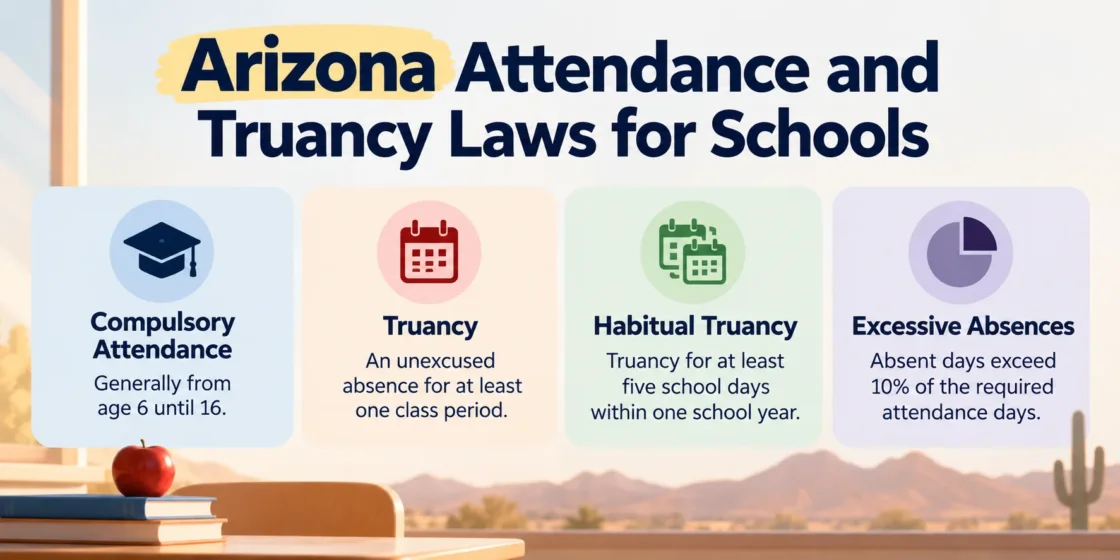
Arizona schools need to keep three attendance triggers separate. State law defines truancy as an unexcused absence for at least one class period, habitual truancy as truancy for at least five school days in one school year, and excessive absences as absences that exceed 10% of the required attendance days. These rules operate alongside compulsory-attendance requirements, parent-notification duties, local attendance policies, enrollment rules, and Arizona Education Data Standards reporting.
| Rule | Arizona Standard | What Schools Should Track |
|---|---|---|
| Compulsory attendance | Generally from age 6 until age 16 | Enrollment, lawful attendance option, and applicable exemptions |
| Truant | Unexcused absence for at least one class period | Unexcused class-period absences |
| Habitually truant | Truant for at least 5 school days within one school year | Accumulated days involving truancy |
| Excessive absences | Absent days exceed 10% of required attendance days | Total absent days under the statutory calculation |
| Enrollment withdrawal | 10 consecutive school days absent, excluding qualifying excused absences | Consecutive absence blocks and the last day of attendance or qualifying excused absence |
Compulsory Attendance From Age 6 Until 16
A.R.S. § 15-802 requires every child between six and sixteen years of age to attend school and receive instruction in specified academic subjects. The person who has custody of the child must choose an authorized education option, including a public, private or charter school, homeschool, or an applicable Arizona empowerment scholarship account arrangement.
For a child enrolled in a public, private or charter school, the parent or person with custody is responsible for enrolling the child and ensuring attendance while school is in session. Arizona law also recognizes several circumstances that may excuse a person from the ordinary attendance duties.
- A physical or mental condition that makes instruction impracticable or inappropriate.
- Completion of the high school course of study required for completion of grade 10.
- A reason for nonattendance accepted by the principal or the principal’s designee.
- Lawful employment for a child over age 14 with the consent of the person who has custody.
- Enrollment in an approved work-training, career education, career and technical education, vocational education or manual-training program.
- Certain periods of suspension or expulsion.
- Enrollment in an education program provided by a state educational or other institution.
The exact exemption should be documented rather than assumed. A student who is absent from a regular school because the student is being lawfully homeschooled, for example, is not treated the same way as an enrolled student who simply misses class without authorization.
When an Absence Becomes Truancy
A.R.S. § 15-803 gives Arizona’s central truancy definitions. A truant is a child with an unexcused absence for at least one class period during the day. The statute does not require a full-day absence before truancy can occur.
A child becomes habitually truant when the child is truant for at least five school days within one school year. A child who is habitually truant may be adjudicated an incorrigible child under Arizona law. The word may matters: reaching the threshold does not mean a juvenile-court outcome occurs automatically.
Arizona law states that absences may be considered excessive when absent days exceed 10% of the required attendance days. Unlike the truancy definition, this sentence is not limited to unexcused class-period absences. Schools should therefore maintain total-absence and unexcused-absence counts separately.
For a 180-day calendar, 10% equals 18 days. The statutory language is exceeds 10%, so schools should rely on the actual statutory calculation and current Arizona Department of Education guidance rather than reducing the rule to a shorthand statement such as “18 absences.”
Excused and Unexcused Absences
The Arizona Department of Education’s School Finance Manual, revised February 23, 2026, identifies excused absences that include illness, a doctor’s appointment, mental or behavioral health matters, homelessness, bereavement, family emergencies, time needed to process for the armed forces, and qualifying out-of-school suspensions. The current guidance is available through the Arizona Department of Education School Finance Guidelines and Manuals.
ADE leaves the treatment of a family vacation to the individual school district or charter school. A vacation therefore should not be assumed to be either excused or unexcused statewide; the applicable local policy must be checked.
A.R.S. § 15-807 specifically requires ADE to identify an absence related to a pupil’s mental or behavioral health as an excused absence for the purposes addressed by the statute.
Religious absences have their own policy requirement. Under A.R.S. § 15-806, each school district governing board and charter-school governing body must adopt a policy governing absences for religious purposes. If the policy permits religious instruction or exercises during school time, statutory conditions include written consent from the person with custody and participation at a suitable location away from school property.
Parent Notification Duties for K–8 Absences
Arizona has specific notification rules when a kindergarten through eighth-grade pupil is absent without an excuse or without notice from the parent or other person having custody. The school must make a reasonable effort to promptly telephone the parent or custodian.
| Student | Absence Situation | Notification Timing |
|---|---|---|
| Kindergarten through grade 6 | First class in which the pupil is absent | Within 2 hours after that class |
| Grade 7 or 8 | The pupil’s first class of the school day is the first missed class | Within 2 hours after that class |
| Grade 7 or 8 | The first missed class occurs later in the school day | Within 5 hours after that class |
The statute also requires notification to parents or custodians, on or before enrollment in kindergarten through grade 8, that they are responsible for authorizing an absence and notifying the school in advance or at the time of the absence. The district must request at least one telephone number, if available, and parents or custodians are expected to report changes to that number.
Attendance Records, AzEDS Reporting, and the 10-Day Rule
ADE’s February 2026 excused-absence guidance instructs schools to document the date of an absence, the reason, and the person who reported it. The guidance also states that the documented record must be retained for at least four years after the fiscal year in which it was created or received.
School districts and charter schools must report student absence data to the Arizona Education Data Standards, or AzEDS, at least once every 60 days in session. The reporting must distinguish excused from unexcused absences.
A separate enrollment rule applies to prolonged consecutive absences. Under A.R.S. § 15-901, withdrawals for average-daily-membership purposes include students who are absent for ten consecutive school days, except for excused absences identified by ADE. The effective withdrawal date is retroactive to the student’s last day of actual attendance or qualifying excused absence.
Habitual truancy is based on at least five school days of truancy during a school year. The ten-consecutive-day rule concerns withdrawal and enrollment reporting. A school should not use the two rules interchangeably.
ADE previously introduced automated non-fundable attendance intervals in AzEDS. Its current School Finance guidelines continue to mark implementation of the Non-Fundable Interval process as paused until further notice. The statutory attendance, truancy and withdrawal rules remain separate from that paused finance process.
Attendance Officers and Legal Enforcement
A school district governing board may appoint an attendance officer under A.R.S. § 15-804. An attendance officer has authority under A.R.S. § 15-805 to enforce the state’s school-attendance laws for children within the compulsory-attendance age range.
Among the powers provided by statute, an attendance officer may issue a citation to an adult or child alleged to be violating the applicable attendance laws. If a citation is issued to a child under 18, the parent or person with custody must be required to appear with the child. An attendance officer may also report a suspected attendance-law violation to local law enforcement and request an investigation.
These are enforcement options rather than an automatic consequence of every unexcused absence. School attendance procedures commonly begin with documentation, parent contact and interventions under the district’s adopted policy before a matter reaches formal enforcement.
Arizona law also places responsibility on the parent or person with custody. Under A.R.S. § 15-802, a parent or custodian who is not otherwise exempt and who fails to enroll a child or ensure required school attendance can be guilty of a class 3 misdemeanor. Individual cases depend on the student’s education arrangement, exemptions and the facts reflected in the official attendance record.
District Rules for Excessive Absenteeism
A.R.S. § 15-843 requires school district governing boards to prescribe discipline rules that address excessive pupil absenteeism under A.R.S. § 15-803. The statute identifies possible attendance-related penalties that can include failure in a subject, failure to pass a grade, suspension or expulsion.
Those listed consequences are not automatic outcomes for every student who exceeds an absence threshold. District policy, the student’s age and grade, the reason for the absences, applicable health protections, procedural rules and other statutory limits must still be considered.
Arizona also limits expulsion based solely on excessive absenteeism. A.R.S. § 15-841 states that a pupil may be expelled for excessive absenteeism only after the pupil has reached the age or completed the grade after which school attendance is no longer required under A.R.S. § 15-802. Separate restrictions also apply to suspension and expulsion of younger pupils.
Students With Chronic Health Problems
Attendance staff should also distinguish ordinary absence rules from the protections for students with chronic health problems. Under A.R.S. § 15-346, district governing boards must maintain policies and procedures intended to provide continuing learning while qualifying pupils are absent and to support their return to the regular education program.
The statute covers qualifying students who cannot attend regular classes for intermittent periods because of illness, disease, pregnancy complications or accident when supported by the required health-professional certification, as well as students with conditions requiring long-term management. These cases should be handled through the applicable chronic-health procedures rather than treated as ordinary unexplained absences.
Truancy and Chronic Absenteeism Measure Different Things
Unexcused absence
Arizona’s legal definition begins with an unexcused absence for at least one class period.
Attendance data measure
ADE accountability rules use accumulated absences and are not a substitute for the statutory truancy definition.
Current ADE federal school-improvement business rules describe chronically absent students as students who are absent 10% or more of the school year for the covered accountability calculation. The methodology includes its own grade scope and exclusions. Truancy, by contrast, depends on an absence being unexcused and can begin after a single missed class period.
Excessive absences under A.R.S. § 15-803 are another distinct concept. Schools should therefore avoid using truant, habitually truant, excessively absent and chronically absent as interchangeable labels in attendance records or parent communications.
Where Local School Policy Still Applies
Arizona statutes establish statewide attendance duties and legal thresholds, but several day-to-day decisions remain dependent on district or charter policy. These can include whether a family vacation is excused, documentation required for particular absences, attendance interventions, make-up work procedures, course-attendance rules and the sequence of parent conferences or referrals.
A school’s own attendance code should therefore be read together with current Arizona statutes and ADE guidance. For an individual student, the official school record, applicable district or charter policy, verified excused-absence documentation and any lawful exemption determine how the absence should be classified and what action is appropriate.