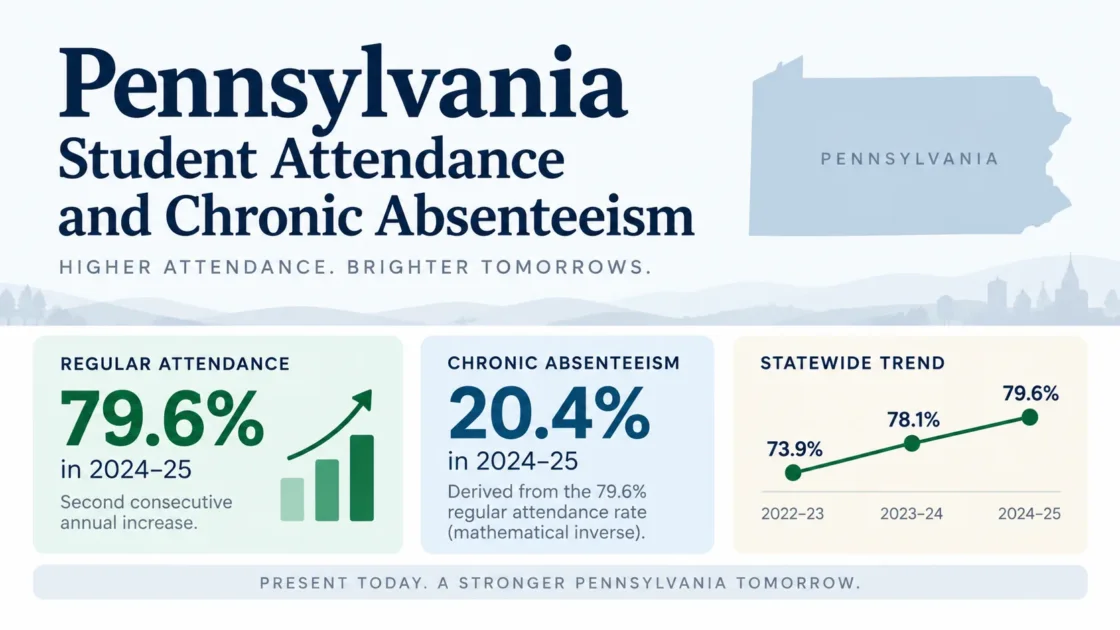
Pennsylvania’s latest released statewide attendance figure shows 79.6% Regular Attendance in 2024–25, the second consecutive annual increase.1 Pennsylvania reports chronic absenteeism through the inverse Future Ready PA measure: an eligible student is in Regular Attendance when enrolled for at least 90 school days and present for at least 90% of enrolled days.2
Using that definition, the published 79.6% Regular Attendance figure corresponds to a derived chronic-absence share of 20.4% for the same eligible population. The 20.4% figure is the mathematical inverse of the rounded Regular Attendance rate, not a separately published statewide headline statistic.
Pennsylvania Regular Attendance Rose to 79.6% in 2024–25
PDE reported Regular Attendance at 73.9% in 2022–23 and 78.1% in 2023–24.3 The 2024–25 figure reached 79.6%. Across those three school years, Regular Attendance rose by 5.7 percentage points, while the derived chronic-absence share fell by the same amount.
Percentage of eligible Pennsylvania public-school students meeting the state’s Regular Attendance definition.
PDE reported the first two values in its 2023–24 results release and the 2024–25 value in the following statewide release.31
| School Year | Regular Attendance | Derived Chronic-Absence Share | Annual Change in Regular Attendance |
|---|---|---|---|
| 2022–23 | 73.9% | 26.1% | — |
| 2023–24 | 78.1% | 21.9% | +4.2 percentage points |
| 2024–25 | 79.6% | 20.4% | +1.5 percentage points |
The improvement continued in both annual comparisons, although the increase was smaller in 2024–25 than in the prior year. The derived chronic-absence share moved from 26.1% to 20.4% over the three-year span.
The statewide releases used for these percentages do not provide the exact statewide denominator of students meeting the 90-day eligibility rule. Applying the rate to total statewide enrollment would mix different populations, so no statewide chronic-absence student count is inferred here.
Pennsylvania Uses a More-Than-10% Chronic Absence Threshold
Pennsylvania defines chronic absenteeism as the percentage of students enrolled for at least 90 days who miss more than 10% of their enrolled school days across the academic year. Students enrolled for fewer than 90 days at a school are excluded from that school’s calculation. PDE calculates the measure for public schools with at least 20 students and also reports qualifying student groups of 20 or more at the building level.2
Absence percentage = equivalent days absent ÷ enrolled school days × 100. The student crosses the state chronic-absence threshold only when the result is greater than 10%, provided the student has at least 90 enrolled days.
What the Threshold Means in Whole-Day Absences
The phrase more than 10% matters. If attendance is recorded only in whole days, a student enrolled for 180 days is exactly at 10.0% after 18 absences and crosses the threshold with the 19th absence. The same logic changes with the number of enrolled days.
| Days Enrolled | Exactly 10% | First Whole-Day Absence Total Above 10% | Absence Share at That Point |
|---|---|---|---|
| 90 | 9 days | 10 days | 11.11% |
| 100 | 10 days | 11 days | 11.00% |
| 120 | 12 days | 13 days | 10.83% |
| 150 | 15 days | 16 days | 10.67% |
| 180 | 18 days | 19 days | 10.56% |
Eighteen absences out of 180 enrolled days equal exactly 10%, not more than 10%. Fractional or equivalent-day reporting can also cross the threshold before another full day is accumulated; for example, 18.25 equivalent absent days out of 180 equal about 10.14%.
Pennsylvania also allows local educational agencies to satisfy instructional-time requirements through either a day-based or hour-based model. Beginning with 2023–24 and continuing thereafter, covered LEAs must provide at least 180 instructional days or the applicable minimum instructional hours: 450 hours for half-time pre-kindergarten and kindergarten, 900 hours for full-time pre-kindergarten and kindergarten and grades 1–6, and 990 hours for grades 7–12. An LEA may vary the model by building or grade level.4
For chronic absenteeism, the student’s actual enrolled-day record remains the relevant denominator. A general statement such as “18 missed days means chronically absent” therefore cannot replace the Pennsylvania calculation.
Excused Absences Can Still Count Toward Chronic Absenteeism
PDE’s chronic absenteeism measure is based on lost instructional time rather than the truancy classification of an absence. Both excused and unexcused absences can count. An absence may be fully excused under a local attendance policy and still reduce the student’s Regular Attendance calculation.2
| Recorded as Absent | Recorded as Present |
|---|---|
|
|
Tardies and Early Dismissals Depend on Local Day-Aggregation Rules
Local educational agencies report aggregate Days Enrolled and Days Present through PIMS, while their student information systems and local policies determine how missed hours, periods, and fractions of days are aggregated. That can change the equivalent-day total used in the chronic absenteeism calculation.2
Consider a student enrolled for 180 days who is one-quarter day late on four occasions. If local policy counts the student present for each day because at least half the day was attended, the record can show 180 days present. If the LEA totals the missed fractions, four quarter-days equal one full equivalent day and the record can show 179 days present.
As a result, there is no single statewide rule stating that a particular number of tardies always equals one absence for chronic absenteeism. The local policy and SIS aggregation method determine how those fractions enter the state-reported Days Present and Days Enrolled fields.
Future Ready PA Reports the Inverse Metric as Regular Attendance
Pennsylvania’s public accountability display presents Regular Attendance as the reported measure rather than showing chronic absenteeism as the headline percentage. The numerator is the number of students enrolled for 90 or more school days who were present for at least 90% of their enrolled days. The denominator is all students enrolled for 90 or more school days.2
Student-level threshold measure
Share of eligible students present for at least 90% of enrolled school days.
Average daily presence
Average number of students present on a given day; it can hide repeated absences concentrated among particular students.
This distinction explains why a school can post a high average daily attendance figure while still having a notable chronic absenteeism problem. Regular Attendance asks how many individual students stayed above the attendance threshold, rather than how full the school was on an average day.
PDE describes Regular Attendance as a lagging indicator because the underlying attendance data are published only after reporting and validation are completed. The measure uses Days Enrolled and Days Present from the PIMS Student Calendar Fact template in the end-of-year Child Accounting collection.2
Chronic Absenteeism and Truancy Use Different Triggers
Chronic absenteeism and truancy can overlap, but Pennsylvania does not calculate them the same way. Chronic absenteeism includes qualifying missed time regardless of whether an absence is excused. Truancy is tied to unexcused absences and compulsory-attendance law.
| Status | What Counts | Trigger | Role |
|---|---|---|---|
| Chronically absent | Excused and unexcused absences, plus other time coded absent under PDE guidance | More than 10% of enrolled school days after at least 90 enrolled days2 | Attendance reporting and accountability measure |
| Truant | Unexcused absences | 3 or more school days during the current school year5 | Compulsory-attendance status |
| Habitually truant | Unexcused absences | 6 or more school days during the current school year5 | Higher-level compulsory-attendance response |
A student with 19 fully excused whole-day absences during 180 enrolled days can cross the chronic absenteeism threshold without becoming truant on the basis of those excused absences. In the other direction, a student with 7 unexcused absences in 180 enrolled days can meet the habitual-truancy threshold while remaining below the more-than-10% chronic absenteeism threshold.
Pennsylvania compulsory attendance begins when a parent elects to have a child enter school, no later than age 6, and generally continues until age 18 unless a statutory exception applies or the student has already graduated from a qualifying high school. A child is truant after three or more school days of unexcused absences and habitually truant after six or more.5
After the third unexcused absence, the school must provide written notice to the person in parental relation within 10 school days. If additional unexcused absences occur after that notice and a School Attendance Improvement Conference has not already been offered, the school must offer one.5 Those legal steps do not change the separate chronic absenteeism calculation.
Attendance Rules That Changed for 2026–27
Several Pennsylvania attendance provisions changed in 2026. The changes affect transfer continuity, school reporting, and cyber-charter attendance records rather than changing the more-than-10% chronic absenteeism definition.6
Habitual-truancy responsibility follows the student after a transfer
When a habitually truant child transfers, the school where the child is currently enrolled must provide an attendance improvement plan and continue the applicable response until the child is no longer truant or is no longer of compulsory school age. School entities also gained attendance-reporting duties, while charter and cyber charter schools must report all unexcused absences to PDE through PIMS.
Missing a required cyber-charter weekly benchmark is an absence
For approved 2026–27 benchmark policies, a cyber charter student who does not complete the required weekly asynchronous benchmark must receive an absence under the school’s attendance policy. The prior option to use another consequence instead of an absence is removed.
Updated truancy notice and hearing procedures begin
The updated process adds a standardized Administrative Office of Pennsylvania Courts notice explaining how to request an educational best-interest hearing in cases involving certain cyber-charter transfers. PDE’s implementation guide also places attendance-recovery resources and notice of the habitual-truancy cyber-transfer restriction within the post-third-unexcused-absence notification process.
The 2026 changes do not convert truancy into chronic absenteeism or reset the chronic-absence threshold. Schools still use the Future Ready PA attendance methodology for the state chronic absenteeism measure, while compulsory-attendance and cyber-charter provisions govern separate attendance duties and responses.6