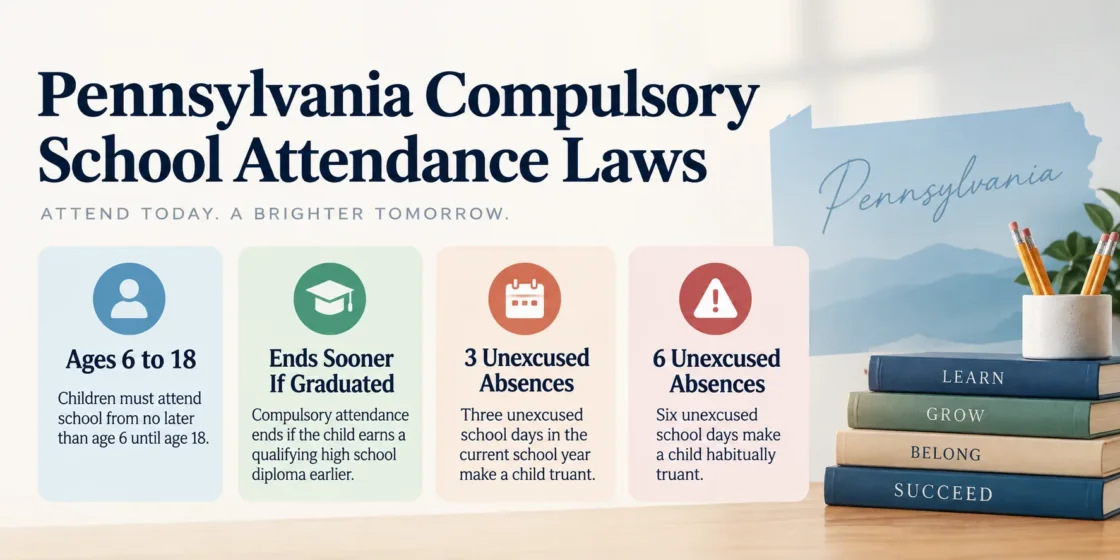
Pennsylvania generally requires a child to attend school from the time the child enters school, no later than age 6, until age 18. A child who already holds a qualifying high school graduation certificate is outside the compulsory-school-age definition. The law uses separate unexcused-absence thresholds: three school days in the current school year make a child truant, while six make the child habitually truant.
When Compulsory Attendance Begins and Ends
A child who turns 6 on or before September 1 must enroll and attend school or begin a lawful home education program for that school year. Compulsory attendance continues until age 18 unless the child graduates from a regularly accredited, licensed, registered, or approved high school earlier.
Parents can also trigger compulsory attendance before age 6 by choosing to enroll a younger child in school. Pennsylvania’s treatment of early enrollment comes from the state Supreme Court’s Commonwealth v. Kerstetter decision. Pennsylvania Department of Education guidance states that a child formally withdrawn from kindergarten before reaching compulsory school age should not be treated as subject to compulsory attendance solely because of that earlier enrollment.
Other Lawful Ways to Meet or Be Excused From the Attendance Requirement
The Public School Code recognizes several arrangements and exceptions beyond ordinary attendance at a public or nonpublic day school. Some have narrow age, approval, or instructional-time conditions.
| Arrangement or exception | Attendance-law condition |
|---|---|
| School operated by a bona fide church or religious body | At least 180 days of instruction, or 900 hours per year at the elementary level or 990 hours at the secondary level. |
| Home education or private tutoring | At least 180 days of instruction, or 900 elementary hours or 990 secondary hours per year, along with the separate legal requirements that apply to the chosen program. |
| Accredited day or boarding school | The school must be accredited by an accrediting association approved by the State Board of Education. |
| Private trade or business school | At age 15, approval is required from the district superintendent and Secretary of Education. At age 16, district-superintendent approval is required. |
| Lawful employment at age 16 | The child must have a valid employment certificate and be regularly engaged in useful and lawful employment during the school session. Pennsylvania defines regular engagement here as 35 or more hours per week. |
| Farm work or domestic service at age 15 | A permit approved by the school district is required. |
| Farm work or domestic service at age 14 | The child must have satisfactorily completed the equivalent of the district’s highest elementary grade and hold a permit recommended by the district and approved by the Secretary of Education. |
| Excusal after psychological examination | An approved psychological professional must identify the child as unable to profit from further public-school attendance, and the school board must excuse the child. |
They describe compulsory-attendance conditions. Home education, private tutoring, religious schools, employment exceptions, and other arrangements can carry additional statutory or administrative requirements.
When an Absence Is Lawful or Unlawful
Pennsylvania law allows absences for mental, physical, or other urgent reasons. State guidance also treats several common situations as lawful when the school’s requirements are met, including illness, a family emergency, death of a family member, medical or dental appointments, authorized school activities, and educational travel approved in advance.
An absence can also be lawful when a student is dismissed during school hours by specified nursing or school personnel, or when the student is absent to receive professional health care or therapy from a licensed practitioner. Time away from school for certain court hearings connected with county children and youth services or juvenile probation may not be classified as unlawful.
Pennsylvania Department of Education guidance directs schools to treat an absence as unlawful until the school receives the written explanation required by its attendance policy. The local policy sets the submission period and documentation process, so a reason that can be excused under state law can still require a timely note or other documentation.
Pennsylvania guidance states that absences caused by homelessness must not be counted as unexcused absences. Schools are expected to address attendance barriers without creating an enrollment or retention barrier for a student experiencing homelessness.
Attendance policies must also operate consistently with federal disability protections. When a disability or health condition is connected to repeated absences, the attendance issue may require an IEP, Section 504, or other disability-related response rather than being treated only as ordinary truancy.
Three and Six Unexcused Days Trigger Different Legal Statuses
Pennsylvania counts unexcused school days accumulated during the current school year. The absences do not have to occur consecutively for the statutory truancy definitions to apply.
| Status | Threshold in the current school year | What the threshold changes |
|---|---|---|
| Truant | 3 or more unexcused school days | The school’s statutory notice and attendance-intervention process begins. |
| Habitually truant | 6 or more unexcused school days | Age-based attendance-improvement, agency-referral, and possible citation rules apply. |
The third unexcused absence does not itself produce a court conviction or fine. Likewise, reaching six unexcused days establishes habitual-truancy status but does not automatically impose a monetary penalty.
Pennsylvania’s legal truancy definitions use unexcused absences. Chronic absenteeism is a separate attendance-data concept that measures missed instructional time more broadly and may include excused absences under the metric being used.
What the School Must Do Before Truancy Proceedings
When a child becomes truant, the school must send written notice to the person in parental relation who lives in the same household as the child within 10 school days of the third unexcused absence. The notice must describe the consequences of habitual truancy, use the person’s preferred mode and language of communication, identify resources for returning the child to compliant compulsory attendance and academic recovery, and address the restriction on transferring a habitually truant child to a cyber charter school during the school year.
The School Attendance Improvement Conference Comes Before a Truancy Case
A School Attendance Improvement Conference, commonly shortened to SAIC, examines the child’s absences and the reasons behind them. The school must invite the child, the person in parental relation, people that person identifies as possible resources, appropriate school personnel, and recommended service providers.
The child and parent or caregiver are not legally required to attend. If they decline or fail to appear after advance written notice and reasonable communication attempts, the school still holds the conference. The school then documents the outcome in a written School Attendance Improvement Plan, or SAIP. The plan can address academic, social, health, family, and community supports; student and family responsibilities; and ongoing attendance monitoring.
Pennsylvania guidance states that schools may not suspend a student out of school, expel the student, or place the student in an Alternative Education for Disruptive Youth program for truant behavior. Truancy proceedings also may not begin until a SAIC has been held.
Attendance Improvement Plans Follow Habitual Truancy Across School Transfers
Since August 1, 2026, the school in which a habitually truant child is currently enrolled must provide a school attendance improvement plan and continue pursuing remedies until the child is no longer truant or no longer of compulsory school age. The duty applies even when the six or more unexcused absences occurred while the child was enrolled in another educational entity.
The Response to Habitual Truancy Changes at Age 15
Once the child has six or more unexcused school days in the current school year, Pennsylvania law separates the required response into two age groups.
Referral is required
The school must refer the child to a school- or community-based attendance improvement program or to the county children and youth agency. The school may also file a citation against the person in parental relation who lives with the child.
Program referral or citation
The school must either refer the child to an attendance improvement program or file a citation against the child or the person in parental relation. Additional absences after referral, or refusal to participate, can lead to a county children and youth agency referral.
When a school refers a habitually truant child of any age to the county children and youth agency or files a truancy citation, it must be able to verify that a School Attendance Improvement Conference was held.
Habitual Truancy Can Restrict a Midyear Cyber Charter Transfer
A child who is habitually truant may not transfer to a cyber charter school during the school year unless a judge determines that the transfer is in the child’s educational best interest. Habitual-truancy status is based on the six-unexcused-day definition; a prior truancy conviction is not required for the transfer restriction to apply.
For a student seeking cyber charter enrollment after the school year has started, the cyber charter must confirm the student’s habitual-truancy status with the prior school and request the attendance and truancy record. The prior school must provide that record within five business days after receiving the written request. A cyber charter may not enroll a student who is habitually truant during the current school year unless the required judicial determination has been made.
For an educational-best-interest determination, Pennsylvania law directs the judge to consider the child’s health and well-being, including anxiety and trauma; attendance record; grades; enrollment history; likelihood of success in the proposed program; safety concerns such as bullying; access to academic programs; disciplinary or criminal actions; family support; and other relevant circumstances.
Beginning October 10, the notice connected with the third unexcused absence is scheduled to include a standardized Administrative Office of Pennsylvania Courts notice explaining the right to request an educational-best-interest hearing if the child becomes habitually truant. If no citation has been filed, a person in parental relation living with the child, or the child if age 15 or older, will be able to request the hearing. The judge must hold the hearing within 10 days of receiving the request or a truancy citation.
Court Proceedings and Possible Penalties
A truancy citation is a court step, not an automatic consequence of the sixth unexcused absence. At a hearing, the school carries the burden of proving beyond a reasonable doubt that the child was subject to compulsory attendance and was habitually truant without justification. A person in parental relation may defend the case by showing, by a preponderance of the evidence, that every reasonable step was taken to ensure the child’s attendance.
If a person is convicted, the judge chooses among the penalties authorized by law. The maximum fine is not a fixed charge automatically generated by the attendance count.
| Offense | Maximum fine | Additional terms |
|---|---|---|
| First offense | Up to $300 | Court costs may be added. |
| Second offense | Up to $500 | The higher maximum applies to a person in parental relation and must be within that person’s ability to pay; court costs may be added. |
| Third or subsequent offense | Up to $750 | The higher maximum applies to a person in parental relation and must be within that person’s ability to pay; court costs may be added. |
The court may sentence the person to community service or require an approved course or program designed to improve school attendance. These are separate sentencing options authorized by the truancy law. The court may also suspend a sentence and remit or waive fines and costs when the child attends school according to a court-devised plan.
If a judge enters a truancy sentence after the school year in which the habitual truancy occurred has ended, current Pennsylvania law limits the available penalties to community service or an approved attendance-improvement course or program. A fine is not among the penalties available in that post-school-year situation.
A separate driver’s-license consequence can arise only after additional steps. If a child is convicted and then fails to comply with the imposed penalty, the judge may send the conviction record to PennDOT. The resulting operating-privilege consequence is 90 days for a first qualifying occurrence and six months for a second or later one. For a child who does not yet have a license, the ineligibility period begins when the child turns 16.
If a person in parental relation fails to comply with a court-imposed penalty, a jail sentence of up to three days is possible only if the court finds that the person had a reasonable ability to comply and that the noncompliance was willful. A child’s failure to satisfy an imposed penalty is not treated as a delinquent act, although it may lead to a dependency determination under Pennsylvania’s Juvenile Act.
Ten Consecutive Absences Are a Separate Enrollment Rule
Pennsylvania’s 10-consecutive-school-day rule is not the state’s truancy threshold. A student who is absent for 10 consecutive school days is generally removed from the active membership roll unless the school has evidence that the absence is lawful or compulsory-attendance prosecution is being pursued.
Three unexcused days define truancy. Six unexcused days define habitual truancy. Ten consecutive days concern active membership and disenrollment. A student with an IEP is subject to different disenrollment procedures under IDEA and Pennsylvania special-education rules.
What the State Sets and What the School’s Attendance Policy Still Controls
Pennsylvania sets the compulsory-school-age range, the three- and six-day statutory truancy definitions, the notice requirements, the attendance-improvement process, the age-based habitual-truancy response, and the court-authorized penalties. Local attendance policies operate within those statewide requirements. Nonpublic schools may adopt additional criteria for truant or habitually truant status under their own attendance policies, while the student’s district of residence retains responsibility for enforcing compulsory-attendance law.
Each school must still maintain a written attendance policy and distribute it to parents annually. That policy supplies many of the day-to-day rules families encounter, including how absence explanations are submitted, the deadline for documentation, how medical or other lawful absences are verified, and how requests such as educational travel are approved.
Because those procedural details can differ by school or district, a student’s official attendance record and the school’s current written policy control the classification of individual dates. State law supplies the legal boundaries; the local policy supplies the documentation process used inside those boundaries.