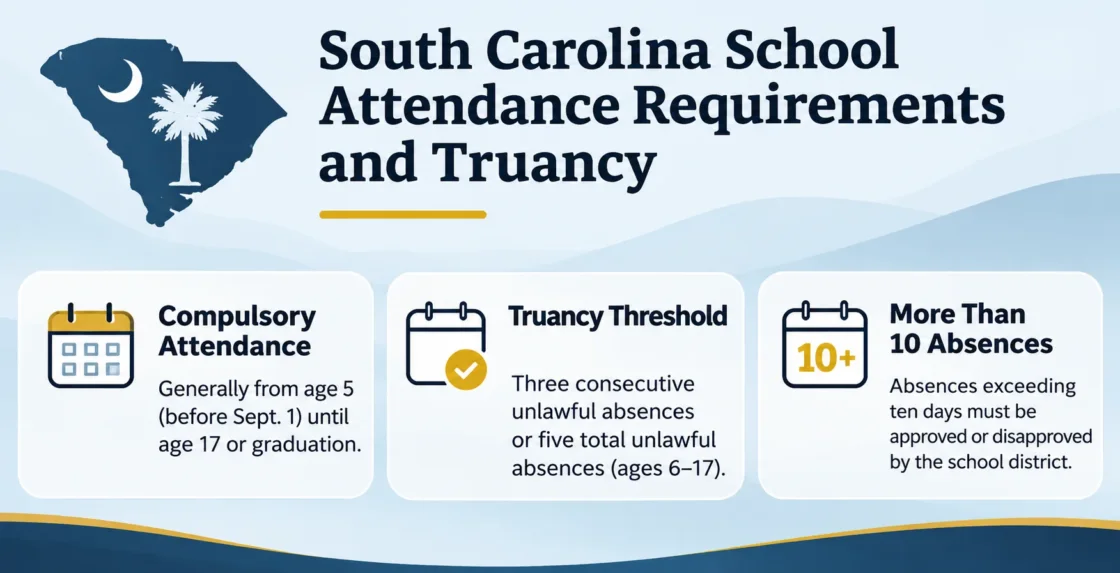
South Carolina generally requires regular school attendance from the school year in which a child is five before September 1 until the child reaches the seventeenth birthday or graduates from high school, subject to a written kindergarten election available to certain five-year-olds.1 Under the state attendance regulation, truancy is triggered by three consecutive unlawful absences or five total unlawful absences for a child within the regulation’s ages 6–17 range. Absences exceeding ten days are subject to district approval or disapproval; ten days is not the statewide truancy threshold.2
South Carolina Compulsory Attendance Requirements
| Requirement | South Carolina Rule |
|---|---|
| Compulsory attendance period | Generally begins in the school year when the child is five before September 1 and continues until the seventeenth birthday or high school graduation.1 |
| Kindergarten election | A parent or guardian whose child is not six on or before September 1 may file the prescribed written election with the resident school district so the child is not required to attend kindergarten.1 |
| Truancy threshold | Three consecutive unlawful absences or five total unlawful absences for a child described by Regulation 43-274 as ages 6–17.2 |
| More than 10 absences | The district board of trustees or its designee must approve or disapprove absences exceeding ten days, whether lawful, unlawful, or a combination of both.2 |
South Carolina also requires the public-school calendar to contain a statutory term of 190 days, including at least 180 instructional days and at least 1,080 instructional hours over the term.3 That calendar requirement should not be interpreted as a rule allowing every student to miss a fixed number of days. Individual absences, truancy, excessive-absence approval, and course-credit requirements operate under separate rules.
Lawful and Unlawful Absences
Regulation 43-274 requires school districts to adopt policies defining and listing lawful and unlawful absences. The state regulation supplies categories that local policies must account for while leaving districts to administer documentation and other attendance procedures.2
Accepted reasons under state regulation
Examples include the student’s illness when attendance would endanger health, illness or death in the immediate family, a recognized religious holiday, and activities approved in advance by the principal.
Absence without acceptable cause
Examples include absence without the parent’s knowledge or absence without acceptable cause even when the parent knows about it.
Suspension is specifically excluded from unlawful absences for truancy purposes.2 A district may require particular documentation or deadlines before an absence is recorded as lawful, so the attendance code shown in the student’s official record can depend on the applicable district policy.
South Carolina law requires districts to maintain a policy allowing excused absences of up to ten school days per school year for qualifying Career and Technical Student Organization experiences or interscholastic activities authorized by the school or district, subject to the statutory conditions.4 This activity provision is separate from the rule requiring review when a student’s total absences exceed ten days.
When a Student Is Considered Truant
South Carolina’s attendance regulation uses a staged truancy process rather than treating every unexcused absence as an immediate court matter.2
| Status | Age Stated in Regulation | Trigger |
|---|---|---|
| Truant | 6–17 | Three consecutive unlawful absences or five total unlawful absences. |
| Habitual truant | 12–17 | Failure to comply with the written intervention plan followed by two or more additional unlawful absences. |
| Chronic truant | 12–17 | The student has progressed through intervention and habitual-truancy status, has been placed under a Family Court attendance order, and continues accumulating unlawful absences. |
The South Carolina Department of Education further describes the state truancy measure as counting only full-day unexcused absences. Excused absences and suspensions do not contribute to the truancy count.5 Local policies may separately address tardiness, missed class periods, early dismissals, or course attendance even when those events do not satisfy the statewide truancy definition.
What Happens After the Truancy Threshold Is Reached
Once a student meets the initial truancy definition, school officials must make reasonable efforts to meet with the parent or guardian and determine why the unlawful absences are continuing. Regulation 43-274 identifies telephone calls, written messages, emails, and home visits among the methods that may be used to involve the family.2
The school must develop a written intervention plan with the student and parent or guardian. The plan must address the reasons for the unlawful absences, actions expected from the student and family, actions assigned to intervention-team members, referrals to appropriate services or programs, what will happen if unlawful absences continue, family involvement or documented attempts to obtain it, and procedures for revising the plan.2
Regulation 43-274 states that a child ages 6–17 should not be referred to Family Court for an order to attend school before the required written intervention planning has been completed. It separately defines a student ages 12–17 as a habitual truant when the student fails to comply with the intervention plan and accumulates at least two additional unlawful absences. The intervention plan and documentation of noncompliance must accompany a truancy petition seeking court intervention.2
What the 10-Day Attendance Rule Actually Means
South Carolina does not use ten absences as the initial truancy threshold. Truancy can arise much earlier from unlawful absences: three consecutive days or five total days under Regulation 43-274.2
The ten-day provision addresses a different issue. For students in grades K–12, the district board of trustees or its designee must approve or disapprove absences in excess of ten days, regardless of whether the absences are lawful, unlawful, or a combination of both. The regulation also applies this review when determining whether excessive absences can be approved for purposes of receiving credit for the year.2
The state regulation requires review of absences exceeding ten days. Truancy depends on unlawful absences, while academic credit is governed by separate attendance and proficiency requirements. Local documentation and make-up policies can affect how an individual case is handled.
For a Carnegie unit, Regulation 43-274 states that a student must be in attendance for at least 120 hours per unit or demonstrate proficiency as determined by the local school district. Within this attendance provision, the proficiency exception to the 120-hour requirement is administered case by case for students whose excessive absences have been approved. Students with approved excessive absences should be allowed to make up missed work to satisfy the attendance requirement, subject to the regulation and district procedures.2
Chronic Absenteeism Is Not the Same as Truancy
South Carolina’s chronic absenteeism reporting measure counts missed instructional time regardless of whether the absence is excused or unexcused. A K–12 student is considered chronically absent when the student misses 50 percent or more of the instructional day for any reason on 10 percent or more of the student’s enrollment period. For a student enrolled for a full 180-day academic year, 18 or more missed days reaches the 10 percent level.5
Based on unlawful absences
The state threshold is three consecutive or five total unlawful absences under Regulation 43-274.
Based on all qualifying absences
Excused absences, unexcused absences, and suspensions can contribute to the chronic-absence measure.
A student can therefore become chronically absent without being truant. For example, repeated lawful medical absences may count toward chronic absenteeism even though those lawful absences do not count toward the unlawful-absence truancy threshold.5
Parent Responsibility and Court Enforcement
South Carolina law places responsibility on the parent or guardian to require attendance during the compulsory-attendance period.1 Section 59-65-20 provides that a parent or guardian who neglects to enroll a child or refuses to make the child attend school may, upon conviction, be fined no more than $50 or imprisoned for no more than 30 days, with each day’s absence treated as a separate offense; the court may suspend a sentence.6
Those penalties are not automatically imposed when a student reaches the initial truancy threshold. State law authorizes the school district board of trustees or its designee to report persistent nonattendance to the court with juvenile jurisdiction when the district is unable to obtain the child’s attendance. The court may then address attendance under the procedures established in state law.6
Regulation 43-274 requires schools to use the intervention process before seeking an attendance order and calls for reasonable educational and community alternatives before a contempt petition is pursued. A student who has already reached habitual-truant status, has been placed under a Family Court attendance order, and continues accumulating unlawful absences meets the regulation’s definition of a chronic truant.2
How District Attendance Policies Affect Individual Cases
State law establishes the compulsory-attendance period and statewide truancy process, but school districts administer attendance records and must maintain their own policies defining lawful and unlawful absences.2 District rules may specify how quickly an excuse must be submitted, when medical documentation is required, how parent notes are handled, how missed work or attendance time can be recovered, and who is authorized to approve excessive absences.
For a student-specific attendance dispute, the school’s coded attendance record, the district’s current attendance policy, any submitted documentation, and any written intervention plan determine how the state rules apply to that case. A lawful absence, an unlawful absence, chronic absenteeism, excessive absence, and truancy describe different attendance issues and should not be treated as interchangeable terms.