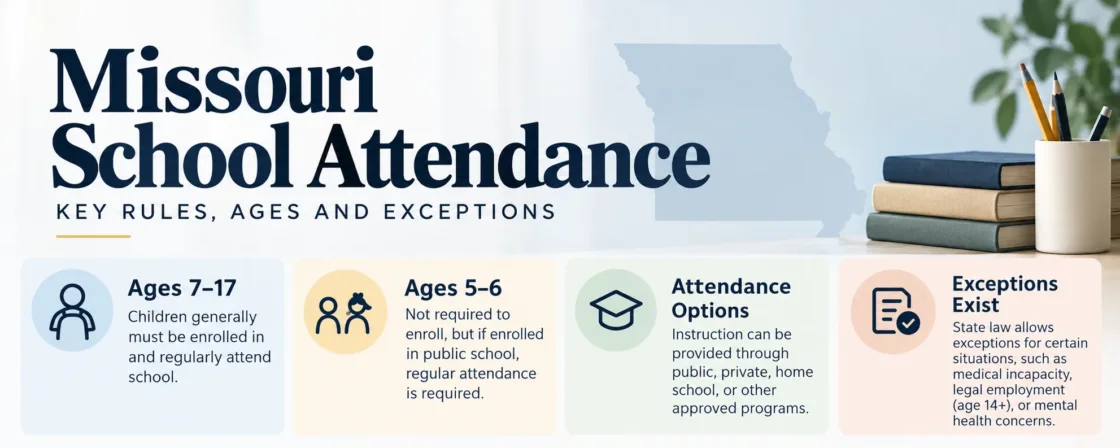
Missouri generally requires a child to receive regular academic instruction from age 7 until the child reaches the district’s compulsory attendance age. In most districts, that point is age 17 or earlier completion of 16 credits toward high school graduation. Children ages 5 and 6 are not required to enroll, but once a parent enrolls a child in that age range in public school, regular attendance is required unless the child is properly withdrawn. These rules come primarily from Missouri Revised Statutes § 167.031.
Who Must Attend School in Missouri
| Student | State Rule |
|---|---|
| Under age 5 | Missouri’s compulsory attendance statute does not require school enrollment. |
| Ages 5–6, not enrolled in public school | Enrollment is not compulsory under § 167.031. |
| Ages 5–6, enrolled in public school | The parent or other responsible person must cause the child to attend regularly. A written request may be used to have the child dropped from the school’s rolls. |
| Age 7 to compulsory attendance age | The child generally must be enrolled in and regularly attend an allowable program of academic instruction for the full term of the school attended. |
| Most districts | The compulsory attendance age is 17, or the point at which the student has successfully completed 16 credits toward high school graduation. |
| Metropolitan school district provisions | A metropolitan school district may establish age 17 by board resolution and may later lower that age to 16 by resolution, subject to the effective-date rules in the statute. |
The required instruction can be provided through a public, private, parochial, parish, home school, Family Paced Education school, or a qualifying full-time-equivalent combination of schools. Missouri law therefore requires education and regular attendance during the compulsory period; it does not require every covered child to attend a traditional public school. Missouri DESE’s compulsory attendance guidance gives the same basic description of the rule.
For home school or Family Paced Education school purposes, § 167.031 defines a completed high-school credit used for the compulsory-age provision as at least 100 hours of instruction in a course.
When State Law Allows an Attendance Exception
Missouri’s compulsory attendance statute contains several specific circumstances in which full-time attendance may be excused. These are statutory exceptions rather than a general list of ordinary day-to-day excused absences.
| Situation | Requirement |
|---|---|
| Mental or physical incapacity | A child may be excused for all or part of the required attendance period when the superintendent of the district of residence, or the chief school officer where applicable, is satisfied that the child is mentally or physically incapacitated. |
| Legal employment | A child from age 14 to the district’s compulsory attendance age may be excused for all or part of the required time when legal employment has been obtained and the statutory approval requirements are met. |
| Public-school enrollment at ages 5–6 | A child in this age range must be excused from attendance when the parent, guardian, or other person with custody makes a written request to have the child dropped from the school’s rolls. |
| Mental or behavioral health concerns | A child may be excused for all or part of the required attendance period when the school receives documentation from a mental health professional licensed under the Missouri provisions identified in the statute and acting within the professional’s authorized scope of practice. |
The mental and behavioral health provision is part of the version of § 167.031 effective August 28, 2024. It is broader than an ordinary local absence classification because the statute itself authorizes an excuse from the compulsory attendance requirement when its documentation conditions are met.
Excused and Unexcused Absences Are Mostly Local Policy
State law establishes the duty to attend regularly, but local school districts set many of the operational rules for reporting, documenting, and classifying ordinary absences. A district handbook may therefore use limits or intervention steps that differ from another Missouri district.
Missouri Revised Statutes § 171.011 authorizes each school board to adopt rules for the organization and government of its district. In practice, district attendance policies commonly address matters such as parent notification, documentation for illness, religious observance, family emergencies, appointments, tardiness, make-up work, and when repeated absences trigger administrative action.
An excused absence is still an absence for state attendance reporting when the student is not actually receiving instruction in a qualifying attendance setting. Missouri DESE’s July 2026 attendance reporting guidance states that a district may have a policy excusing an absence for reasons such as illness or religious beliefs, but the district cannot claim attendance time for a student who was neither in instructional attendance nor under the direct supervision required by the state’s reporting rules. The same guidance says a district may require make-up time after excessive absences, but those later hours do not retroactively convert the original missed time into attendance hours. Missouri DESE Attendance Reporting Guidance, July 2026.
This creates two separate questions. A district may decide that an absence is excused under its local policy, while the missed instructional time still remains an absence in the state’s attendance records.
Repeated Unjustified Absences and Truancy
Missouri does not establish a single statewide numerical truancy trigger in the compulsory attendance statute. The state’s juvenile-court law instead addresses a child who, while subject to compulsory school attendance, is repeatedly and without justification absent from school. That circumstance is included in Missouri Revised Statutes § 211.031 among the situations that can bring a child within juvenile or family court jurisdiction.
Because the statute does not turn that language into a statewide rule such as “five unexcused days equals truancy,” local district attendance policies matter. One district may begin parent conferences or other attendance interventions after a different number or pattern of absences than another district.
Chronic absenteeism should also be kept separate from truancy. A chronic-absence measure can count missed instructional time regardless of whether individual absences were excused. Truancy and compulsory-attendance enforcement focus on the legal or administrative requirements surrounding school attendance and unjustified nonattendance. A chronic-absence percentage should not be treated as Missouri’s statewide legal truancy threshold.
The 15-Absence Rule Applies to St. Louis City
Missouri has one statutory absence count that is easy to mistake for a statewide rule. Missouri Revised Statutes § 167.034 applies in a city not within a county, which means St. Louis City.
For a child under age 17 who is required to attend school under § 167.031, the school district must report the case to the Children’s Division within 10 business days after the child accumulates 15 or more absences during one school year. The statute requires the report even when a parent or guardian contacted the school and approved the absences.
It is a reporting rule written specifically for St. Louis City. It should not be applied to students elsewhere in Missouri unless another applicable district policy or rule creates its own threshold.
Compulsory Attendance Violations
The primary legal responsibility for complying with Missouri’s compulsory attendance law rests with the parent, guardian, or other person who has charge, control, or custody of the child. Missouri DESE states that failure to ensure regular attendance may lead to a report to the Children’s Division or the county prosecutor’s office.
Under Missouri Revised Statutes § 167.061, violation of § 167.031 is a class C misdemeanor. After a conviction, and while any judicial appeal is pending, the responsible person must enroll the child in an allowable school or educational setting within three public-school days. Each successive school day after that period can constitute a separate violation.
Missouri’s general criminal-sentencing statutes currently authorize up to 15 days of imprisonment for a class C misdemeanor and a fine of up to $750. Those are statutory maximums, not automatic outcomes in an attendance case. Missouri Revised Statutes § 558.011 sets the imprisonment range, while § 558.002 sets the general fine limit.
Section 167.061 also allows a court, in the circumstances described by the statute, to suspend and ultimately remit a fine or imprisonment when the child is immediately placed and kept in regular attendance and that attendance is later proved to the court’s satisfaction.
Changing to Another Educational Option
Leaving a public school’s rolls does not by itself end Missouri’s compulsory education requirement for a child who is still within compulsory attendance age. The child must continue through an educational option that satisfies the applicable state requirements.
Under Missouri Revised Statutes § 167.042, effective August 28, 2025, when a parent or other person with custody gives written notification of an intent to pursue other educational options under § 167.031 and requests that the child be dropped from the resident public school district’s rolls, the school must comply and remove the child promptly.
Missouri law also separately recognizes Family Paced Education schools. The current definition and instructional-record requirements appear in Missouri Revised Statutes § 167.013. An FPE school is a distinct statutory category and should not automatically be treated as interchangeable with every home-school arrangement.
What a District Attendance Policy Can Control
For an individual public-school student, the state statutes are only part of the attendance picture. The local district’s current handbook or board policy should be checked for rules that Missouri law leaves to local administration.
- How and when a parent must report an absence.
- Which reasons the district classifies as excused.
- When medical or other documentation may be required.
- How partial-day absences and tardies are recorded.
- When the district contacts parents about an attendance pattern.
- When an attendance conference, support plan, or referral may occur.
- Rules for completing work missed during excused or unexcused absences.
- Any district-specific attendance conditions connected with course credit, promotion, or other academic procedures.
A local attendance rule can be stricter in its documentation or intervention procedures than another district’s rule, but it does not replace the state compulsory attendance statutes. For a specific student’s attendance status, credit decision, truancy referral, or legal compliance, the controlling record is the one maintained and applied by the student’s school district and the relevant Missouri authorities.