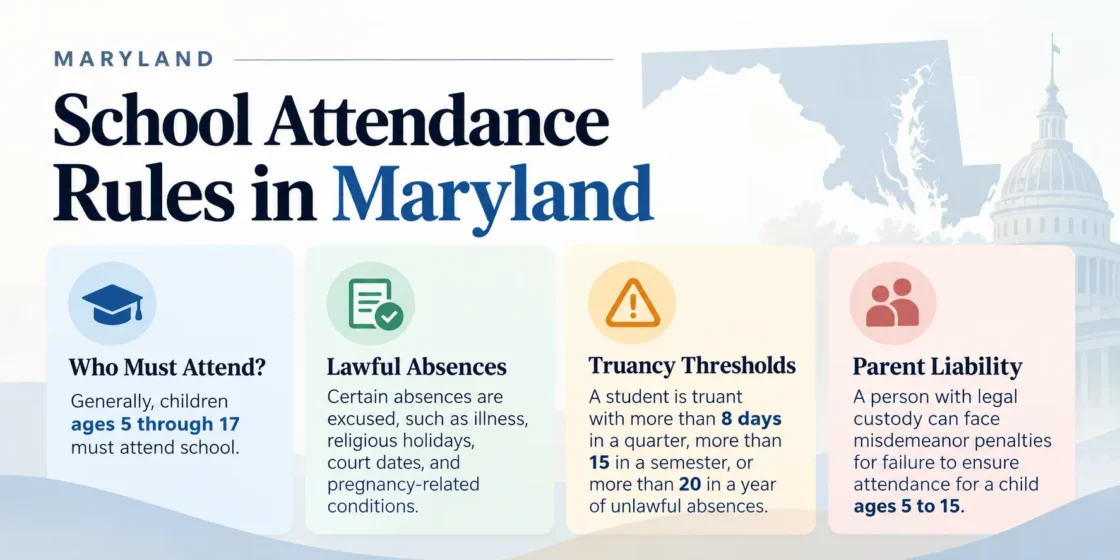
Maryland generally requires a child who lives in the state and is 5 years old or older and under 18 to attend school regularly for the entire school year, unless a statutory exception applies.1 Truancy is narrower than ordinary absence: it turns on whether an absence is unlawful, while Maryland’s chronic-absence rules count missed school for lawful and unlawful reasons.
Who Must Attend School in Maryland?
The basic compulsory-attendance rule covers children from age 5 through age 17. Maryland law also recognizes specific exceptions, including students who already hold a qualifying high school diploma or GED, students receiving regular and thorough instruction outside public school, certain students who require home or hospital instruction, and students in specified alternative education situations.1
A 5-year-old may receive a one-year delay from mandatory attendance when a parent or guardian files a written maturity-based request with the local school system. The request is due before the opening of school for the year in which the child becomes 5, and the local school system must approve the delay or withdrawal in writing within five working days after receiving the request.2
The student’s general attendance duty continues until age 18, but the misdemeanor provision for a person with legal custody or care and control specifically applies when the child is age 5 or older and under 16.1
Which Absences Are Lawful?
For students enrolled in Maryland public schools, COMAR treats an absence, including part of a school day, as lawful only when it falls within an approved category. The statewide categories include:3
- death in the immediate family, with the local school system determining which relationships qualify;
- illness of the student;
- pregnancy- and parenting-related conditions;
- a court summons;
- hazardous weather that would endanger the student while traveling to or from school;
- work approved or sponsored by the school, local school system, or Maryland State Department of Education and accepted by the proper school official;
- observance of a religious holiday;
- a state emergency;
- suspension;
- lack of authorized transportation, except when transportation was denied for disciplinary reasons; and
- another emergency or circumstance that the superintendent or designee accepts as good and sufficient cause.
For a student reported continuously absent because of a physical illness or somatic health need, the school may require a physician’s certificate. For a continuous absence tied to a behavioral health need, the school may require documentation from an appropriate licensed or certified health care provider. When the school is told that an absence was due to a behavioral health need, it must provide information about available school or community behavioral health resources.3
Pregnancy and Parenting Absences
Maryland law gives pregnant and parenting students additional attendance protections. County policies must excuse pregnancy- and parenting-related conditions, provide at least 10 excused days for a parenting student after the birth of the student’s child, and excuse a child’s illness or medical appointment. For up to four such days per school year, the school may not require a physician’s note. The law also covers specified family-law appointments and time needed to use a lactation space.4
2026 Civic-Engagement Attendance Rule
Effective July 1, 2026, each county board’s student attendance policy must allow an excused or discretionary absence for a public school student participating in specified civic-engagement activities, including testimony before a public-facing legislative body, meetings with its members, contribution to policy issues, and participation in the Maryland General Assembly Page Program. If the local attendance policy requires documentation, it must allow an appropriate representative to provide the note or other reasonable documentation.5
Maryland’s Truancy Thresholds
Maryland uses several related attendance definitions. They should not be treated as interchangeable.
| Category | Trigger | Absences Counted | What the Rule Does |
|---|---|---|---|
| Truancy | Absence for a school day or any portion of it without lawful cause | Unlawful absence only | An absence outside the lawful categories is presumed unlawful and may constitute truancy.6 |
| Truant student | More than 8 days in a quarter, more than 15 days in a semester, or more than 20 days in a school year | Unlawful absence only | A K-12 student meeting any listed threshold must be referred immediately to the county board’s active-intervention system.7 |
| Habitual truant | Unlawfully absent for more than 20% of school days within a marking period, semester, or year | Unlawful absence only | A local school system may use a stricter definition, such as a lower percentage threshold, but not a less stringent one.6 |
| Chronic absence / chronic absenteeism | At least 10 enrolled or membership days and absence for 10% or more of school days while enrolled at that school | Lawful and unlawful absence | This is an attendance measurement and intervention category, not the same legal concept as truancy.8 |
For the chronic-absence regulation, a day of attendance means the student attends an approved instructional program for more than half of the school day.8 A student can therefore have a high chronic-absence rate even when many missed days are excused. Truancy, by contrast, depends on unlawful absence.
What Schools Must Do About Unlawful Absence
A public or private school principal or head teacher must report a child who is absent or irregular in attendance without lawful excuse to the county superintendent, supervisor of pupil personnel, or another designated official so the cause can be examined and solutions can be developed.9
When a public school reports that a student is habitually truant without lawful excuse, the appropriate school-system representative must investigate the cause. The representative may provide information about social, health, and educational services and, in circumstances specified by law, may or must make referrals to other agencies.9
Local attendance policies must also address verification of absences and tardiness, early intervention, chronic-absence case management, make-up work, attendance monitoring, appeals, and tiered academic, behavioral, and social-emotional supports. Each local school system must review attendance data at least annually and post its current attendance policy online; each school must also make the policy available on its website and in its student handbook.8
Parent and Other Adult Liability
For a person who has legal custody or care and control of a child age 5 or older and under 16, failure to see that the child attends school or receives the required instruction can be prosecuted as a misdemeanor. On a first conviction, the statute allows a fine of up to $50 per day of unlawful absence, imprisonment for up to three days, or both. For a second or later conviction, the maximum rises to $100 per day of unlawful absence, imprisonment for up to five days, or both.1
The same statute provides an affirmative defense when the person made reasonable and substantial efforts to get the child to attend but could not cause the child to attend. A court may also order community service and may suspend a fine or jail sentence on terms designed to promote attendance. Separately, a person who induces a child to be unlawfully absent, or employs or harbors a child who is unlawfully absent while school is in session, may face a misdemeanor carrying up to a $500 fine, up to 30 days of imprisonment, or both.1
Maryland’s Truancy Reduction Pilot Program statute applies only where an authorized county program has been established and funded. Within that subtitle, a student’s attendance violation is a civil Code violation and is not a criminal conviction.10
Local Policies Can Set Additional Attendance Rules
Maryland sets the statewide floor, but local school systems control many day-to-day details. A district may specify how quickly a parent must verify an absence, what documentation is accepted, how tardiness is recorded, what attendance standard applies within a marking period or semester, how make-up work is handled, and how an attendance decision can be appealed.8
Local systems may also define habitual truancy more strictly than the statewide rule and may add criteria for unlawful absence to their board-approved attendance policies.6 Because attendance records, local policy terms, and the reason assigned to an absence can affect the outcome of an individual case, the student’s official school record and the current local board policy control the case-specific determination.