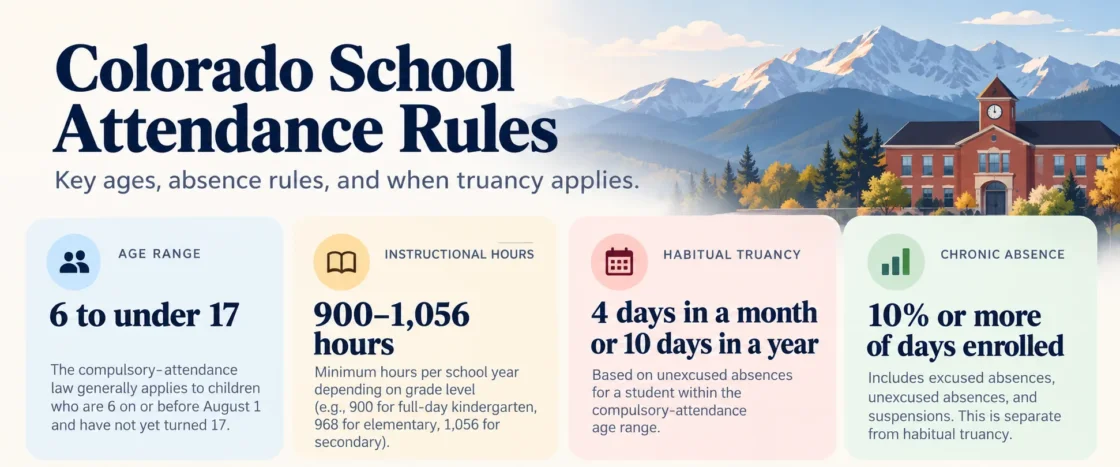
Colorado’s compulsory-attendance law generally applies to a child who is 6 years old on or before August 1 and has not yet turned 17. Unless a statutory exception applies, the child must meet Colorado’s school-attendance requirements. The current rules are found in Title 22 of the 2026 Colorado Revised Statutes, while the Colorado Department of Education provides statewide guidance on how attendance, truancy, and chronic absence are reported.
Who Colorado’s Compulsory Attendance Law Covers
C.R.S. § 22-33-104 applies when a child has reached age 6 on or before August 1 of the year in question and is under age 17. A parent, guardian, or legal custodian is generally responsible for ensuring that a child covered by the law attends school unless an exception applies.
The statute sets annual instructional-hour requirements according to the student’s school level:
| Student Level | Minimum Hours per School Year |
|---|---|
| Secondary school | 1,056 hours |
| Elementary school, excluding kindergarten | 968 hours |
| Full-day kindergarten | 900 hours |
| Half-day kindergarten | 450 hours |
The same statute provides that a school generally may not be in session for fewer than 160 days without prior approval from the Colorado Commissioner of Education. The 160-day provision is a school-calendar requirement. It is not a rule allowing an individual student to miss all days beyond a particular number.
Colorado public schools generally admit resident children from ages 5 through 20, but the compulsory-attendance rule has a narrower age range. A child being eligible to enroll does not by itself mean that compulsory attendance already applies.
How Colorado Treats Excused Absences
Colorado does not use one statewide list to decide every routine absence. Each local board of education must adopt a written attendance policy. That policy must recognize the exclusions contained in state compulsory-attendance law and must provide for temporary absences due to behavioral health concerns.
The state’s standardized attendance rule, 1 CCR 301-78, allows district policy to determine whether an absence has a valid and verifiable excuse. Depending on local policy, excused reasons may include:
- illness or injury;
- a funeral;
- a medical procedure or appointment;
- a legal obligation;
- a religious observance; and
- other reasons accepted under the district’s written attendance policy.
A school may require documentation when its attendance policy permits that requirement. An absence that has no valid excuse, or an excuse that does not meet the district’s attendance rules, may be recorded as unexcused.
State law also contains several situations in which the ordinary compulsory public-school attendance requirement does not apply. These include qualifying nonpublic or home-based education, certain extended absences connected to a physical disability or a mental or behavioral health disorder, approved work-study arrangements, graduation from 12th grade, and other statutory circumstances.
Colorado also requires an excused absence for specified therapy, medical, legal, or victim-services appointments related to a student experiencing harassment or discrimination, as well as behavioral or mental health concerns related to that experience. This protection was added through Senate Bill 23-296.
When Unexcused Absences Become Habitual Truancy
Colorado defines truancy as an unexcused absence. For a student within the compulsory-attendance age range, habitual truancy is reached when the student accumulates either:
- 4 total days of unexcused absence in any one calendar month; or
- 10 total days of unexcused absence during a school year.
The two thresholds are alternatives. A student does not need to meet both. Four unexcused days within one calendar month can establish habitual-truancy status even when the student has not yet reached 10 unexcused days for the school year.
| Attendance Record | Treatment for Habitual Truancy |
|---|---|
| Excused absence | Does not count toward the unexcused-absence threshold |
| Unexcused absence | Counts toward the 4-day monthly and 10-day school-year thresholds |
| Tardy | Not included in the CDE habitual-truant calculation |
| Suspension or expulsion absence | Reported as excused for purposes of determining habitual-truancy status |
| Partial-day unexcused absence | Fractions of days can accumulate when unexcused absences are converted to total days |
The Colorado Department of Education’s attendance state policy uses these same statewide definitions. A district may have additional rules for tardiness, class cutting, attendance notifications, documentation, or other attendance concerns, but those local rules do not change the state reporting threshold for habitual truancy.
Chronic Absence Uses a Different Threshold
Habitual truancy and chronic absence are not interchangeable. Habitual truancy is based on unexcused absences. Colorado’s chronic-absence measure looks at the student’s total missed time.
4 days in a month or 10 days in a school year
Uses unexcused absences for a student in the compulsory-attendance age range.
10% or more of days enrolled
Includes excused absences, unexcused absences, and suspensions in CDE reporting.
A student can therefore be chronically absent without being habitually truant. For example, a student who misses at least 10% of enrolled school days but whose absences are properly excused may meet the chronic-absence definition while remaining below the habitual-truancy threshold.
Likewise, four unexcused days concentrated within one calendar month can meet Colorado’s habitual-truancy definition even when the student has not missed 10% of the school year. The Colorado Department of Education attendance page reports the two measures separately for this reason.
What a District Must Do When Truancy Continues
Colorado school districts must adopt and implement attendance procedures that address students who are habitually truant. Under C.R.S. § 22-33-107, those procedures must provide for an attendance plan designed to help the child remain in school.
When practicable, the plan is developed with the participation of the student’s parent, guardian, or legal custodian. School personnel must make reasonable efforts to meet with the family to review and evaluate the reasons for the truancy. The response may also involve school or community services intended to address barriers affecting attendance.
The district applies its written attendance policy and Colorado reporting rules.
The 4-day monthly or 10-day school-year threshold applies.
The plan is intended to help the student remain in school and address the reasons for truancy.
State law treats judicial proceedings as a last-resort response when habitual truancy continues after the plan has been created and implemented.
Before filing a truancy proceeding, the district must provide written notice to the child and parent that proceedings will be initiated if attendance requirements are not met. If the notice and summons are combined, the filing date stated in the petition must be at least five days after the notice and summons. The notice must also explain that proceedings will not be initiated if the identified attendance requirements are met before filing.
State law supplies the compulsory-attendance and habitual-truancy rules, while the district’s written policy determines many day-to-day questions about whether a particular absence is excused and what documentation is required. A student’s official attendance record and the applicable school or district policy determine how specific absences are recorded.