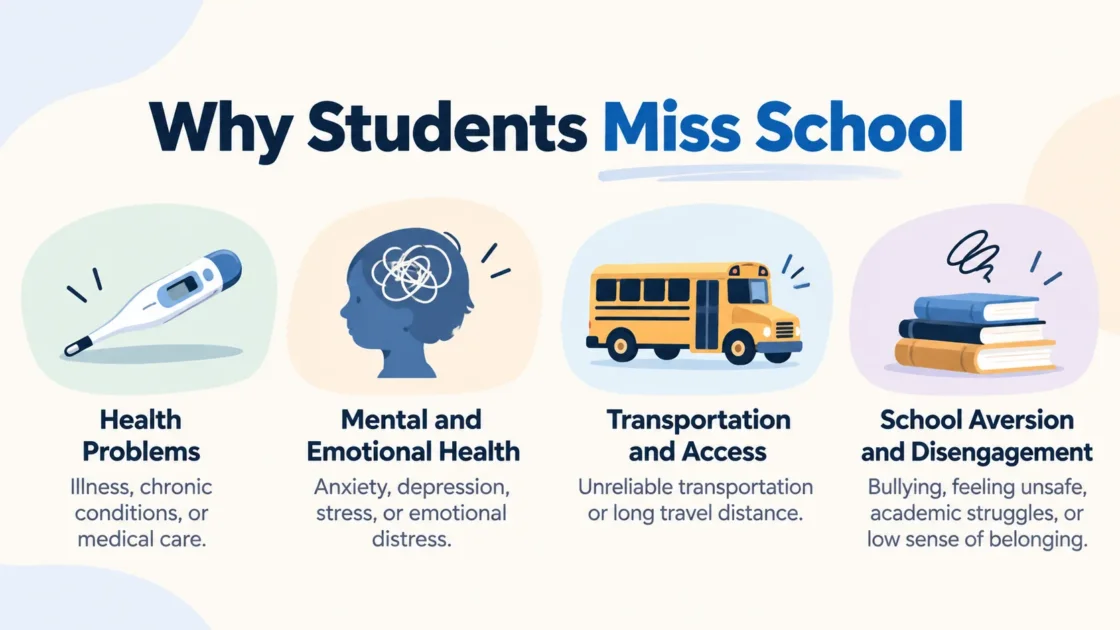
Students miss school for many different reasons, and repeated absence is rarely explained by a single behavior. Illness, mental health needs, transportation problems, unstable housing, family responsibilities, difficulty with schoolwork, bullying, weak relationships at school, and misunderstandings about when a student should stay home can all affect attendance. Federal education resources group many of these reasons into broad patterns involving barriers to attendance, school aversion, disengagement, and misconceptions about absence.1
Chronic absenteeism is typically defined as missing at least 10% of school days for any reason, including both excused and unexcused absences. Truancy is a separate legal or administrative concept tied to unexcused attendance and depends on state or local rules.2
The Main Reasons Students Miss School
Attendance problems can begin with circumstances outside a student’s control, with experiences inside school, or with several issues happening at the same time. Looking only at whether an absence was excused does not explain why the student was unable or unwilling to attend.
| Reason | Examples | How It Can Affect Attendance |
|---|---|---|
| Physical health | Acute illness, chronic conditions, medical or dental care | A student may be unable to attend, need appointments, or have recurring symptoms. |
| Mental and emotional health | Anxiety, depression, stress, emotional distress | Symptoms may make leaving home, entering school, concentrating, or completing a full school day difficult. |
| Transportation and access | Unreliable transportation, long travel distance, family vehicle problems | The student may be ready for school but lack a dependable way to get there. |
| Housing and household instability | Homelessness, frequent moves, changing family arrangements | Changes in location, routines, transportation, and family responsibilities can interrupt regular attendance. |
| Family responsibilities | Caring for siblings or relatives, helping an ill family member, working | Responsibilities outside school can compete directly with the school day. |
| School aversion | Bullying, social conflict, feeling unsafe, anxiety about school, academic struggles | A student may avoid a setting associated with fear, embarrassment, stress, or repeated difficulty. |
| Disengagement | Weak relationships, low sense of belonging, instruction perceived as irrelevant | Students who feel detached from school may have less motivation to attend consistently. |
| Attendance misconceptions and routines | Keeping a student home for minor symptoms, treating excused absences as harmless, weak morning routines | Individual absences that appear minor can accumulate across a school year. |
These categories overlap. An unreliable ride can combine with a parent’s work schedule. Anxiety may be connected to bullying or academic difficulty. Housing instability can affect transportation, sleep, health care, and the ability to maintain a predictable morning routine. The reason recorded in an attendance system may therefore describe only part of the situation.
Health Problems and Health-Related Absences
Physical illness is one of the most direct reasons students stay home. Short-term infections can produce isolated absences, while conditions such as asthma or other recurring health problems can contribute to repeated missed days. Federal education research also identifies chronic health problems as one reason children may frequently miss school.3
Health-related absence is not limited to days when a student is clearly too sick to attend. Families also make daily decisions about mild symptoms. In the latest NCES School Pulse Panel absenteeism release, collected in June 2025 for the 2024–25 school year, 70% of U.S. public schools reported that students missed too much school because they stayed home unnecessarily for minor symptoms.4
It means 70% of responding public schools identified unnecessary staying home for minor symptoms as a reason students at their school missed too much school. It does not mean 70% of students were absent for that reason.4
Mental Health Can Affect the Ability to Attend
Mental and emotional health can also interfere with regular attendance. Anxiety may make the trip to school or the school day itself feel difficult. Other students may struggle with stress, low mood, social pressure, or emotional distress. The U.S. Department of Education includes student and family health challenges among the recurring contributors to chronic absence.2
Transportation, Housing, and Access Barriers
Some students want to attend but face practical obstacles. Transportation may be unreliable or unavailable. A family may be moving between temporary living arrangements. A parent’s work schedule may make morning transportation difficult. A student may also have trouble reaching medical, dental, or mental health services, allowing a manageable health problem to interfere with attendance for longer.
IES resources specifically identify transportation access, chronic illness, and other conditions outside a student’s control as attendance barriers. Research on absenteeism in the early grades also gives family homelessness and unpredictable parental work schedules as examples of circumstances that can keep children away from school.13
Caregiving, Work, and Other Family Demands
Students sometimes miss school because responsibilities at home conflict with attendance. A student may care for a younger sibling, help an ill family member, or take on other household duties. Older students may also work outside school to help support themselves or their families.
The U.S. Department of Education notes that these competing demands can differ by age. High-school-age students are more likely to report responsibilities such as caring for younger siblings or sick relatives and working outside the home as reasons connected with absence.2
A family-related absence should not automatically be interpreted as a lack of interest in education. The same attendance record could reflect child-care needs, changing work schedules, transportation problems, illness in the household, or several of these conditions together.
When Students Want to Avoid School
Some absences are connected to what a student expects to experience at school. Bullying, peer conflict, feeling unsafe, academic difficulty, anxiety about returning after falling behind, or an unwelcoming school climate can make attendance harder. IES describes this pattern as aversion: the student is avoiding an experience associated with discomfort or distress rather than simply deciding that attendance does not matter.1
Academic struggles can contribute as well. Missing class can leave a student behind, and returning while behind can make school feel more difficult. In some cases, attendance problems and academic difficulty can reinforce each other rather than appearing as two unrelated issues.
Belonging and Relationships Can Shape Attendance
Disengagement is different from being physically unable to reach school. A student may have transportation and no immediate health barrier but still feel little connection to the school, classmates, teachers, or learning.
The CDC describes school connectedness as the feeling that adults and peers at school care about a student and about the student’s learning. Students who feel connected to school are more likely to have better attendance, along with other positive academic outcomes.5
Weak adult relationships, isolation from peers, boredom, or feeling that instruction has little relevance can therefore appear alongside absence. These experiences should not be treated as interchangeable, because a student who is bored may need a different response from a student who feels unsafe or socially isolated.
Small Absences Can Accumulate Without Feeling Serious
Some attendance problems develop gradually. Families may view an excused absence differently from an unexcused one, or assume that scattered days do not matter because the student is not missing a full week at once. A family may also keep a student home whenever minor symptoms appear, even when the student could reasonably attend under the school’s health guidance.
Chronic absenteeism measures the accumulation of missed instructional time rather than the motive behind every day missed. Because the usual 10% measure includes excused and unexcused absences, repeated legitimate or understandable absences can still produce chronic absenteeism.2
The Same Absence Count Can Reflect Very Different Problems
Health barrier
Repeated illness, appointments, or a chronic condition leads to missed days.
Access barrier
Transportation or housing instability makes getting to school unreliable.
School aversion
Anxiety, bullying, social conflict, or academic stress makes the student avoid school.
Competing responsibility
Caregiving, employment, or another family obligation overlaps with school time.
An attendance total shows how much school a student missed, but it does not identify the reason. Two students with the same number of absences may need entirely different support. Understanding whether missed days come from health, access, family demands, school experiences, disengagement, or attendance habits provides more useful information than assuming every absence has the same cause.