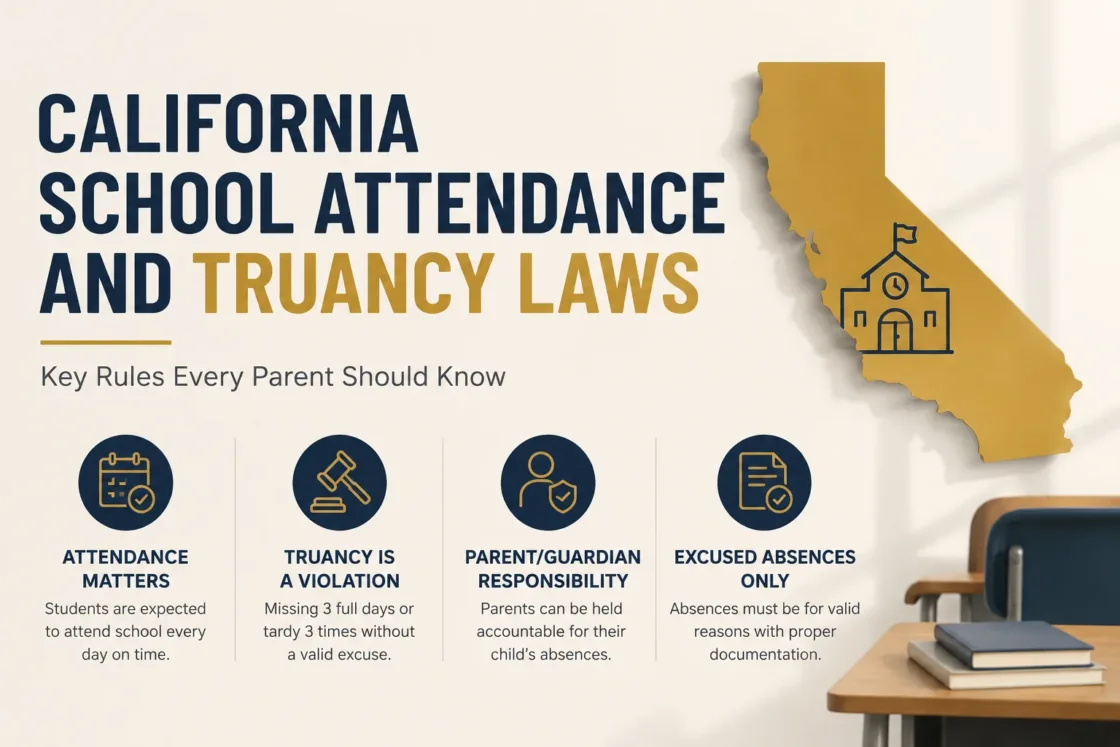
California generally requires children between 6 and 18 years of age to attend full-time school unless an exemption applies.1 A student can be classified as a truant after three full school days without a valid excuse, being tardy or absent for more than a 30-minute period without a valid excuse on three occasions during the school day, or a combination of those events in one school year.2
Who Must Attend School in California?
Education Code Section 48200 sets the general compulsory-attendance range for children between 6 and 18 years of age. A student within that range must attend the applicable full-time day school, continuation school, or classes for the school day set by the district, unless a lawful exemption applies.1
California does not make school compulsory solely because a child is five years old. The California Department of Education states that children become subject to compulsory full-time education at age six. It also states that, once a child is enrolled in kindergarten, the child must attend on the same basis as other enrolled students.3
When California Law Classifies a Student as Truant
California does not use a statewide rule that every student may miss a fixed number such as 10 days before truancy begins. The first legal classification can occur much earlier when the absences or long tardies are without a valid excuse.
| Classification | State Rule |
|---|---|
| Truant | Three full school days without a valid excuse; or tardy or absent for more than a 30-minute period without a valid excuse on three occasions; or a combination in one school year. |
| Repeat truancy report | After a student has already been reported as truant, one or more additional days of absence without a valid excuse or one or more additional days of tardiness can trigger another report. |
| Habitual truant | Reported as truant three or more times in a school year, after the district has made a conscientious effort to hold at least one conference with the parent or guardian and student. |
| Chronic truant | Absent without a valid excuse for 10% or more of school days from enrollment to the current date, after the required truancy steps have been followed. |
The initial truancy threshold is based on qualifying unexcused absences or long tardies. The separate 10% threshold applies to the legal category of chronic truancy, not to the first truancy classification.
Which Absences Count as Valid Excuses?
Education Code Section 48205 lists many absences that schools must excuse. Common examples include illness, including an absence for mental or behavioral health; quarantine directed by a county or city health officer; medical, dental, optometrical, or chiropractic appointments; funeral services or grieving within the statutory limit; jury duty; and certain justifiable personal reasons approved under district standards.4
The statute also covers other circumstances, including specified military-family events, a pupil’s naturalization ceremony, cultural ceremonies or events, military entrance processing, and additional absences authorized at a school administrator’s discretion. Education Code Section 48260 also allows a school administrator to treat other reasons as valid excuses based on the student’s circumstances.2
What Happens After a Truancy Classification?
The First Notice Changed in 2025
For truancy classifications on or after July 1, 2025, Education Code Section 48260.5 requires the school district to notify the parent or guardian using the most cost-effective method possible, which may include email or a telephone call. The notice must state that the student is truant and that the parent or guardian is obligated to compel school attendance.2
The current notice also states that alternative educational programs are available in the school district, that families may meet with appropriate school personnel, that mental health and supportive services may be available, and that school staff can help develop strategies to support attendance. This version became operative on July 1, 2025.2
Repeated Reports and SARB Referral
If unexcused absences or tardiness continue after the first report, the student can be reported as truant again. After three or more truancy reports in the same school year, and after the required effort to hold a conference, the student is deemed a habitual truant. A habitual truant may be referred to a School Attendance Review Board, commonly called a SARB, or to other services allowed by state law.2
Truancy, Chronic Truancy, and Chronic Absenteeism Are Different
California’s attendance terms measure different things. Truancy is tied to absences or tardies without a valid excuse and to a legal reporting process. Chronic absenteeism is a data measure based on total days absent, regardless of whether those days were excused or unexcused.
10%+ unexcused
The student is absent without a valid excuse for at least 10% of school days from enrollment to the current date, after the required truancy steps are completed.2
10%+ total absences
The calculation divides total days absent by enrolled school days when school was actually taught, excluding Saturdays and Sundays.5
An excused absence can therefore count toward chronic absenteeism even though it does not count as an unexcused truancy event. The two measures should not be treated as interchangeable.45
Possible Legal Responses to Repeated Truancy
Parent and Guardian Provisions in 2026
California changed one parent-related truancy penalty for 2026. Assembly Bill 461, Chapter 154 of the Statutes of 2025, repealed Penal Code Section 270.1, which had created a misdemeanor for certain parents or guardians of younger students who were chronic truants. That former misdemeanor is no longer part of California law in 2026.6
A separate Education Code provision remains. Section 48293 states that a parent, guardian, or other person responsible for a student who fails to comply with the compulsory-education chapter, unless excused or exempted, may be convicted of an infraction. The maximum fine is $100 for a first conviction, $250 for a second, and $500 for a third or later conviction involving willful refusal to comply. The court may order a parent education and counseling program instead of those fines.7
Student Response Stages
Education Code Section 48264.5 uses a staged response. After a first truancy report, the student and parent or guardian may be asked to meet with school staff to discuss the causes of the attendance problem and make a plan. A second report may lead to a written warning. A third report places the student in the habitual-truant category and may lead to SARB or truancy mediation. A fourth report in the same school year can bring additional juvenile-court procedures under the statute.2
The state process contains notice, school intervention, repeated-report rules, and possible SARB or mediation steps before later legal responses. The exact stage depends on the student’s attendance record and the actions already taken by the school or district.
Where District Records and Local Rules Matter
State law sets the baseline definitions, but individual absences still have to be classified from the facts and the school’s records. Education Code Section 48260 allows administrators to recognize valid excuses beyond the listed statutory categories when the student’s circumstances support that decision.2
Districts may also use local procedures for absence verification, attendance meetings, alternative educational programs, and attendance-support services. For any individual student, the school or district attendance office is the proper place to confirm how a particular absence was coded, which notices were issued, and whether a state truancy threshold has actually been met.