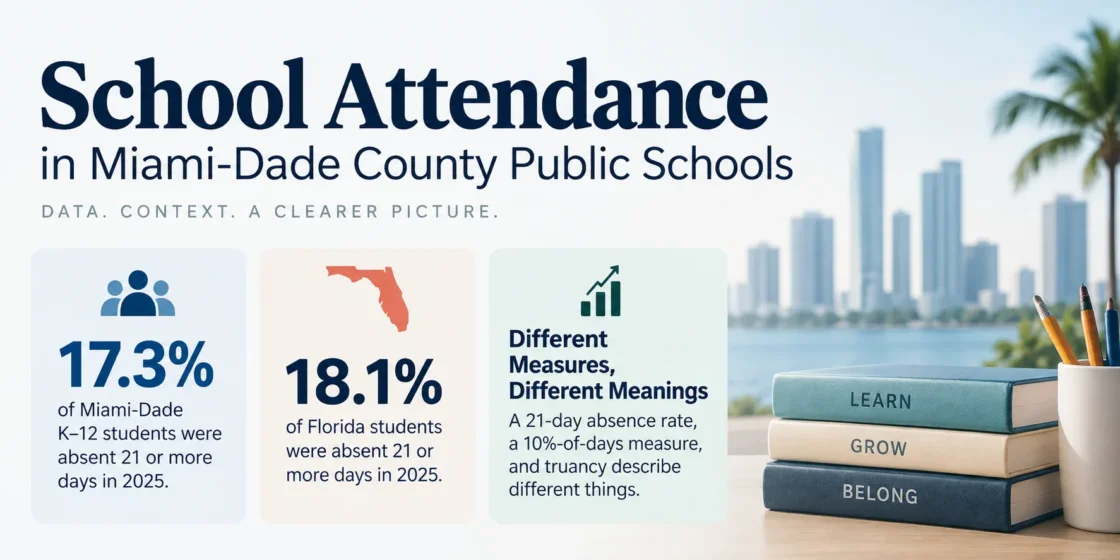
Miami-Dade school attendance has two separate layers: public data showing how much school students miss, and district rules that determine how an individual absence is recorded and when intervention begins. A 21-day absence rate, a 10%-of-days measure, and a truancy threshold describe different things and should not be treated as interchangeable.
Miami-Dade’s 21-Day Absence Rate Was 17.3% in 2025
In the 2025 data year, 17.3% of Miami-Dade K–12 students were absent 21 or more days, compared with 18.1% statewide. The Miami-Dade rate was 0.8 percentage points below Florida’s rate. It was unchanged from 2024 and 1.5 percentage points below the local high of 18.8% recorded in 2022.1
Students Absent 21 or More Days: Miami-Dade vs. Florida
Percentage of enrolled K–12 students, data years 2015–2025
Florida Health Charts identifies Florida Department of Education as the data source and notes that school years may vary by district.1
| Data Year | Miami-Dade | Florida | Miami-Dade vs. Florida |
|---|---|---|---|
| 2015 | 11.2% | 9.8% | +1.4 pp |
| 2016 | 9.2% | 10.1% | −0.9 pp |
| 2017 | 9.7% | 10.2% | −0.5 pp |
| 2018 | 10.7% | 11.3% | −0.6 pp |
| 2019 | 10.7% | 11.3% | −0.6 pp |
| 2020 | 12.5% | 9.8% | +2.7 pp |
| 2021 | 17.9% | 16.6% | +1.3 pp |
| 2022 | 18.8% | 20.9% | −2.1 pp |
| 2023 | 17.8% | 19.4% | −1.6 pp |
| 2024 | 17.3% | 19.9% | −2.6 pp |
| 2025 | 17.3% | 18.1% | −0.8 pp |
Across the full series, Miami-Dade moved from 11.2% in 2015 to 17.3% in 2025, a rise of 6.1 percentage points. The sharpest sustained increase appears between 2020 and 2022; the rate then declined and leveled off at 17.3% in both 2024 and 2025. These figures describe the share of students missing at least 21 days. They do not identify why the days were missed.
Florida publishes separate district attendance measures for students absent 21 or more days and students absent 10% or more of their enrolled days. The state also publishes Average Daily Attendance/Average Daily Membership data. The current Florida Department of Education attendance files are for 2024–25.2 A student enrolled for 180 days reaches 10% at 18 missed days, while a student enrolled for fewer days reaches 10% sooner. The fixed 21-day measure therefore cannot be substituted for a 10%-of-enrollment measure.
What Counts as Present in M-DCPS
The 2026–27 Miami-Dade County Public Schools attendance policy distinguishes a full school day, a partial day, a class period, and a tardy. That distinction matters because a student can meet the district’s school-day attendance rule while still missing one or more class periods.3
| Status | District Rule |
|---|---|
| Full school day | The student is actually present for at least two hours of the school day, participates in an approved school-sponsored educational activity that is part of the instructional program, or participates in a pre-approved extracurricular activity. |
| Partial day | Attendance is recorded only for the appropriate portion of the day at the school or instructional center. |
| Class attendance | The student is physically present for at least half of the class period, is excused by the teacher for a class-related assignment, or is requested by school staff to participate in an approved school activity during that period. |
| Tardy | The student is not present when school or the class period begins but reports later. A tardy student is not marked absent for the school day if the full-day attendance rule is met. |
This creates an important separation between school-day attendance and class attendance. The district’s later grade-withholding rule is based on unexcused class absences, not simply the number of whole school days missed.
How M-DCPS Classifies Excused and Unexcused Time
Reasons That Can Be Excused
M-DCPS lists specific reasons that can qualify as excused school or class absences and tardies. Documentation requirements differ by reason, and the principal has final authority to decide whether the explanation is acceptable.3
| Reason | What the Policy Requires |
|---|---|
| Student illness or injury | Documentation explaining the absence or tardy. If the illness or injury lasts more than five consecutive days, a written statement from a licensed practicing physician must cover all days missed. |
| Repeated absence for a specific medical condition | The student must be under the supervision of a health care provider for the absences to be excused. |
| Medical appointment | A written statement from the health care provider showing the date and time of the appointment. The policy includes qualifying therapy appointments. |
| Non-school-sponsored activity or event | Prior written permission from the principal. When more than one school is involved, approval requirements extend to each principal and the Region Superintendent involved. |
| Court or DCF center appearance | A court absence can be excused when the appearance is required by subpoena or is otherwise mandatory. DCF center appearances are also listed as excused. |
| Outdoor suspension | The absence is treated as excused. |
| Immediate-family death or qualifying religious observance/instruction | The district policy recognizes these as excused circumstances, subject to the applicable attendance rules. |
The Three-School-Day Documentation Rule
Required documentation must be submitted within three school days after the student returns to school. Until the required explanation is submitted, the absence is marked unexcused; failure to submit the required documentation within that three-school-day window results in the absence being recorded as unexcused.3
Parents and students must report each school or class absence or tardy and provide an explanation to the attendance office as soon as practicable. When the policy requires supporting documentation, that documentation still has to be submitted on time.3
Absences the District Lists as Unexcused
The district specifically lists several situations as unexcused, including:3
- vacations and personal services;
- unapproved non-school-sponsored events, programs, or sporting activities;
- an older student staying home to provide day care for siblings;
- illness of another person;
- noncompliance with immunization requirements unless the student is lawfully exempt; and
- an absence for which required documentation is not submitted within the district deadline.
A student who leaves school without having been in attendance for at least two hours is also treated as unexcused unless documentation that excuses the departure is submitted within three school days.3
When Absences Trigger Attendance Intervention
M-DCPS uses unexcused absences and absences with an unknown reason to identify early patterns of nonattendance. The district’s 2026–27 policy defines a compulsory-age student as excessively absent after at least five such absences in one calendar month or ten within a 90-calendar-day period. It defines a compulsory-age student as truant after more than 15 unexcused absences in a 90-calendar-day period. A student becomes habitually truant under the district definition when the student is truant and fails to comply with assigned interventions or enforcement actions.3
Florida law requires a possible pattern of nonattendance to be reported when a student has at least five unexcused or unknown-reason absences in a calendar month, or ten within 90 calendar days. Unless there is clear evidence that the absences do not form a pattern, the principal refers the case to the school’s child study team.4
What Happens After a Pattern Is Flagged
Florida law sets out a staged school response rather than treating the first threshold as a final legal status. The school must contact the parent for each unexcused or unknown-reason absence. If the 5-in-a-month or 10-in-90-days threshold is reached, the primary teacher reports the possible pattern and the principal reviews the case for referral to the child study team.4
If the initial meeting does not resolve the attendance problem, the statute calls for continued family communication, efforts to identify reasons and available remedies, referrals to services when appropriate, evaluation for alternative education programs, and attendance contracts. The student’s individual status still depends on the official school record and the steps actually taken in the case.4
Absence Reporting and Truancy Measure Different Attendance Problems
A student can accumulate a large amount of missed instructional time without meeting the district’s truancy definition. Conversely, a pattern of unexcused absences can trigger school intervention before the student has missed 10% of all enrolled days.
Total time missed
Florida publishes measures such as absent 21+ days and absent 10% or more. These measures describe the amount of school missed, not the student’s legal or disciplinary status.2
Unexcused or unknown patterns
The 5-in-a-month and 10-in-90-days thresholds are used to identify a possible pattern of nonattendance and start the school response process.4
An excused absence can therefore matter when measuring total instructional time missed even though it is treated differently from an unexcused absence under attendance enforcement rules. The reason for the absence, the number of days missed, and the metric being reported must be kept separate.
Make-Up Work and Grade Withholding
For an excused absence, M-DCPS requires an opportunity to complete make-up work within a reasonable period, and principals may extend the deadline when circumstances justify it. Students must request make-up assignments for excused absences and tardies within three days after returning to school or class. By contrast, the district policy says teachers are not required to provide make-up work for unexcused absences.3
The policy also allows quarterly, semester, and final grades to be withheld when a student accumulates the equivalent of 10 or more unexcused class absences in an annual course or 5 or more unexcused class absences in a designated semester course, pending administrative screening and completion of assigned truancy child study team interventions.3
The 10-absence annual-course rule and 5-absence semester-course rule apply to unexcused class absences. They should not be read as the number of whole school days a student may miss.
Florida Compulsory Attendance Ages in Miami-Dade
Florida generally requires regular school attendance for children who have reached age 6, or who will reach age 6 by February 1 of the school year, and who have not yet reached age 16. A student who turns 16 does not end compulsory attendance merely by reaching that birthday. To terminate enrollment, the student must file a formal declaration of intent with the district school board; the declaration must be signed by the student and parent and is followed by the statutory notification and exit-interview process.5
For an individual student, the school and district record controls how a particular day or class period is coded and whether attendance interventions, grade withholding, or other procedures apply. The statewide reporting measures are useful for comparing absence patterns, but they do not determine a student’s official truancy status.